2,453 (2024 est.)
 Tokelau
Key facts and a structured country profile. 🧾 Change log 📐 True Size
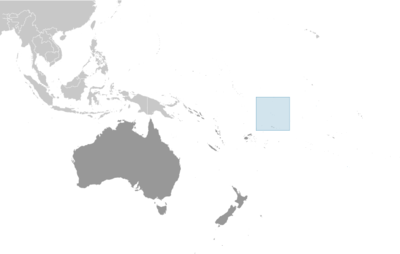
Locator 🗺️ Map
12 sq km
Oceania, group of three atolls in the South Pacific Ocean, about one-half of the way from Hawaii to New Zealand
🧭 Background
Tokelau is composed of three atolls (Fakaofo, Atafu, and Nukunonu), and it was first settled by Polynesians around A.D. 1000. The atolls operated relatively independently, but Fakaofo Atoll eventually subjugated the others. British explorers first saw the atolls in 1765 and 1791. Catholic and Protestant missionaries arrived in the 1840s and converted the population on the islands on which they landed. In 1863 Peruvian slave raiders abducted many islanders, and roughly contemporary outbreaks of disease reduced the population to about 200. Settlers of diverse nationalities subsequently intermarried with Tokelauans. In the same period, local governance moved to a system based on a Council of Elders, which still exists today. British interest began in the late 1870s, and Tokelau became a British protectorate in 1889, and in 1916 under the name Union Group, Tokelau became part of the Gilbert and Ellice Islands Colony. In 1925, the UK placed Tokelau under New Zealand administration. The Tokelau Islands Act of 1948 formally transferred sovereignty from the UK to New Zealand, and Tokelauans were granted New Zealand citizenship. In 1979, the US relinquished its claim to Tokelau in the Treaty of Tokehega, and Tokelau relinquished its claim to Swains Island, which is part of American Samoa. Economic opportunities in Tokelau are sparse, and about 80% of Tokelauans live in New Zealand. Tokelau held self-governance referendums in 2006 and 2007 in which more than 60% of voters chose free association with New Zealand; however, the referendums failed to achieve the two-thirds majority necessary to enact a status change.
🗺️ Geography
Oceania, group of three atolls in the South Pacific Ocean, about one-half of the way from Hawaii to New Zealand
9 00 S, 172 00 W
Oceania
12 sq km
12 sq km
0 sq km
About 17 times the size of the National Mall in Washington, D.C.
0 km
101 km
12 nm
200 nm
Tropical; moderated by trade winds (April to November)
Low-lying coral atolls enclosing large lagoons
Unnamed location 5 m
Pacific Ocean 0 m
Fish
60% (2023 est.)
Arable land: 0% (2022 est.)
Permanent crops: 60% (2023 est.)
Permanent pasture: 0% (2022 est.)
0% (2022 est.)
40% (2023 est.)
0 sq km (2022)
The small population is fairly evenly distributed among the three atolls
Lies in Pacific cyclone belt
Consists of three atolls (Atafu, Fakaofo, Nukunonu), each with a lagoon surrounded by a number of reef-bound islets of varying length and rising to over 3 m (10 ft) above sea level
👥 People and Society⬆️ Top
2,453 (2024 est.)
1,201 (2024 est.)
1,252 (2024 est.)
Tokelauan(s)
Tokelauan
Tokelauan 64.5%, part Tokelauan/Samoan 9.7%, part Tokelauan/Tuvaluan 2.8%, Tuvaluan 7.5%, Samoan 5.8%, other Pacific Islander 3.4%, other 5.6%, unspecified 0.8% (2016 est.)
Tokelauan 88.1% (a Polynesian language), English 48.6%, Samoan 26.7%, Tuvaluan 11.2%, Kiribati 1.5%, other 2.8%, none 2.8%, unspecified 0.8% (2016 ests.)
Congregational Christian Church 50.4%, Roman Catholic 38.7%, Presbyterian 5.9%, other Christian 4.2%, unspecified 0.8% (2016 est.)
52.7 (2024)
40 (2024)
12.6 (2024)
7.9 (2024)
-0.01% (2019 est.)
-3.84 migrant(s)/1,000 population (2021 est.)
The small population is fairly evenly distributed among the three atolls
0% of total population (2023)
0% annual rate of change (2020-25 est.)
Rural: 99.7% of population (2022 est.)
Total: 99.7% of population (2022 est.)
Rural: 0.3% of population (2022 est.)
Total: 0.3% of population (2022 est.)
1.67 physicians/1,000 population (2021)
Rural: 100% of population (2022 est.)
Total: 100% of population (2022 est.)
Rural: 0% of population (2022 est.)
Total: 0% of population (2022 est.)
100% (2022 est.)
100% (2022 est.)
100% (2022 est.)
🌿 Environment⬆️ Top
Overfishing; damage to forest resources; pollution of freshwater and coastal waters from improper disposal of chemicals
Tropical; moderated by trade winds (April to November)
60% (2023 est.)
Arable land: 0% (2022 est.)
Permanent crops: 60% (2023 est.)
Permanent pasture: 0% (2022 est.)
0% (2022 est.)
40% (2023 est.)
0% of total population (2023)
0% annual rate of change (2020-25 est.)
🏛️ Government⬆️ Top
None
Tokelau
Union Islands, Tokelau Islands
The name comes from the Polynesian word tokelau, meaning "north wind;" the name "Tokelau Islands" was adopted in 1946, and the shortened form in 1976
Parliamentary democracy under a constitutional monarchy
Tokelau is a non-self-governing territory of New Zealand and part of the Realm of New Zealand; Tokelau has its own political institutions, judicial system, public services (including telecommunications and shipping), and budget control
UTC+13 (18 hours ahead of Washington, DC during Standard Time)
Common law system of New Zealand
Many previous; latest effective 1 January 1949 (Tokelau Act 1948 of New Zealand)
Proposed as a resolution by the General Fono; passage requires support by each village and approval by the General Fono
See New Zealand
21 years of age; universal
King CHARLES III (since 8 September 2022); represented by Governor-General of New Zealand Dame Cindy KIRO (since 21 September 2021); New Zealand is represented by Administrator Don HIGGINS (since June 2022)
(Ulu o Tokelau) Esera Fofō Filipo Tuisano TUISANO (since 17 March 2025)
Council for the Ongoing Government of Tokelau (or Tokelau Council) functions as a cabinet; consists of 3 village leaders (Faipule) and 3 village mayors (Pulenuku)
The monarchy is hereditary; governor general appointed by the monarch; administrator appointed by the Minister of Foreign Affairs and Trade in New Zealand; head of government chosen from the Council of Faipule to serve a 1-year term
General Fono (Fono Fakamua)
Unicameral
20
Plurality/majority
Full renewal
3 years
26 January 2023
Independents (20)
15%
January 2026
Court of Appeal (in New Zealand) (consists of the court president and 8 judges sitting in 3- or 5-judge panels, depending on the case)
Judges nominated by the Judicial Selection Committee and approved by three-quarters majority of the Parliament; judges serve for life
High Court (in New Zealand); Council of Elders or Taupulega
None
None (territory of New Zealand)
None (territory of New Zealand)
PIF (associate member), SPC, UNESCO (associate), UPU
None (territory of New Zealand)
Waitangi Day, 6 February (1840)
Description: a stylized yellow Tokelauan canoe on a dark blue field sails toward four white five-pointed stars on the left side meaning: the stars are the Southern Cross constellation and represent the role of Christianity in Tokelauan culture; the stars and canoe together symbolize the country navigating into the future; yellow stands for happiness and peace, and blue for the ocean
Tuluma (fishing tackle box)
Blue, yellow, white
"God Save the King"
Unknown
Official anthem, as a territory of New Zealand; normally played only when a member of the royal family or the governor-general is present
💹 Economy⬆️ Top
Small New Zealand territorial island economy; labor force can work in New Zealand or Australia; significant remittances; largely solar-powered infrastructure; reliant on New Zealand funding; stamp, coin, and crafts producer
$7,711,583 (2017 est.)
$6,004 (2017 est.)
$4,855 (2016 est.)
$4,292 (2015 est.)
$12.658 million (2017 est.)
4% (2020 est.)
2.5% (2019 est.)
11% (2017 est.)
Coconuts, root vegetables, tropical fruits, pork, bananas, eggs, chicken (2023)
Small-scale enterprises for copra production, woodworking, plaited craft goods; stamps, coins; fishing
$24,324,473 (2017 est.)
$11,666,542 (2017 est.)
Czechia 92%, Singapore 2%, Brazil 1%, South Africa 1%, Sri Lanka 1% (2023)
Cars, telephones, garments, iron fasteners, fabric (2023)
Samoa 31%, Italy 23%, France 21%, Netherlands 16%, Germany 2% (2023)
Integrated circuits, stone processing machines, refined petroleum, gas turbines, plastic products (2023)
New Zealand dollars (NZD) per US dollar -
1.652 (2024 est.)
1.628 (2023 est.)
1.577 (2022 est.)
1.414 (2021 est.)
1.542 (2020 est.)
📡 Communications⬆️ Top
300 (2010 est.)
22 (2010 est.)
Sky TV access for about a third of the population; each atoll operates a radio service with shipping news and weather reports (2019)
.tk
58.3% (2021 est.)
🛡️ Military and Security⬆️ Top
Defense is the responsibility of New Zealand
Source: Factbook JSON archive.