Bern
 Switzerland
Key facts and a structured country profile. 🧾 Change log 📐 True Size
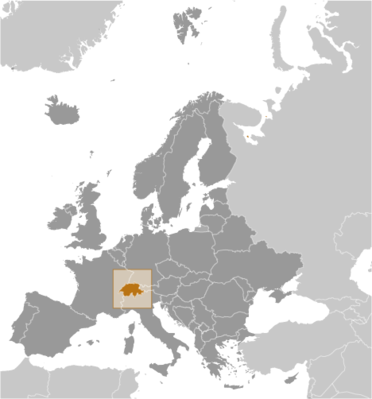
Locator 🗺️ Map
8,925,741 (2025 est.)
41,277 sq km
Central Europe, east of France, north of Italy
🧭 Background
The Swiss Confederation was founded in 1291 as a defensive alliance among three cantons. In succeeding years, other localities joined the original three. The Swiss Confederation secured its independence from the Holy Roman Empire in 1499. A constitution of 1848, which was modified in 1874 to allow voters to introduce referenda on proposed laws, replaced the confederation with a centralized federal government. The major European powers have long honored Switzerland's sovereignty and neutrality, and the country was not involved in either World War. The political and economic integration of Europe over the past half-century, as well as Switzerland's role in many UN and international organizations, has strengthened Switzerland's ties with its neighbors. However, the country did not officially become a UN member until 2002. Switzerland remains active in many UN and international organizations but retains a strong commitment to neutrality.
🗺️ Geography
Central Europe, east of France, north of Italy
47 00 N, 8 00 E
Europe
41,277 sq km
39,997 sq km
1,280 sq km
Slightly less than twice the size of New Jersey
1,770 km
Austria 158 km; France 525 km; Italy 698 km; Liechtenstein 41 km; Germany 348 km
0 km (landlocked)
None (landlocked)
Temperate, but varies with altitude; cold, cloudy, rainy/snowy winters; cool to warm, cloudy, humid summers with occasional showers
Mostly mountains (Alps in south, Jura in northwest) with a central plateau of rolling hills, plains, and large lakes
Dufourspitze on Monte Rosa 4,634 m
Lake Maggiore 195 m
1,350 m
Hydropower potential, timber, salt
37.8% (2023 est.)
Arable land: 10% (2023 est.)
Permanent crops: 0.6% (2023 est.)
Permanent pasture: 27.1% (2023 est.)
32% (2023 est.)
32.6% (2023 est.)
494 sq km (2020)
Lake Constance (shared with Germany and Austria) - 540 sq km; Lake Geneva (shared with France) - 580 sq km
Rhein (Rhine) river source (shared with Germany, France, and Netherlands [m]) - 1,233 km note: [s] after country name indicates river source; [m] after country name indicates river mouth
Rhine-Maas (198,735 sq km), (Black Sea) Danube (795,656 sq km), (Adriatic Sea) Po (76,997 sq km), (Mediterranean Sea) Rhone (100,543 sq km)
Population distribution corresponds to elevation, with the northern and western areas far more heavily populated; the higher Alps of the south limit settlement
Avalanches, landslides; flash floods
Landlocked; crossroads of northern and southern Europe; along with southeastern France, northern Italy, and southwestern Austria, has the highest elevations in the Alps
👥 People and Society⬆️ Top
8,925,741 (2025 est.)
4,436,858
4,488,883
Swiss (singular and plural)
Swiss
Swiss 69.2%, German 4.2%, Italian 3.2%, Portuguese 2.5%, French 2.1%, Kosovan 1.1%, Turkish 1%, other 16.7% (2020 est.)
German (or Swiss German) (official) 62.1%, French (official) 22.8%, Italian (official) 8%, English 5.7%, Portuguese 3.5%, Albanian 3.3%, Serbo-Croatian 2.3%, Spanish 2.3%, Romansh (official) 0.5%, other 7.9% (2019 est.)
Das World Factbook, die unverzichtbare Quelle für grundlegende Informationen. (German) The World Factbook, une source indispensable d'informations de base. (French) L'Almanacco dei fatti del mondo, l'indispensabile fonte per le informazioni di base. (Italian) The World Factbook, the indispensable source for basic information.
Roman Catholic 34.4%, Protestant 22.5%, other Christian 5.7%, Muslim 5.4%, other 1.5%, none 29.4%, unspecified 1.1% (2020 est.)
15.1% (male 685,221/female 650,802)
64.6% (male 2,887,767/female 2,834,842)
20.3% (2024 est.) (male 830,117/female 971,825)
55.8 (2025 est.)
23.5 (2025 est.)
32.3 (2025 est.)
3.1 (2025 est.)
44.4 years (2025 est.)
43.5 years
44.9 years
0.72% (2025 est.)
10.01 births/1,000 population (2025 est.)
8.61 deaths/1,000 population (2025 est.)
5.79 migrant(s)/1,000 population (2025 est.)
Population distribution corresponds to elevation, with the northern and western areas far more heavily populated; the higher Alps of the south limit settlement
74.2% of total population (2023)
0.79% annual rate of change (2020-25 est.)
1.432 million Zurich, 441,000 BERN (capital) (2023)
1.05 male(s)/female
1.05 male(s)/female
1.02 male(s)/female
0.85 male(s)/female
0.99 male(s)/female (2024 est.)
31.1 years (2020 est.)
5 deaths/100,000 live births (2023 est.)
3 deaths/1,000 live births (2025 est.)
3.4 deaths/1,000 live births
2.5 deaths/1,000 live births
83.9 years (2024 est.)
82 years
85.8 years
1.59 children born/woman (2025 est.)
0.78 (2025 est.)
Urban: 100% of population (2022 est.)
Rural: 100% of population (2022 est.)
Total: 100% of population (2022 est.)
Urban: 0% of population (2022 est.)
Rural: 0% of population (2022 est.)
Total: 0% of population (2022 est.)
11.8% of GDP (2021)
12.4% of national budget (2022 est.)
4.48 physicians/1,000 population (2022)
4.4 beds/1,000 population (2021 est.)
Urban: 100% of population (2022 est.)
Rural: 100% of population (2022 est.)
Total: 100% of population (2022 est.)
Urban: 0% of population (2022 est.)
Rural: 0% of population (2022 est.)
Total: 0% of population (2022 est.)
19.5% (2016)
9.41 liters of pure alcohol (2019 est.)
3.17 liters of pure alcohol (2019 est.)
4.35 liters of pure alcohol (2019 est.)
1.76 liters of pure alcohol (2019 est.)
0.12 liters of pure alcohol (2019 est.)
22.8% (2025 est.)
25.5% (2025 est.)
20.1% (2025 est.)
57.5% (2022 est.)
4.9% of GDP (2022 est.)
15.4% national budget (2022 est.)
17 years (2023 est.)
17 years (2023 est.)
17 years (2023 est.)
🌿 Environment⬆️ Top
Air pollution from vehicle emissions; water pollution from agricultural fertilizers; soil pollution from chemical contaminants; soil erosion; loss of biodiversity
Air Pollution, Air Pollution-Heavy Metals, Air Pollution-Multi-effect Protocol, Air Pollution-Nitrogen Oxides, Air Pollution-Persistent Organic Pollutants, Air Pollution-Sulphur 85, Air Pollution-Sulphur 94, Air Pollution-Volatile Organic Compounds, Antarctic-Environmental Protection, Antarctic Treaty, Biodiversity, Climate Change, Climate Change-Kyoto Protocol, Climate Change-Paris Agreement, Comprehensive Nuclear Test Ban, Desertification, Endangered Species, Environmental Modification, Hazardous Wastes, Law of the Sea, Marine Dumping-London Convention, Marine Dumping-London Protocol, Marine Life Conservation, Nuclear Test Ban, Ozone Layer Protection, Ship Pollution, Tropical Timber 2006, Wetlands, Whaling
None of the selected agreements
Temperate, but varies with altitude; cold, cloudy, rainy/snowy winters; cool to warm, cloudy, humid summers with occasional showers
37.8% (2023 est.)
Arable land: 10% (2023 est.)
Permanent crops: 0.6% (2023 est.)
Permanent pasture: 27.1% (2023 est.)
32% (2023 est.)
32.6% (2023 est.)
74.2% of total population (2023)
0.79% annual rate of change (2020-25 est.)
33.306 million metric tonnes of CO2 (2023 est.)
195,000 metric tonnes of CO2 (2023 est.)
27.528 million metric tonnes of CO2 (2023 est.)
5.583 million metric tonnes of CO2 (2023 est.)
9 micrograms per cubic meter (2019 est.)
6.08 million tons (2024 est.)
30.1% (2022 est.)
930 million cubic meters (2022)
642.7 million cubic meters (2022 est.)
160.1 million cubic meters (2022 est.)
53.5 billion cubic meters (2022 est.)
🏛️ Government⬆️ Top
Swiss Confederation
Switzerland
Schweizerische Eidgenossenschaft (German)/ Confederation Suisse (French)/ Confederazione Svizzera (Italian)/ Confederaziun Svizra (Romansh)
Schweiz (German)/ Suisse (French)/ Svizzera (Italian)/ Svizra (Romansh)
CH
Name derives from the canton of Schwyz, one of the founding cantons of the Swiss Confederacy formed in the late 13th century
Federal republic (formally a confederation)
Bern
46 55 N, 7 28 E
UTC+1 (6 hours ahead of Washington, DC, during Standard Time)
+1hr, begins last Sunday in March; ends last Sunday in October
The origin of the name is uncertain; it is sometimes associated with the German word Baer (bear), but a more likely origin is an Indo-European root word ber, meaning "marshy place"
26 cantons (cantons, singular - canton in French; cantoni, singular - cantone in Italian; Kantone, singular - Kanton in German); Aargau, Appenzell Ausserrhoden, Appenzell Innerrhoden, Basel-Landschaft, Basel-Stadt, Berne/Bern, Fribourg/Freiburg, Genève (Geneva), Glarus, Graubuenden/Grigioni/Grischun, Jura, Luzern (Lucerne), Neuchatel, Nidwalden, Obwalden, Sankt Gallen, Schaffhausen, Schwyz, Solothurn, Thurgau, Ticino, Uri, Valais/Wallis, Vaud, Zug, Zuerich
Civil law system; judicial review of legislative acts, except federal decrees of a general obligatory character
Previous 1848, 1874; latest adopted by referendum 18 April 1999, effective 1 January 2000
Proposed by the two houses of the Federal Assembly or by petition of at least one hundred thousand voters (called the "federal popular initiative"); passage of proposals requires majority vote in a referendum; following drafting of an amendment by the Assembly, its passage requires approval by majority vote in a referendum and approval by the majority of cantons
Accepts compulsory ICJ jurisdiction with reservations; accepts ICCt jurisdiction
No
At least one parent must be a citizen of Switzerland
Yes
12 years including at least 3 of the last 5 years prior to application
18 years of age; universal
President of the Swiss Confederation Guy PARMELIN (since 1 January 2026)
President of the Swiss Confederation Guy PARMELIN (since 1 January 2026)
Federal Council or Bundesrat (in German), Conseil Federal (in French), Consiglio Federale (in Italian) indirectly elected by the Federal Assembly for a 4-year term
President and vice president elected by the Federal Assembly from among members of the Federal Council for a 1-year, non-consecutive term
11 December 2024
2024: Karin KELLER-SUTTER elected president for 2025; Federal Assembly vote - Karin KELLER-SUTTER (FDP.The Liberals) 168 of 203; Guy PARLEMIN (SVP) elected vice president for 2025; Federal Assembly vote - 196 of 219 2023: Viola AMHERD elected president for 2024; Federal Assembly vote - Viola AMHERD (The Center) 158 of 204; Karin KELLER-SUTTER (FDP.The Liberals) elected vice president for 2024; Federal Assembly vote - 138 of 196 2022: Alain BERSET elected president for 2023; Federal Assembly vote - Alain BERSET (SP) 140 OF 181; Viola AMHERD elected vice president; Federal assembly vote - 207 of 223
December 2025
Federal Assembly (Bundesversammlung - Assemblée fédérale - Assemblea federale)
Bicameral
National Council (Nationalrat - Conseil national - Consiglio nazionale)
200 (all directly elected)
Proportional representation
Full renewal
4 years
10/22/2023
Swiss People's Party (SVP/UDC) (62); Socialist Party (SP/PS) (41); Centre Party (29); FDP/The Liberals (FDP/PLR) (28); Green Party (GPS/PES) (23); Liberal Green Party (GLP/PVL) (10); Other (7)
39.5%
October 2027
Council of States (Ständerat - Conseil des Etats - Consiglio degli Stati)
46 (all directly elected)
Other systems
Full renewal
4 years
10/22/2023
Centre Party (15); FDP/The Liberals (FDP/PLR) (11); Socialist Party (SP/PS) (9); Swiss People's Party (SVP/UDC) (6); Green Party (GPS/PES) (3); Other (2)
33.3%
October 2027
Federal Supreme Court (consists of 38 justices and 19 deputy justices organized into 7 divisions)
Judges elected by the Federal Assembly for 6-year terms; judges are affiliated with political parties and are elected according to linguistic and regional criteria in approximate proportion to party representation in the Federal Assembly
Federal Criminal Court (established in 2004); Federal Administrative Court (established in 2007)
The Center (Die Mitte, Alleanza del Centro, Le Centre, Allianza dal Center) (merger of the Christian Democratic People's Party and the Conservative Democratic Party) Evangelical Peoples' Party or EVP/PEV Federal Democrats or EDU Geneva Citizens Movement or MCR/MCG Green Liberal Party (Gruenliberale Partei or GLP, Parti vert liberale or PVL, Partito Verde-Liberale or PVL, Partida Verde Liberale or PVL) Green Party (Gruene Partei der Schweiz or Gruene, Parti Ecologiste Suisse or Les Verts, Partito Ecologista Svizzero or I Verdi, Partida Ecologica Svizra or La Verda) The Liberals or FDP.The Liberals (FDP.Die Liberalen, PLR.Les Liberaux-Radicaux, PLR.I Liberali, Ils Liberals) Social Democratic Party (Sozialdemokratische Partei der Schweiz or SP, Parti Socialiste Suisse or PSS, Partito Socialista Svizzero or PSS, Partida Socialdemocratica de la Svizra or PSS) Swiss People's Party (Schweizerische Volkspartei or SVP, Union Democratique du Centre or UDC, Unione Democratica di Centro or UDC, Uniun Democratica dal Center or UDC)
Ambassador Ralph HECKNER (since 18 September 2024)
2900 Cathedral Ave NW, Washington, DC 20008
[1] (202) 745-7900
[1] (202) 387-2564
Washington@eda.admin.ch https://www.eda.admin.ch/washington
Atlanta, Chicago, New York, San Francisco
Boston
Ambassador Callista GINGRICH (since 23 October 2025) note - also accredited to Liechtenstein
Sulgeneckstrasse 19, CH-3007 Bern
5110 Bern Place, Washington DC 20521-5110
[41] (031) 357-70-11
[41] (031) 357-73-20
Https://ch.usembassy.gov/
ADB (nonregional member), AfDB (nonregional member), Australia Group, BIS, CD, CE, CERN, EAPC, EBRD, EFTA, EITI (implementing country), ESA, FAO, FATF, G-10, IADB, IAEA, IBRD, ICAO, ICC (national committees), ICCt, ICRM, IDA, IEA, IFAD, IFC, IFRCS, IGAD (partners), ILO, IMF, IMO, IMSO, Interpol, IOC, IOM, IPU, ISO, ITSO, ITU, ITUC (NGOs), LAIA (observer), MIGA, MONUSCO, NEA, NSG, OAS (observer), OECD, OIF, OPCW, OSCE, Pacific Alliance (observer), Paris Club, PCA, PFP, Schengen Convention, UN, UNCTAD, UNESCO, UNHCR, UNIDO, UNITAR, UNMISS, UNMOGIP, UNOOSA, UNRWA, UNTSO, UNWTO, UPU, Wassenaar Arrangement, WCO, WHO, WIPO, WMO, WTO, ZC
1 August 1291 (founding of the Swiss Confederation)
Founding of the Swiss Confederation in 1291
Description: red square with an equal-armed white cross in the center that does not extend to the edges of the flag history: the origin of the flag is unclear, but a white cross was used to identify Swiss Confederation troops at the Battle of Laupen (1339)
Swiss cross (white cross on red field)
Red, white
The Swiss anthem has four names: "Schweizerpsalm" [German] "Cantique Suisse" [French] "Salmo svizzero," [Italian] "Psalm svizzer" [Romansch] (Swiss Psalm)
Leonhard WIDMER [German], Charles CHATELANAT [French], Camillo VALSANGIACOMO [Italian], and Flurin CAMATHIAS [Romansch]/Alberik ZWYSSIG
Adopted 1981; all four of the versions (German, French, Italian, Romansch) are considered official
13 (9 cultural, 4 natural)
Old City of Berne (c); Swiss Alps Jungfrau-Aletsch (n); Monte San Giorgio (n); Abbey of St Gall (c); Three Castles, Defensive Wall, and Ramparts of the Market-Town of Bellinzona (c); Rhaetian Railway in the Albula/Bernina Landscapes (c); La Chaux-de-Fonds/Le Locle, Watchmaking Town Planning (c); Prehistoric Pile Dwellings around the Alps (c); Benedictine Convent of St John at Müstair (c); Lavaux, Vineyard Terraces (c)
💹 Economy⬆️ Top
High-income, non-EU European economy; top ten in GDP per capita; renowned banking and financial hub; low unemployment and inflation; slowed GDP growth post-pandemic; highly skilled but aging workforce; key pharmaceutical and precision manufacturing exporter; leader in innovation and competitiveness indices
$741.035 billion (2024 est.)
$731.508 billion (2023 est.)
$726.544 billion (2022 est.)
1.3% (2024 est.)
0.7% (2023 est.)
3% (2022 est.)
$82,000 (2024 est.)
$82,300 (2023 est.)
$82,800 (2022 est.)
$936.564 billion (2024 est.)
1.1% (2024 est.)
2.1% (2023 est.)
2.8% (2022 est.)
0.6% (2024 est.)
24.7% (2024 est.)
72% (2024 est.)
51.1% (2023 est.)
11.3% (2023 est.)
25.8% (2023 est.)
0.2% (2023 est.)
73.3% (2023 est.)
-62% (2023 est.)
Milk, sugar beets, wheat, potatoes, pork, apples, barley, beef, maize, grapes (2023)
Machinery, chemicals, watches, textiles, precision instruments, tourism, banking, insurance, pharmaceuticals
1.7% (2024 est.)
5.153 million (2024 est.)
4.2% (2024 est.)
4.1% (2023 est.)
4.2% (2022 est.)
7.9% (2024 est.)
8.3% (2024 est.)
7.5% (2024 est.)
15.8% (2021 est.)
33.8 (2021 est.)
9% of household expenditures (2023 est.)
3.5% of household expenditures (2023 est.)
3% (2021 est.)
26.6% (2021 est.)
0.4% of GDP (2024 est.)
0.4% of GDP (2023 est.)
0.4% of GDP (2022 est.)
$153.795 billion (2023 est.)
$152.488 billion (2023 est.)
19.9% of GDP (2023 est.)
9% (of GDP) (2023 est.)
$47.162 billion (2024 est.)
$47.455 billion (2023 est.)
$72.325 billion (2022 est.)
$675.059 billion (2024 est.)
$654.175 billion (2023 est.)
$628.737 billion (2022 est.)
Germany 14%, China 12%, USA 11%, Italy 5%, Turkey 5% (2023)
Gold, packaged medicine, vaccines, nitrogen compounds, base metal watches (2023)
$582.554 billion (2024 est.)
$556.351 billion (2023 est.)
$518.002 billion (2022 est.)
Germany 17%, USA 9%, Italy 8%, France 6%, China 5% (2023)
Gold, packaged medicine, vaccines, cars, jewelry (2023)
$909.366 billion (2024 est.)
$863.892 billion (2023 est.)
$923.628 billion (2022 est.)
Swiss francs (CHF) per US dollar -
0.88 (2024 est.)
0.898 (2023 est.)
0.955 (2022 est.)
0.914 (2021 est.)
0.939 (2020 est.)
⚡ Energy⬆️ Top
100% (2022 est.)
26.502 million kW (2023 est.)
55.643 billion kWh (2023 est.)
33.856 billion kWh (2023 est.)
27.462 billion kWh (2023 est.)
4.81 billion kWh (2023 est.)
0.6% of total installed capacity (2023 est.)
34.9% of total installed capacity (2023 est.)
6.6% of total installed capacity (2023 est.)
0.3% of total installed capacity (2023 est.)
53% of total installed capacity (2023 est.)
4.7% of total installed capacity (2023 est.)
4 (2025)
2.97GW (2025 est.)
32.4% (2023 est.)
2 (2025)
126,000 metric tons (2023 est.)
300 metric tons (2023 est.)
156,000 metric tons (2023 est.)
300 bbl/day (2023 est.)
194,000 bbl/day (2024 est.)
2.915 billion cubic meters (2023 est.)
2.869 billion cubic meters (2023 est.)
99.578 million Btu/person (2023 est.)
📡 Communications⬆️ Top
3.003 million (2023 est.)
34 (2023 est.)
11.6 million (2024 est.)
129 (2024 est.)
Publicly owned Swiss Broadcasting Corporation (SRG/SSR) has 8 national TV networks, 3 broadcasting in German, 3 in French, and 2 in Italian; private commercial TV stations broadcast regionally and locally; German, Italian, and French TV broadcasts widely available via multi-channel cable and satellite TV; SRG/SSR has 17 radio stations (2019)
.ch
97% (2023 est.)
4.33 million (2023 est.)
49 (2023 est.)
🚚 Transportation⬆️ Top
HB
66 (2025)
52 (2025)
5,296 km (2020) 5,296 km electrified; Switzerland remains the only country with a fully electrified network
17 (2023)
Bulk carrier 14, general cargo 1, other 2 (includes Liechtenstein)
🛡️ Military and Security⬆️ Top
Swiss Armed Forces (aka Swiss Army or Schweizer Armee); Army (aka Land Forces), Swiss Air Force (2025)
0.7% of GDP (2024 est.)
0.7% of GDP (2023 est.)
0.7% of GDP (2022 est.)
0.7% of GDP (2021 est.)
0.7% of GDP (2020 est.)
Approximately 145,000 Swiss Armed Forces (2024)
The military's inventory includes a mix of domestically produced and imported European and US weapons systems; the Swiss defense industry produces a range of military land vehicles (2025)
Every Swiss man 18-30 is obligated to serve in the military or the alternative civilian service; women can serve on a voluntary basis; required military service is 245 days, including 18-21 weeks of basic training generally between the ages of 19-25, followed by six three-week recalls for refresher training over the following nine years; the system offers opportunities for conscripts to train as non-commissioned and commissioned officers in the militia with longer service commitments (2026)
200 Kosovo (NATO/KFOR) (2025)
The Swiss military is responsible for territorial defense, limited support to international disaster response and peacekeeping, and providing support to civil authorities when their resources are not sufficient to ward off threats to internal security or provide sufficient relief during disasters; Switzerland has long maintained a policy of military neutrality but does periodically participate in EU, NATO, Organization for Security and Cooperation in Europe (OSCE), and UN military and peacekeeping operations; however, Swiss units will only participate in operations under the mandate of the UN or OSCE; Switzerland joined NATO’s Partnership for Peace program in 1996; it has contributed to the NATO-led force in Kosovo (KFOR) since 1999 (2025)
🚨 Terrorism⬆️ Top
Islamic State of Iraq and ash-Sham (ISIS)
🌐 Transnational Issues⬆️ Top
213,177 (2024 est.)
97 (2024 est.)
1,267 (2024 est.)
Source: Factbook JSON archive.