644,426 (2024 est.)
 Macau
Macau
Key facts and a structured country profile. 🧾 Change log 📐 True Size
Locator 🗺️ Map
28 sq km
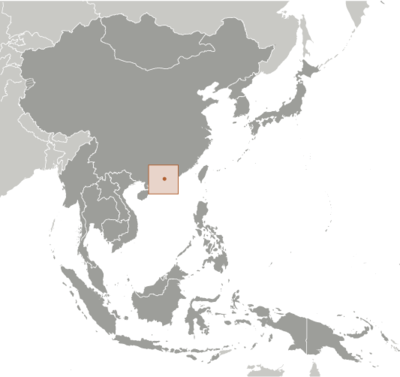
Eastern Asia, bordering the South China Sea and China
🧭 Background
Portuguese ships began arriving in 1513. In the 1550s, Portuguese paying tribute to China settled in Macau, which became the official entrepôt for all international trade with China and Japan and the first European settlement in the Far East. The first governor was appointed in the 17th century, but the Portuguese remained largely under the control of the Chinese. In the 1930s and ’40s Macau was declared a neutral territory during the Sino-Japanese War and World War II and became a refuge for both Chinese and Europeans. Portugal officially made Macau an overseas province in 1951. In April 1987, Portugal and China reached an agreement to return Macau to Chinese rule in 1999, using the Hong Kong Joint Declaration between China and the UK as a model. In this agreement, China promised that, under its "one country, two systems" formula, China's political and economic system would not be imposed on Macau, and that Macau would enjoy a "high degree of autonomy" in all matters except foreign affairs and defense for the next 50 years. However, after China's multi-year crackdown against the pro-democracy movement in nearby Hong Kong, the governments of China and the Macau Special Administrative Region worked to limit Macau's political autonomy by suppressing opposition activity in the 2021 legislative elections.
🗺️ Geography
Eastern Asia, bordering the South China Sea and China
22 10 N, 113 33 E
Southeast Asia
28 sq km
28.2 sq km
0 sq km
Less than one-sixth the size of Washington, D.C.
3 km
China 3 km
41 km
Not specified
Subtropical; marine with cool winters, warm summers
Generally flat
Alto Coloane 172 m
South China Sea 0 m
NEGL
0% (2022 est.)
0% (2022 est.)
100% (2022 est.)
0 sq km (2012)
Population fairly equally distributed
Typhoons
Primarily urban; an area of land reclaimed from the sea measuring 5.2 sq km (2 sq mi) and known as Cotai now connects the islands of Coloane and Taipa; the island area is connected to the mainland peninsula by three bridges
👥 People and Society⬆️ Top
644,426 (2024 est.)
304,988
339,438
Chinese
Chinese
Chinese 89.4%, Chinese and Portuguese 1%, Portuguese 0.8%, Chinese and non-Portuguese 0.2%, Portuguese and others 0.2%, other 8.5% (2021 est.)
Cantonese 81%, Mandarin 4.7%, other Chinese dialects 5.4%, English 3.6%, Tagalog 2.9%, Portuguese 0.6%, other 1.8% (2021 est.)
世界概况, 必須擁有的基本資料参考书 (Cantonese) The World Factbook, the indispensable source for basic information.
Folk religion 58.9%, Buddhist 17.3%, Christian 7.2%, other 1.2%, none 15.4% (2020 est.)
14.4% (male 47,346/female 45,216)
69.9% (male 210,059/female 240,577)
15.7% (2024 est.) (male 47,583/female 53,645)
43 (2024 est.)
20.5 (2024 est.)
22.5 (2024 est.)
4.5 (2024 est.)
43 years (2025 est.)
41.5 years
43.1 years
0.64% (2025 est.)
8.31 births/1,000 population (2025 est.)
5.02 deaths/1,000 population (2025 est.)
3.08 migrant(s)/1,000 population (2025 est.)
Population fairly equally distributed
100% of total population (2023)
1.46% annual rate of change (2020-25 est.)
682,000 Macau (2023)
1.05 male(s)/female
1.05 male(s)/female
0.87 male(s)/female
0.89 male(s)/female
0.9 male(s)/female (2024 est.)
4.3 deaths/1,000 live births (2025 est.)
4.5 deaths/1,000 live births
4.3 deaths/1,000 live births
85.3 years (2024 est.)
82.5 years
88.3 years
1.25 children born/woman (2025 est.)
0.61 (2025 est.)
Urban: 100% of population
6.3% of GDP (2020 est.)
18 years
17 years
19 years (2021)
🌿 Environment⬆️ Top
Air pollution; coastal water pollution; solid-waste disposal; noise pollution
Subtropical; marine with cool winters, warm summers
0% (2022 est.)
0% (2022 est.)
100% (2022 est.)
100% of total population (2023)
1.46% annual rate of change (2020-25 est.)
1.595 million metric tonnes of CO2 (2023 est.)
-1,239 metric tonnes of CO2 (2023 est.)
1.358 million metric tonnes of CO2 (2023 est.)
238,000 metric tonnes of CO2 (2023 est.)
377,900 tons (2024 est.)
🏛️ Government⬆️ Top
Macau Special Administrative Region
Macau
Aomen Tebie Xingzhengqu (Chinese)/ Regiao Administrativa Especial de Macau (Portuguese)
Aomen (Chinese)/ Macau (Portuguese)
Name derived from the Chinese ama-gao, or “Bay of Ama,” for Ama, the patron goddess of sailors
Executive-led limited democracy; a special administrative region of the People's Republic of China
Special administrative region of the People's Republic of China
Civil law system based on the Portuguese model
Previous 1976 (Organic Statute of Macau, under Portuguese authority); latest adopted 31 March 1993, effective 20 December 1999 (Basic Law of the Macau Special Administrative Region of the People's Republic of China serves as Macau's constitution)
Proposed by the Standing Committee of the National People’s Congress (NPC), the People’s Republic of China State Council, and the Macau Special Administrative Region; submittal of proposals to the NPC requires two-thirds majority vote by the Legislative Assembly of Macau, approval by two thirds of Macau's deputies to the NPC, and consent of the Macau chief executive; final passage requires approval by the NPC
See China
18 years of age in direct elections for some legislative positions, universal for permanent residents living in Macau for the past 7 years
President of China XI Jinping (since 14 March 2013)
Chief Executive Sam Hou FAI (since 20 December 2024)
Executive Council appointed by the chief executive
President indirectly elected by National People's Congress for a 5-year term (eligible for a second term); chief executive chosen by a 400-member Election Committee for a 5-year term (eligible for a second term)
President: 10 March 2023 chief executive: 13 October 2024
2024: Sam Hou FAI (unopposed; received 394 out of 400 votes) 2019: HO lat Seng (unopposed; received 392 out of 400 votes)
President: March 2028 chief executive: 2029
Legislative Assembly (Regiao Administrativa Especial de Macau)
Unicameral
33 (14 directly elected, 12 indirectly elected, 7 appointed)
Mixed
Full renewal
4 years
9/12/2021
United Citizens Association of Macau (ACUM) (3); Union for Development (UPD) (2); Macau-Guangdong Union (UGM) (2); Union for Promoting Progress (UPP) (2); Alliance for a Happy Home (ABL) (2); New Hope (NE) (2); Association of Synergy of Macau (PS) (1)
September 2025
Court of Final Appeal of Macau Special Administrative Region (consists of the court president and 2 associate justices)
Justices appointed by the Macau chief executive upon the recommendation of an independent commission of judges, lawyers, and "eminent" persons; judge tenure NA
Court of Second Instance; Court of First instance; Lower Court; Administrative Court
Alliance for a Happy Home or ABL Association of Synergy of Macau ("Synergy Power" or Poder da Singeria) or PS Macau-Guangdong Union or UGM New Hope or NE Union for Development or UPD Union for Promoting Progress or UPP or UNIPRO United Citizens Association of Macau or ACUM
None (Special Administrative Region of China)
The US has no offices in Macau; US Consulate General in Hong Kong is accredited to Macau
ICC (national committees), IHO, IMF, IMO (associate), Interpol (subbureau), ISO (correspondent), UNESCO (associate), UNWTO (associate), UPU, WCO, WMO, WTO
None (special administrative region of China)
National Day (anniversary of the Founding of the People's Republic of China), 1 October (1949)
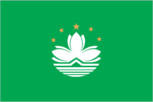
Description: green with a lotus flower above a stylized bridge and water in white, under an arc of five five-pointed gold stars meaning: the lotus is the national floral emblem, and the three petals represent the country's peninsula and two islands; the five stars echo the Chinese flag
Lotus blossom
Green, white, yellow
"Yiyongjun Jinxingqu" (The March of the Volunteers)
TIAN Han/NIE Er
Official anthem, as a Special Administrative Region of China
💹 Economy⬆️ Top
High-income, Chinese special administrative region economy; known for apparel exports and gambling tourism; currency pegged to Hong Kong dollar; significant recession due to 2015 Chinese anticorruption campaign; COVID-19 further halved economic activity
$77.524 billion (2024 est.)
$71.248 billion (2023 est.)
$40.699 billion (2022 est.)
8.8% (2024 est.)
75.1% (2023 est.)
-19.6% (2022 est.)
$112,800 (2024 est.)
$105,000 (2023 est.)
$60,100 (2022 est.)
$50.183 billion (2024 est.)
0.5% (2023 est.)
1% (2022 est.)
0% (2021 est.)
5.4% (2023 est.)
91.4% (2023 est.)
29% (2024 est.)
12.2% (2024 est.)
13.8% (2024 est.)
0.7% (2024 est.)
89.8% (2024 est.)
-45.4% (2024 est.)
Pork, chicken, beef, eggs, pork offal, pork fat, pepper, beef offal, cattle hides, goose meat (2023)
Tourism, gambling, clothing, textiles, electronics, footwear, toys
6.8% (2023 est.)
382,100 (2024 est.)
2.5% (2024 est.)
2.3% (2023 est.)
2.5% (2022 est.)
7.2% (2024 est.)
9.4% (2024 est.)
5.6% (2024 est.)
0.2% of GDP (2023 est.)
0.4% of GDP (2022 est.)
0.2% of GDP (2021 est.)
$12.513 billion (2023 est.)
$11.509 billion (2023 est.)
0% of GDP (2016 est.)
22.8% (of GDP) (2023 est.)
$14.38 billion (2023 est.)
$3.476 billion (2022 est.)
$2.705 billion (2021 est.)
$41.839 billion (2023 est.)
$21.097 billion (2022 est.)
$28.163 billion (2021 est.)
Hong Kong 73%, China 6%, USA 6%, Philippines 3%, Singapore 1% (2023)
Jewelry, garments, broadcasting equipment, precious metal watches, video and card games (2023)
$23.205 billion (2023 est.)
$20.923 billion (2022 est.)
$23.77 billion (2021 est.)
China 36%, Hong Kong 17%, USA 6%, France 6%, Japan 5% (2023)
Jewelry, garments, trunks and cases, broadcasting equipment, electricity (2023)
$29.392 billion (2024 est.)
$27.771 billion (2023 est.)
$25.971 billion (2022 est.)
Patacas (MOP) per US dollar -
8.037 (2024 est.)
8.063 (2023 est.)
8.065 (2022 est.)
8.006 (2021 est.)
7.989 (2020 est.)
⚡ Energy⬆️ Top
100% (2022 est.)
427,000 kW (2023 est.)
5.659 billion kWh (2023 est.)
5.327 billion kWh (2023 est.)
161.125 million kWh (2023 est.)
58.5% of total installed capacity (2023 est.)
41.5% of total installed capacity (2023 est.)
600 metric tons (2023 est.)
7 metric tons (2023 est.)
11,000 bbl/day (2023 est.)
121.747 million cubic meters (2023 est.)
121.716 million cubic meters (2023 est.)
64.641 million Btu/person (2023 est.)
📡 Communications⬆️ Top
87,000 (2023 est.)
12 (2023 est.)
1.37 million (2023 est.)
175 (2022 est.)
Local government dominates broadcast media; 2 TV stations operated by the government, with one broadcasting in Portuguese and the other in Cantonese and Mandarin; 1 cable TV and 4 satellite TV services available; 3 radio stations broadcasting, of which 2 are government-operated (2019)
.mo
89% (2023 est.)
212,000 (2023 est.)
30 (2023 est.)
🚚 Transportation⬆️ Top
B-M
1 (2025)
4 (2025)
5 (2023)
Other 5
1 (2024)
0
1
0
0
1
Macau
🛡️ Military and Security⬆️ Top
Macau Public Security Police Force
Defense is the responsibility of China; the Chinese People's Liberation Army (PLA) maintains a garrison in Macau
🌐 Transnational Issues⬆️ Top
Tier 3 — Macau does not fully meet the minimum standards for the elimination of trafficking and is not making significant efforts to do so, therefore, Macau remained on Tier 3; for more details, go to: https://www.state.gov/reports/2025-trafficking-in-persons-report/macau
Source: Factbook JSON archive.