Tashkent (Toshkent)
 Uzbekistan
Key facts and a structured country profile. 🧾 Change log 📐 True Size
Locator 🗺️ Map
37,015,151 (2025 est.)
447,400 sq km
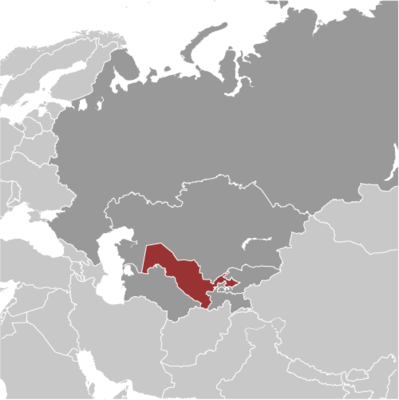
Central Asia, north of Turkmenistan, south of Kazakhstan
🧭 Background
Uzbekistan is the geographic and population center of Central Asia, with a diverse economy and a relatively young population. Russia conquered and united the disparate territories of present-day Uzbekistan in the late 19th century. Stiff resistance to the Red Army after the Bolshevik Revolution was eventually suppressed and a socialist republic established in 1924. During the Soviet era, intensive production of "white gold" (cotton) and grain led to the overuse of agrochemicals and the depletion of water supplies, leaving the land degraded and the Aral Sea and certain rivers half-dry. Independent since the Union of Soviet Socialist Republics (USSR) dissolved in 1991, the country has diversified agricultural production while developing its mineral and petroleum export capacity and increasing its manufacturing base, although cotton remains a major part of its economy. Uzbekistan’s first president, Islom KARIMOV, led Uzbekistan for 25 years until his death in 2016. His successor, former Prime Minister Shavkat MIRZIYOYEV, has improved relations with Uzbekistan’s neighbors and introduced wide-ranging economic, judicial, and social reforms. MIRZIYOYEV was reelected in 2021 with 80% of the vote and again following a 2023 constitutional referendum with 87% of the vote.
🗺️ Geography
Central Asia, north of Turkmenistan, south of Kazakhstan
41 00 N, 64 00 E
Asia
447,400 sq km
425,400 sq km
22,000 sq km
About four times the size of Virginia; slightly larger than California
6,893 km
Afghanistan 144 km; Kazakhstan 2,330 km; Kyrgyzstan 1,314 km; Tajikistan 1,312 km; Turkmenistan 1,793 km
0 km (doubly landlocked)
None (doubly landlocked)
Mostly mid-latitude desert, long, hot summers, mild winters; semiarid grassland in east
Mostly flat-to-rolling sandy desert with dunes; broad, flat intensely irrigated river valleys along course of Amu Darya, Syr Darya (Sirdaryo), and Zaravshan; Fergana Valley in east surrounded by mountainous Tajikistan and Kyrgyzstan; shrinking Aral Sea in west
Xazrat Sulton Tog' 4,643 m
Sariqamish Kuli -12 m
Natural gas, petroleum, coal, gold, uranium, silver, copper, lead and zinc, tungsten, molybdenum
58.1% (2023 est.)
Arable land: 9.1% (2023 est.)
Permanent crops: 1% (2023 est.)
Permanent pasture: 47.9% (2023 est.)
8.7% (2023 est.)
31.8% (2023 est.)
37,305 sq km (2022)
Aral Sea (shared with Kazakhstan) - largely dried up
Syr Darya (shared with Kyrgyzstan [s], Tajikistan, and Kazakhstan [m]) - 3,078 km; Amu Darya river mouth (shared with Tajikistan [s], Afghanistan, and Turkmenistan) - 2,620 km note: [s] after country name indicates river source; [m] after country name indicates river mouth
(Aral Sea basin) Amu Darya (534,739 sq km), Syr Darya (782,617 sq km)
Most of the population is concentrated in the fertile Fergana Valley in the easternmost arm of the country; the south has significant clusters of people, but the central and western deserts are sparsely populated
Earthquakes; floods; landslides or mudslides; avalanches; droughts
Along with Liechtenstein, one of the only two doubly landlocked countries in the world
👥 People and Society⬆️ Top
37,015,151 (2025 est.)
18,576,048
18,439,103
Uzbekistani
Uzbekistani
Uzbek 83.8%, Tajik 4.8%, Kazakh 2.5%, Russian 2.3%, Karakalpak 2.2%, Tatar 1.5%, other 2.9% (2017 est.)
Uzbek (official) 74.3%, Russian 14.2%, Tajik 4.4%, other 7.1%
Jahon faktlari kitobi, asosiy ma'lumotlar uchun zaruriy manba. (Uzbek) The World Factbook, the indispensable source for basic information.
Muslim 88% (mostly Sunni), Eastern Orthodox 9%, other 3%
29.6% (male 5,597,947/female 5,213,403)
63.7% (male 11,649,017/female 11,617,411)
6.7% (2024 est.) (male 1,077,849/female 1,364,966)
57.3 (2025 est.)
46.3 (2025 est.)
11.1 (2025 est.)
9 (2025 est.)
29.2 years (2025 est.)
28.1 years
29.8 years
1.26% (2025 est.)
18.93 births/1,000 population (2025 est.)
5 deaths/1,000 population (2025 est.)
-1.31 migrant(s)/1,000 population (2025 est.)
Most of the population is concentrated in the fertile Fergana Valley in the easternmost arm of the country; the south has significant clusters of people, but the central and western deserts are sparsely populated
50.5% of total population (2023)
1.25% annual rate of change (2020-25 est.)
2.603 million TASHKENT (capital) (2023)
1.08 male(s)/female
1.07 male(s)/female
1 male(s)/female
0.79 male(s)/female
1.01 male(s)/female (2024 est.)
23.7 years (2019 est.)
26 deaths/100,000 live births (2023 est.)
17.6 deaths/1,000 live births (2025 est.)
21.1 deaths/1,000 live births
15.1 deaths/1,000 live births
76.2 years (2024 est.)
73.6 years
79 years
2.6 children born/woman (2025 est.)
1.25 (2025 est.)
Urban: 98% of population (2022 est.)
Rural: 95.2% of population (2022 est.)
Total: 96.6% of population (2022 est.)
Urban: 2% of population (2022 est.)
Rural: 4.8% of population (2022 est.)
Total: 3.4% of population (2022 est.)
7.7% of GDP (2021)
7.1% of national budget (2022 est.)
2.81 physicians/1,000 population (2021)
4.9 beds/1,000 population (2021 est.)
Urban: 98.1% of population (2022 est.)
Rural: 98.7% of population (2022 est.)
Total: 98.4% of population (2022 est.)
Urban: 1.9% of population (2022 est.)
Rural: 1.3% of population (2022 est.)
Total: 1.6% of population (2022 est.)
16.6% (2016)
2.45 liters of pure alcohol (2019 est.)
0.18 liters of pure alcohol (2019 est.)
0.09 liters of pure alcohol (2019 est.)
2.19 liters of pure alcohol (2019 est.)
0 liters of pure alcohol (2019 est.)
15.4% (2025 est.)
30.2% (2025 est.)
1% (2025 est.)
1.8% (2021 est.)
74.7% (2022 est.)
0.2% (2022)
3.4% (2022)
5.5% of GDP (2023 est.)
22.1% national budget (2024 est.)
100% (2022 est.)
100% (2022 est.)
100% (2022 est.)
13 years (2024 est.)
13 years (2024 est.)
13 years (2024 est.)
🌿 Environment⬆️ Top
Growing concentrations of chemical pesticides and natural salts in the shrinking Aral Sea; desertification; water pollution and soil salination from industrial wastes and the heavy use of fertilizers and pesticides; soil contamination from buried nuclear processing and agricultural chemicals
Biodiversity, Climate Change, Climate Change-Kyoto Protocol, Climate Change-Paris Agreement, Comprehensive Nuclear Test Ban, Desertification, Endangered Species, Environmental Modification, Hazardous Wastes, Ozone Layer Protection, Wetlands
None of the selected agreements
Mostly mid-latitude desert, long, hot summers, mild winters; semiarid grassland in east
58.1% (2023 est.)
Arable land: 9.1% (2023 est.)
Permanent crops: 1% (2023 est.)
Permanent pasture: 47.9% (2023 est.)
8.7% (2023 est.)
31.8% (2023 est.)
50.5% of total population (2023)
1.25% annual rate of change (2020-25 est.)
110.992 million metric tonnes of CO2 (2023 est.)
12.845 million metric tonnes of CO2 (2023 est.)
13.437 million metric tonnes of CO2 (2023 est.)
84.71 million metric tonnes of CO2 (2023 est.)
46.6 micrograms per cubic meter (2019 est.)
848.1 kt (2022-2024 est.)
868.1 kt (2019-2021 est.)
261.3 kt (2019-2021 est.)
4.5 kt (2019-2021 est.)
4 million tons (2024 est.)
31.6% (2022 est.)
2.3 billion cubic meters (2022)
1.2 billion cubic meters (2022)
41 billion cubic meters (2022)
48.87 billion cubic meters (2022 est.)
🏛️ Government⬆️ Top
Republic of Uzbekistan
Uzbekistan
O'zbekiston Respublikasi
O'zbekiston
Uzbek Soviet Socialist Republic
The name comes from the local people, the Uzbeks, whose name is said to have originated with Mongol leader Ghiyath ad-Din Muhammad UZBEK; the Persian suffix -stan means "country"
Presidential republic; highly authoritarian
Tashkent (Toshkent)
41 19 N, 69 15 E
UTC+5 (10 hours ahead of Washington, DC, during Standard Time)
The current name of the ancient city was first used in the 11th century and comes from the Sogdian (Turkic) words tash (stone) and kent (town); the city was first recorded in the 5th or 4th century B.C. with the name of Chach or Shash
12 provinces (viloyatlar, singular - viloyat), 1 autonomous republic* (avtonom respublikasi), and 3 cities** (shahar); Andijon Viloyati, Buxoro Viloyati [Bukhara Province], Farg'ona Viloyati [Fergana Province], Jizzax Viloyati, Namangan Shahri, Namangan Viloyati, Navoiy Viloyati, Qashqadaryo Viloyati (Qarshi), Qoraqalpog'iston Respublikasi [Karakalpakstan Republic]* (Nukus), Samarqand Shahri [Samarkand City], Samarqand Viloyati [Samarkand Province], Sirdaryo Viloyati (Guliston), Surxondaryo Viloyati (Termiz), Toshkent Shahri [Tashkent City]**, Toshkent Viloyati [Nurafshon], Xorazm Viloyati (Urganch)
Civil law system
Several previous; latest adopted 8 December 1992
Proposed by the Supreme Assembly or by referendum; passage requires two-thirds majority vote of both houses of the Assembly or passage in a referendum
Has not submitted an ICJ jurisdiction declaration; non-party state to the ICCt
No
At least one parent must be a citizen of Uzbekistan
No
5 years
18 years of age; universal
President Shavkat MIRZIYOYEV (since 14 December 2016)
Prime Minister Abdulla ARIPOV (since 14 December 2016)
Cabinet of Ministers appointed by the president with most requiring approval of the Senate chamber of the Supreme Assembly (Oliy Majlis)
President directly elected by absolute-majority popular vote in 2 rounds, if needed, for a 7-year term (eligible for a second term); prime minister nominated by majority party in the Supreme Assembly but appointed along with the ministers and deputy ministers by the president
9 July 2023
2023: Shavkat MIRZIYOYEV reelected president in snap election; percent of vote - Shavkat MIRZIYOYEV (LDPU) 87.7%, Robaxon Maxmudova (Adolat) 4.5%, Ulugbek Inoyatov (PDP) 4%, Abdushukur Xamzayev (Ecological Party) 3.8% 2021: Shavkat MIRZIYOYEV reelected president in first round; percent of vote - Shavkat MIRZIYOYEV (LDPU) 80.3%, Maqsuda VORISOVA (PDP) 6.7%, Alisher QODIROV (National Revival Democratic Party) 5.5%, Narzullo OBLOMURODOV (Ecological Party) 4.1%, Bahrom ABDUHALIMOV (Adolat) 3.4%
2030
Supreme Assembly (Oliy Majlis)
Bicameral
Legislative Chamber (Qonunchilik palatasi)
150 (all directly elected)
Mixed system
Full renewal
5 years
11/7/2024 to 11/12/2024
Movement of Entrepreneurs and Businesspeople - Liberal Democratic Party (UzLiDeP) (64); Milliy Tiklanish Democratic Party (O'zMTDP) (29); Social Democratic Party ("Adolat" SDP) (21); People's Democratic Party (XDP) (20); Ecological Party (O'EP) (16)
38%
October 2029
Senate (Senat)
65 (56 indirectly elected; 9 appointed)
Full renewal
5 years
10/27/2024
24.6%
November 2029
Supreme Court (consists of 67 judges organized into administrative, civil, criminal, and economic sections); Constitutional Court (consists of 7 judges)
Judges of the highest courts nominated by the president and confirmed by the Senate of the Oliy Majlis; judges appointed for a single 10-year term; the court chairman and deputies appointed for 10-year terms without the right to reelection. (Article 132 of the constitution)
Regional, district, city, and town courts
Ecological Party of Uzbekistan or EPU Justice Social Democratic Party or ASDP People's Democratic Party of Uzbekistan or PDP Uzbekistan Liberal Democratic Party or UzLiDep Uzbekistan National Revival Democratic Party or UzMTDP
Ambassador Furqat SIDIKOV (since 19 April 2023)
1746 Massachusetts Avenue NW, Washington, DC 20036
[1] (202) 887-5300
[1] (202) 293-6804
Info.washington@mfa.uz https://www.uzbekistan.org/
New York
Ambassador Jonathan HENICK (since 14 October 2022)
3 Moyqorghon, 5th Block, Yunusobod District, 100093 Tashkent
7110 Tashkent Place, Washington DC 20521-7110
[998] 78-120-5450
[998] 78-120-6335
ACSTashkent@state.gov https://uz.usembassy.gov/
ADB, CICA, CIS, EAEU (observer), EAPC, EBRD, ECO, EEU (observer), FAO, IAEA, IBRD, ICAO, ICC (national committees), ICCt, ICRM, IDA, IDB, IFAD, IFC, IFRCS, ILO, IMF, Interpol, IOC, ISO, ITSO, ITU, MIGA, NAM, OIC, OPCW, OSCE, PFP, SCO, UN, UNCTAD, UNESCO, UNIDO, UNOOSA, UNWTO, UPU, WCO, WFTU (NGOs), WHO, WIPO, WMO, WTO (observer)
1 September 1991 (from the Soviet Union)
Independence Day, 1 September (1991)
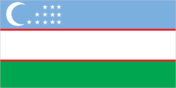
Description: three equal horizontal bands of blue (top), white, and green separated by narrow red stripes with a vertical white crescent moon and 12 five-pointed white stars in the left corner of the top band meaning: blue stands for the Turkic peoples and the sky, white for peace and the striving for purity in thoughts and deeds, and green for nature and Islam; the red stripes represent the vital force of all living organisms; the crescent stands for Islam, and the 12 stars for the months and constellations of the Uzbek calendar
Khumo (mythical bird)
Blue, white, red, green
"O'zbekiston Respublikasining Davlat Madhiyasi" (National Anthem of the Republic of Uzbekistan)
Abdulla ARIPOV/Mutal BURHANOV
Adopted 1992; after the fall of the Soviet Union, Uzbekistan kept the music of its Soviet-era anthem but adopted new lyrics
7 (5 cultural, 2 natural)
Itchan Kala (c); Historic Bukhara (c); Historic Shakhrisyabz (c); Samarkand - Crossroad of Cultures (c); Western Tien Shan (n); Cold Winter Deserts of Turan (n); Silk Roads: Zarafshan-Karakum Corridor (c)
💹 Economy⬆️ Top
Lower-middle income Central Asian economy; key exporter of natural gas, cotton, and gold; ongoing reform efforts to reduce state-owned sector dominance, attract foreign investment, and improve sustainability of cotton production
$379.989 billion (2024 est.)
$356.797 billion (2023 est.)
$335.678 billion (2022 est.)
6.5% (2024 est.)
6.3% (2023 est.)
6% (2022 est.)
$10,500 (2024 est.)
$10,000 (2023 est.)
$9,600 (2022 est.)
$114.965 billion (2024 est.)
9.6% (2024 est.)
10% (2023 est.)
11.4% (2022 est.)
18.3% (2024 est.)
31.8% (2024 est.)
45.2% (2024 est.)
68% (2024 est.)
13.9% (2024 est.)
37.1% (2024 est.)
-3.8% (2024 est.)
22.8% (2024 est.)
-38% (2024 est.)
Milk, wheat, cotton, potatoes, carrots/turnips, tomatoes, grapes, watermelons, vegetables, apples (2023)
Textiles, food processing, machine building, metallurgy, mining, hydrocarbon extraction, chemicals
7.2% (2024 est.)
13.974 million (2024 est.)
4.5% (2024 est.)
4.5% (2023 est.)
4.5% (2022 est.)
10.9% (2024 est.)
7.2% (2024 est.)
18.1% (2024 est.)
11% (2023 est.)
34.5 (2023 est.)
46.3% of household expenditures (2023 est.)
3.2% of household expenditures (2023 est.)
2.1% (2023 est.)
25.3% (2023 est.)
14.4% of GDP (2024 est.)
13.8% of GDP (2023 est.)
17.2% of GDP (2022 est.)
$21.565 billion (2023 est.)
$25.953 billion (2023 est.)
10.5% of GDP (2016 est.)
11.5% (of GDP) (2023 est.)
-$5.738 billion (2024 est.)
-$7.799 billion (2023 est.)
-$2.847 billion (2022 est.)
$26.173 billion (2024 est.)
$25.05 billion (2023 est.)
$20.966 billion (2022 est.)
Switzerland 34%, Russia 12%, UK 11%, China 7%, Turkey 6% (2023)
Gold, cotton yarn, garments, fertilizers, fabric (2023)
$43.624 billion (2024 est.)
$42.646 billion (2023 est.)
$35.643 billion (2022 est.)
China 32%, Russia 17%, Kazakhstan 8%, S. Korea 6%, Turkey 5% (2023)
Cars, vehicle parts/accessories, packaged medicine, refined petroleum, aircraft (2023)
$41.237 billion (2024 est.)
$34.558 billion (2023 est.)
$35.774 billion (2022 est.)
$25.714 billion (2023 est.)
Uzbekistani soum (UZS) per US dollar -
12,652.287 (2024 est.)
11,734.833 (2023 est.)
11,050.145 (2022 est.)
10,609.464 (2021 est.)
10,054.261 (2020 est.)
⚡ Energy⬆️ Top
100% (2022 est.)
17.901 million kW (2023 est.)
75.753 billion kWh (2023 est.)
2.043 billion kWh (2023 est.)
4.977 billion kWh (2023 est.)
3.433 billion kWh (2023 est.)
90.8% of total installed capacity (2023 est.)
0.6% of total installed capacity (2023 est.)
8.7% of total installed capacity (2023 est.)
6.379 million metric tons (2023 est.)
8.941 million metric tons (2023 est.)
4,000 metric tons (2023 est.)
3.521 million metric tons (2023 est.)
1.375 billion metric tons (2023 est.)
64,000 bbl/day (2023 est.)
111,000 bbl/day (2023 est.)
594 million barrels (2021 est.)
43.249 billion cubic meters (2023 est.)
44.455 billion cubic meters (2023 est.)
1.308 billion cubic meters (2023 est.)
2.514 billion cubic meters (2023 est.)
1.841 trillion cubic meters (2021 est.)
55.305 million Btu/person (2023 est.)
📡 Communications⬆️ Top
6.147 million (2023 est.)
17 (2023 est.)
40.2 million (2024 est.)
1,110 (2024 est.)
State-controlled media; 17 state-owned broadcasters, including 13 TV and 4 radio, with national service; about 20 privately owned TV stations, overseen by local officials, broadcast locally; privately owned TV stations required to lease transmitters from state-owned Republic TV and Radio Industry Corporation (2019)
.uz
89% (2023 est.)
10.8 million (2023 est.)
30 (2023 est.)
🚚 Transportation⬆️ Top
UK
74 (2025)
3 (2025)
4,642 km (2018)
4,642 km (2018) 1.520-m gauge (1,684 km electrified)
🛡️ Military and Security⬆️ Top
Armed Forces of Uzbekistan: Army, Air and Air Defense Forces; National Guard Ministry of Internal Affairs: Internal Security Troops, Border Guards, police (2024)
2.8% of GDP (2019 est.)
2.9% of GDP (2018 est.)
2.7% of GDP (2017 est.)
2.5% of GDP (2016 est.)
2.5% of GDP (2015 est.)
Limited available information; estimated 50,000 active Armed Forces (2025)
The Uzbek Armed Forces use mainly Russian or Soviet-era armaments with smaller quantities of items from suppliers such as China, Türkiye, and the US; Uzbekistan has a small defense industry, which is involved in repairing and maintaining aircraft and armored vehicles, as well as producing light armored vehicles, unmanned aerial vehicles/drones, and other military items (2025)
18-30 for voluntary/contract service for men and women; 18-27 years of age for compulsory military service for men with a 12-month service obligation (2025)
The military’s responsibilities include ensuring the country’s sovereignty and territorial integrity, securing its borders, and assisting with internal security; regional security and international terrorism are areas of concern; Uzbekistan joined the Russian-sponsored Collective Security Treaty Organization (CSTO) in the 1990s but withdrew in 1999; it returned in 2006 but left again in 2012; although not part of CSTO, Uzbekistan continues to maintain defense ties with Russia, including joint military exercises and defense industrial cooperation; it also has defense ties with other regional countries, including Azerbaijan, China, India, Kazakhstan, Pakistan, and Turkey; it is part of the Shanghai Cooperation Organization (SCO) and participates in SCO training exercises (2025)
🛰️ Space⬆️ Top
Space Research and Technology Agency (UzCosmos or UzSpace; established 2019) (2025)
Has a small but growing space effort focused on acquiring satellites and developing the country’s space industries and technologies in key sectors, including cartography, data processing, environmental and disaster monitoring, land use, resource management, and telecommunications; recognized for its astronomy program; member of international space organizations; cooperates with foreign space agencies or commercial companies from a variety of countries, including those of Canada, China, France, India, Israel, Japan, Kazakhstan, Russia, South Korea, Spain, Turkey, and the UAE (2025)
2018 - signed space cooperation agreements with France and India 2022 - signed space cooperation agreement with Kazakhstan 2025 - Uzbek engineers began two-year satellite development training program in Japan with goal of building country's first satellite; signed space cooperation agreement with South Korea; announced development of 10-year national space program
🚨 Terrorism⬆️ Top
Islamic Jihad Union (IJU); Islamic Movement of Uzbekistan (IMU); Islamic State of Iraq and ash-Sham - Khorasan (ISIS-K)
🌐 Transnational Issues⬆️ Top
8,505 (2024 est.)
20,000 (2024 est.)
Source: Factbook JSON archive.