Dublin
 Ireland
Key facts and a structured country profile. 🧾 Change log 📐 True Size
Locator 🗺️ Map
5,233,461 (2024 est.)
70,273 sq km
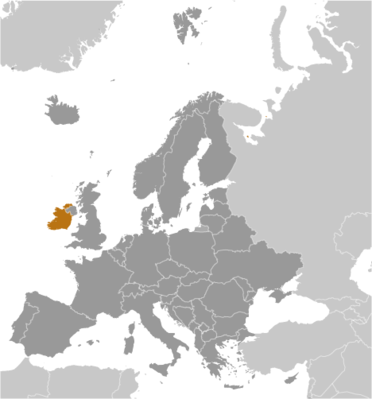
Western Europe, occupying five-sixths of the island of Ireland in the North Atlantic Ocean, west of Great Britain
🧭 Background
Celtic tribes arrived in Ireland between 600 and 150 B.C. Norse invasions that began in the late 8th century finally ended when King Brian BORU defeated the Danes in 1014. Norman invasions began in the 12th century and set off more than seven centuries of Anglo-Irish struggle marked by fierce rebellions and harsh repressions. The Irish famine of the mid-19th century caused an almost 25-percent decline in the island's population through starvation, disease, and emigration. The population of the island continued to fall until the 1960s, but over the last 50 years, Ireland's high birthrate has made it demographically one of the youngest populations in the EU. The modern Irish state traces its origins to the failed 1916 Easter Monday Uprising that galvanized nationalist sentiment. The ensuing guerrilla war led to independence from the UK in 1921 with the signing of the Anglo-Irish Treaty and the creation of the Irish Free State. The treaty was deeply controversial in Ireland, in part because it helped solidify the country's partition, with six of the 32 counties remaining in the UK as Northern Ireland. The split between pro-Treaty and anti-Treaty partisans led to the Irish Civil War (1922-23). The traditionally dominant political parties in Ireland, Fine Gael and Fianna Fail, are de facto descendants of the opposing sides of the treaty debate. Ireland declared itself a republic in 1949 and formally left the British Dominion. Beginning in the 1960s, deep sectarian divides between the Catholic and Protestant populations and systemic discrimination in Northern Ireland erupted into years of violence known as the Troubles. In 1998, the governments of Ireland and the UK, along with most political parties in Northern Ireland, reached the Belfast/Good Friday Agreement with the support of the US. This agreement helped end the Troubles and initiated a new phase of cooperation between the Irish and British Governments. Ireland was neutral in World War II and continues its policy of military neutrality. Ireland joined the European Community in 1973 and the euro-zone currency union in 1999. The economic boom years of the Celtic Tiger (1995-2007) saw rapid economic growth that came to an abrupt end in 2008 with the meltdown of the Irish banking system. As a small, open economy, Ireland has excelled at courting foreign direct investment, especially from US multi-nationals, which has helped the economy recover from the financial crisis and insulated it somewhat from the economic shocks of the COVID-19 pandemic.
🗺️ Geography
Western Europe, occupying five-sixths of the island of Ireland in the North Atlantic Ocean, west of Great Britain
53 00 N, 8 00 W
Europe
70,273 sq km
68,883 sq km
1,390 sq km
Slightly larger than West Virginia
490 km
UK 499 km
1,448 km
12 nm
200 nm
Temperate maritime; modified by North Atlantic Current; mild winters, cool summers; consistently humid; overcast about half the time
Mostly flat to rolling interior plain surrounded by rugged hills and low mountains; sea cliffs on west coast
Carrauntoohil 1,041 m
Atlantic Ocean 0 m
118 m
Natural gas, peat, copper, lead, zinc, silver, barite, gypsum, limestone, dolomite
60.8% (2023 est.)
Arable land: 6.4% (2023 est.)
Permanent crops: 0% (2023 est.)
Permanent pasture: 54.4% (2023 est.)
11.9% (2023 est.)
27.3% (2023 est.)
0 sq km (2022)
Population distribution is weighted to the eastern side of the island, with the largest concentration in and around Dublin; populations in the west are small due to mountainous land, poorer soil, and lack of transport routes
Rare extreme weather events
Strategic location on major air and sea routes between North America and northern Europe; over 40% of the population resides within 100 km of Dublin
👥 People and Society⬆️ Top
5,233,461 (2024 est.)
2,590,542
2,642,919
Irishman(men), Irishwoman(women), Irish (collective plural)
Irish
Irish 76.6%, Irish travelers 0.6%, other White 9.9%, Asian 3.3%, Black 1.5%, other (includes Arab, Roma, and persons of mixed backgrounds) 2%, unspecified 2.6% (2022 est.)
English (official, the language generally used), Irish (Gaelic or Gaeilge) (official, spoken by approximately 37.7% of the population)
Roman Catholic 69.2% (includes lapsed), Protestant 3.7% (Church of Ireland/England/Anglican/Episcopalian 2.5%, other Protestant 1.2%), Orthodox 2%, other Christian 0.9%, Muslim 1.6%, other 1.4%, agnostic/atheist 0.1%, none 14.5%, unspecified 6.7% (2022 est.)
18.6% (male 498,124/female 477,848)
65.5% (male 1,701,680/female 1,728,041)
15.8% (2024 est.) (male 390,738/female 437,030)
52.6 (2024 est.)
28.5 (2024 est.)
24.1 (2024 est.)
4.1 (2024 est.)
40.5 years (2025 est.)
39.7 years
40.6 years
0.8% (2025 est.)
10.95 births/1,000 population (2025 est.)
7.43 deaths/1,000 population (2025 est.)
4.48 migrant(s)/1,000 population (2025 est.)
Population distribution is weighted to the eastern side of the island, with the largest concentration in and around Dublin; populations in the west are small due to mountainous land, poorer soil, and lack of transport routes
64.5% of total population (2023)
1.15% annual rate of change (2020-25 est.)
1.270 million DUBLIN (capital) (2023)
1.06 male(s)/female
1.04 male(s)/female
0.98 male(s)/female
0.89 male(s)/female
0.98 male(s)/female (2024 est.)
30.9 years (2020 est.)
4 deaths/100,000 live births (2023 est.)
3.2 deaths/1,000 live births (2025 est.)
3.2 deaths/1,000 live births
3.3 deaths/1,000 live births
82 years (2024 est.)
80.3 years
83.9 years
1.72 children born/woman (2025 est.)
0.83 (2025 est.)
Urban: 95.4% of population (2022 est.)
Rural: 97% of population (2022 est.)
Total: 96% of population (2022 est.)
Urban: 4.6% of population (2022 est.)
Rural: 3% of population (2022 est.)
Total: 4% of population (2022 est.)
6.1% of GDP (2022)
22.3% of national budget (2022 est.)
3.88 physicians/1,000 population (2023)
2.9 beds/1,000 population (2020 est.)
Urban: 94.8% of population (2022 est.)
Rural: 98.2% of population (2022 est.)
Total: 96.1% of population (2022 est.)
Urban: 5.2% of population (2022 est.)
Rural: 1.8% of population (2022 est.)
Total: 3.9% of population (2022 est.)
25.3% (2016)
10.91 liters of pure alcohol (2019 est.)
4.92 liters of pure alcohol (2019 est.)
2.88 liters of pure alcohol (2019 est.)
2.29 liters of pure alcohol (2019 est.)
0.82 liters of pure alcohol (2019 est.)
16.8% (2025 est.)
19.2% (2025 est.)
14.4% (2025 est.)
47.1% (2022 est.)
2.9% of GDP (2021 est.)
12.3% national budget (2021 est.)
19 years (2022 est.)
19 years (2022 est.)
20 years (2022 est.)
🌿 Environment⬆️ Top
Water pollution, especially of lakes, from agricultural runoff; deforestation, including problems with acid rain
Air Pollution, Air Pollution-Nitrogen Oxides, Air Pollution-Persistent Organic Pollutants, Air Pollution-Sulphur 94, Biodiversity, Climate Change, Climate Change-Kyoto Protocol, Climate Change-Paris Agreement, Comprehensive Nuclear Test Ban, Desertification, Endangered Species, Environmental Modification, Hazardous Wastes, Law of the Sea, Marine Dumping-London Convention, Marine Dumping-London Protocol, Nuclear Test Ban, Ozone Layer Protection, Ship Pollution, Tropical Timber 2006, Wetlands, Whaling
Air Pollution-Heavy Metals, Air Pollution-Multi-effect Protocol, Marine Life Conservation
Temperate maritime; modified by North Atlantic Current; mild winters, cool summers; consistently humid; overcast about half the time
60.8% (2023 est.)
Arable land: 6.4% (2023 est.)
Permanent crops: 0% (2023 est.)
Permanent pasture: 54.4% (2023 est.)
11.9% (2023 est.)
27.3% (2023 est.)
64.5% of total population (2023)
1.15% annual rate of change (2020-25 est.)
35.486 million metric tonnes of CO2 (2023 est.)
3.029 million metric tonnes of CO2 (2023 est.)
22.635 million metric tonnes of CO2 (2023 est.)
9.822 million metric tonnes of CO2 (2023 est.)
7.5 micrograms per cubic meter (2019 est.)
2.911 million tons (2024 est.)
42.4% (2022 est.)
1.106 billion cubic meters (2022 est.)
531.82 million cubic meters (2022 est.)
39.63 million cubic meters (2022 est.)
52 billion cubic meters (2022 est.)
3
Burren & Cliffs of Moher; Copper Coast; Marble Arch Caves (includes United Kingdom) (2023)
🏛️ Government⬆️ Top
None
Ireland
None
Eire
The Irish name Eire evolved from the Gaelic name Eriu, which is possibly derived from the Old Celtic iveriu, meaning "good land;" the English name, Ireland, is a direct translation
Parliamentary republic
Dublin
53 19 N, 6 14 W
UTC 0 (5 hours ahead of Washington, DC, during Standard Time)
+1hr, begins last Sunday in March; ends last Sunday in October
Derived from the Irish words dubh (black or dark) and linn (pool), referring to the color of the Liffey River
28 counties and 3 cities*; Carlow, Cavan, Clare, Cork, Cork*, Donegal, Dublin*, Dun Laoghaire-Rathdown, Fingal, Galway, Galway*, Kerry, Kildare, Kilkenny, Laois, Leitrim, Limerick, Longford, Louth, Mayo, Meath, Monaghan, Offaly, Roscommon, Sligo, South Dublin, Tipperary, Waterford, Westmeath, Wexford, Wicklow
Common law system based on the English model but substantially modified by customary law; Supreme Court reviews legislative acts
Previous 1922; latest drafted 14 June 1937, adopted by plebiscite 1 July 1937, effective 29 December 1937
Proposed as bills by Parliament; passage requires majority vote by both the Senate and House of Representatives, majority vote in a referendum, and presidential signature
Accepts compulsory ICJ jurisdiction with reservations; accepts ICCt jurisdiction
No, unless a parent of a child born in Ireland has been legally resident in Ireland for at least three of the four years prior to the birth of the child
Yes
Yes
4 of the previous 8 years
18 years of age; universal
President Catherine CONNOLLY (since 11 November 2025)
Taoiseach (Prime Minister) Michael MARTIN (since 23 January 2025)
Cabinet nominated by the prime minister, appointed by the president, approved by the Dali Eireann (lower house of Parliament)
President directly elected by majority popular vote for a 7-year term (eligible for a second term); taoiseach (prime minister) nominated by the House of Representatives (Dail Eireann), appointed by the president
26 October 2018
2025: Michael MARTIN is elected taoiseach by parliament, 95 votes to 76, and is appointed taoiseach by the president 2024: Simon HARRIS is elected taoiseach by parliament, 88 votes to 69, and is appointed taoiseach by the president 2018: Michael D. HIGGINS reelected president in first round; percent of vote in first round - Michael D. HIGGINS (independent) 55.8%, Peter CASEY (independent) 23.3%, Sean GALLAGHER (independent) 6.4%, Liadh NI RIADA (Sinn Fein) 6.4%, Joan FREEMAN (independent) 6%, Gavin DUFFY (independent) 2.2%
No later than November 2025
Parliament (Oireachtas)
Bicameral
House of Representatives (Dáil Éireann)
174 (all directly elected)
Proportional representation
Full renewal
5 years
1/29/2025 to 1/30/2025
Fianna Fáil (48); Sinn Féin (39); Fine Gael (38); Social Democratic Party (11); Labour Party (11); Independents (16); Other (11)
25.3%
November 2029
Senate (Seanad Éireann - Senate)
60 (49 indirectly elected; 11 appointed)
Full renewal
5 years
11/29/2024
Fianna Fail (19); Fine Gael (18); Sinn Fein (6); Independents (12); other (5)
45%
January 2030
Supreme Court of Ireland (consists of the chief justice, 9 judges, 2 ex-officio members -- the presidents of the High Court and Court of Appeal -- and organized in 3-, 5-, or 7-judge panels, depending on the importance or complexity of an issue of law)
Judges nominated by the prime minister and Cabinet and appointed by the president; chief justice serves in the position for 7 years; judges can serve until age 70
High Court, Court of Appeal; circuit and district courts; criminal courts
Aontu Solidarity-People Before Profit or PBP-S Fianna Fail Fine Gael Green Party Human Dignity Alliance Independent Ireland Labor (Labour) Party 100% Redress Right to Change or RTC Sinn Fein Social Democrats Socialist Party The Workers' Party
Ambassador Geraldine BYRNE NASON (since 16 September 2022)
2234 Massachusetts Avenue NW, Washington, DC 20008
[1] (202) 462-3939
[1] (202) 232-5993
Https://www.ireland.ie/en/usa/washington/
Atlanta, Austin (TX), Boston, Chicago, Los Angeles, Miami, New York, San Francisco
Ambassador Edward S. WALSH (since 1 July 2025)
42 Elgin Road, Ballsbridge, Dublin 4
5290 Dublin Place, Washington DC 20521-5290
[353] (1) 668-8777
[353] (1) 688-8056
ACSDublin@state.gov https://ie.usembassy.gov/
ADB (nonregional member), Australia Group, BIS, CD, CE, EAPC, EBRD, ECB, EIB, EMU, ESA, EU, FAO, FATF, IAEA, IBRD, ICAO, ICC (national committees), ICCt, ICRM, IDA, IEA, IFAD, IFC, IFRCS, IGAD (partners), IHO, ILO, IMF, IMO, Interpol, IOC, IOM, IPU, ISO, ITSO, ITU, ITUC (NGOs), MIGA, MINURSO, MONUSCO, NEA, NSG, OAS (observer), OECD, OPCW, OSCE, Paris Club, PCA, PFP, UN, UNCTAD, UNDOF, UNESCO, UNHCR, UNIDO, UNIFIL, UNOCI, UNRWA, UNTSO, UPU, Wassenaar Arrangement, WCO, WHO, WIPO, WMO, WTO, ZC
6 December 1921 (from the UK); 6 December 1922 (Irish Free State established); 18 April 1949 (Republic of Ireland Act enabled)
Saint Patrick's Day, 17 March
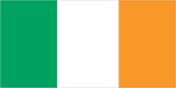
Description: three equal vertical bands of green (left side), white, and orange meaning: the flag colors have no official meaning, but a common interpretation is that the green stands for the Irish nationalist tradition, orange for the Orange tradition (minority supporters of William of Orange), and white for peace or a lasting truce between the green and the orange
Harp, shamrock (trefoil)
Blue, green
The coat of arms features a gold harp on a blue shield and dates back to the 13th century, although it only became official in 1945; the harp, a national symbol that Ireland adopted after gaining independence from the United Kingdom in 1921, represents the country’s history, culture, and national identity
"Amhran na bhFiann" (The Soldier's Song)
Peadar KEARNEY [English], Liam O RINN [Irish]/Patrick HEENEY and Peadar KEARNEY
Adopted 1926; the song "Ireland's Call" is often used as the anthem at athletic events if citizens of Ireland and Northern Ireland are competing as a unified team
2 (both cultural)
Brú na Bóinne - Archaeological Ensemble of the Bend of the Boyne; Sceilg Mhichíl
💹 Economy⬆️ Top
High-income, export-oriented EU economy; large multinational business sector contributes to growth and tax revenues but poses volatility risks; high living standards; strong labor market challenged by skill shortages and aging workforce
$620.544 billion (2024 est.)
$613.056 billion (2023 est.)
$648.943 billion (2022 est.)
1.2% (2024 est.)
-5.5% (2023 est.)
8.6% (2022 est.)
$115,300 (2024 est.)
$115,500 (2023 est.)
$124,500 (2022 est.)
$577.389 billion (2024 est.)
2.1% (2024 est.)
6.3% (2023 est.)
7.8% (2022 est.)
1.1% (2024 est.)
30.8% (2024 est.)
61.8% (2024 est.)
26.8% (2023 est.)
12.2% (2023 est.)
23.2% (2023 est.)
3.1% (2023 est.)
135.1% (2023 est.)
-102.2% (2023 est.)
Milk, barley, beef, wheat, potatoes, pork, oats, chicken, rapeseed, beans (2023)
Pharmaceuticals, chemicals, computer hardware and software, food products, beverages and brewing; medical devices
-4.9% (2024 est.)
2.857 million (2024 est.)
4.4% (2024 est.)
4.3% (2023 est.)
4.6% (2022 est.)
11.1% (2024 est.)
11.2% (2024 est.)
11% (2024 est.)
14% (2021 est.)
29.9 (2022 est.)
8.6% of household expenditures (2023 est.)
4% of household expenditures (2023 est.)
3.6% (2022 est.)
24.5% (2022 est.)
0.1% of GDP (2023 est.)
0.1% of GDP (2022 est.)
0% of GDP (2021 est.)
$118.231 billion (2022 est.)
$108.693 billion (2022 est.)
45.4% of GDP (2022 est.)
16.8% (of GDP) (2022 est.)
$44.744 billion (2023 est.)
$48.427 billion (2022 est.)
$65.118 billion (2021 est.)
$761.876 billion (2023 est.)
$763.233 billion (2022 est.)
$722.655 billion (2021 est.)
USA 28%, Germany 11%, UK 8%, Belgium 8%, China 7% (2023)
Vaccines, packaged medicine, nitrogen compounds, integrated circuits, hormones (2023)
$580.399 billion (2023 est.)
$536.882 billion (2022 est.)
$500.334 billion (2021 est.)
UK 20%, USA 17%, France 10%, China 7%, Germany 7% (2023)
Aircraft, nitrogen compounds, vaccines, packaged medicine, integrated circuits (2023)
$12.698 billion (2024 est.)
$12.905 billion (2023 est.)
$13.039 billion (2022 est.)
Euros (EUR) per US dollar -
0.924 (2024 est.)
0.925 (2023 est.)
0.95 (2022 est.)
0.845 (2021 est.)
0.876 (2020 est.)
⚡ Energy⬆️ Top
100% (2022 est.)
12.321 million kW (2023 est.)
32.282 billion kWh (2023 est.)
441.615 million kWh (2023 est.)
3.89 billion kWh (2023 est.)
2.489 billion kWh (2023 est.)
55.7% of total installed capacity (2023 est.)
1.3% of total installed capacity (2023 est.)
37% of total installed capacity (2023 est.)
2.3% of total installed capacity (2023 est.)
3.7% of total installed capacity (2023 est.)
1.341 million metric tons (2023 est.)
76,000 metric tons (2023 est.)
1.711 million metric tons (2023 est.)
40 million metric tons (2023 est.)
600 bbl/day (2023 est.)
159,000 bbl/day (2024 est.)
1.165 billion cubic meters (2023 est.)
4.919 billion cubic meters (2023 est.)
3.707 billion cubic meters (2023 est.)
9.911 billion cubic meters (2021 est.)
113.837 million Btu/person (2023 est.)
📡 Communications⬆️ Top
1.176 million (2023 est.)
23 (2023 est.)
5.76 million (2023 est.)
113 (2022 est.)
Publicly owned broadcaster Radio Telefis Eireann (RTE) operates 4 TV stations; commercial TV stations are available; about 75% of households use multi-channel satellite and TV services that provide access to a wide range of stations; RTE operates 4 national radio stations and has launched digital audio broadcasts on several; a number of commercial broadcast stations operate at the national, regional, and local levels (2019)
.ie
97% (2023 est.)
1.65 million (2023 est.)
32 (2023 est.)
🚚 Transportation⬆️ Top
EI
100 (2025)
10 (2025)
1,688 km (2020) 53 km electrified
94 (2023)
Bulk carrier 12, general cargo 32, oil tanker 1, other 49
21 (2024)
1
3
3
14
8
Cobh, Cork, Dublin, Foynes
🛡️ Military and Security⬆️ Top
Irish Defense Forces (Oglaigh na h-Eireannn): Army, Air Corps, Naval Service, Reserve Defense Forces (2025)
0.2% of GDP (2024 est.)
0.2% of GDP (2023 est.)
0.3% of GDP (2022 est.)
0.3% of GDP (2021 est.)
0.3% of GDP (2020 est.)
Approximately 7,500 active-duty Defense Forces (authorized establishment of 9,500) (2025)
The Irish Defense Forces have an inventory of imported weapons systems from a variety of mostly European countries (2025)
18-38 years of age for men and women for voluntary military service (2026)
330 Lebanon (UNIFIL); also contributes small numbers of troops to EU, NATO, and other UN missions (2025)
The Irish Defense Forces (IDF) are responsible for external defense, assisting civil authorities upon request, participating in multinational peacekeeping and humanitarian operations, and providing for maritime security; the IDF traces its origins back to the Irish Volunteers, a unit established in 1913 which took part in the 1916 Easter Rising and the Irish War of Independence (1919-1921) Ireland has a long-standing policy of military neutrality; however, Ireland is a signatory of the EU’s Common Security and Defense Policy and has committed a battalion of troops to the EU’s Rapid Reaction Force; Ireland is not a member of NATO but has a relationship with it going back to 1997, when it deployed personnel in support of the NATO-led peacekeeping operation in Bosnia and Herzegovina; Ireland joined NATO’s Partnership for Peace program in 1999; it has been active in UN peacekeeping operations since the 1950s (2025)
🚨 Terrorism⬆️ Top
Continuity Irish Republican Army (CIRA); Real Irish Republican Army (RIRA); Islamic State of Iraq and ash-Sham (ISIS)
🌐 Transnational Issues⬆️ Top
156,441 (2024 est.)
48 (2024 est.)
Source: Factbook JSON archive.