Bandar Seri Begawan
 Brunei
Key facts and a structured country profile. 🧾 Change log 📐 True Size
Locator 🗺️ Map
491,900 (2024 est.)
5,765 sq km
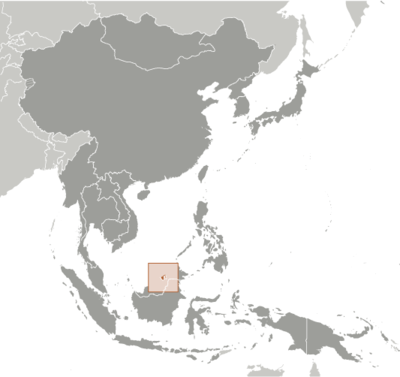
Southeastern Asia, along the northern coast of the island of Borneo, bordering the South China Sea and Malaysia
🧭 Background
The Sultanate of Brunei's influence peaked between the 15th and 17th centuries, when its control extended over coastal areas of northwest Borneo and the southern Philippines. Internal strife over royal succession, colonial expansion of European powers, and piracy subsequently brought on a period of decline. In 1888, Brunei became a British protectorate; independence was achieved in 1984. The same family has ruled Brunei for over six centuries, and in 2017, the country celebrated the 50th anniversary of Sultan Hassanal BOLKIAH’s accession to the throne. Brunei has one of the highest per-capita GDPs in the world, thanks to extensive petroleum and natural gas fields.
🗺️ Geography
Southeastern Asia, along the northern coast of the island of Borneo, bordering the South China Sea and Malaysia
4 30 N, 114 40 E
Southeast Asia
5,765 sq km
5,265 sq km
500 sq km
Slightly smaller than Delaware
266 km
Malaysia 266 km
161 km
12 nm
200 nm or to median line
Tropical; hot, humid, rainy
Flat coastal plain rises to mountains in east; hilly lowland in west
Bukit Pagon 1,850 m
South China Sea 0 m
478 m
Petroleum, natural gas, timber
2.5% (2023 est.)
Arable land: 0.8% (2023 est.)
Permanent crops: 1.1% (2023 est.)
Permanent pasture: 0.6% (2023 est.)
72.1% (2023 est.)
25.4% (2023 est.)
10 sq km (2012)
The vast majority of the population is found along the coast in the western part of Brunei, which is separated from the eastern portion by Malaysia; the largest population concentration is in the far north on the western side of the Brunei Bay, in and around the capital of Bandar Seri Begawan
Typhoons, earthquakes, and severe flooding are rare
Close to vital sea lanes through South China Sea linking Indian and Pacific Oceans; two parts physically separated by Malaysia; the eastern part, the Temburong district, is an exclave and is almost an enclave within Malaysia
👥 People and Society⬆️ Top
491,900 (2024 est.)
239,140
252,760
Bruneian(s)
Bruneian
Malay 67.4%, Chinese 9.6%, other 23% (2021 est.)
Malay (Bahasa Melayu) (official), English, Chinese dialects
Buku Fakta Dunia, sumber yang diperlukan untuk maklumat asas. (Malay) The World Factbook, the indispensable source for basic information.
Muslim (official) 82.1%, Christian 6.7%, Buddhist 6.3%, other 4.9% (2021 est.)
21.7% (male 54,924/female 51,710)
70.8% (male 166,289/female 182,011)
7.5% (2024 est.) (male 17,927/female 19,039)
41.2 (2024 est.)
30.6 (2024 est.)
10.6 (2024 est.)
9.4 (2024 est.)
32.6 years (2025 est.)
31.4 years
33.1 years
1.37% (2025 est.)
15.58 births/1,000 population (2025 est.)
3.96 deaths/1,000 population (2025 est.)
2.09 migrant(s)/1,000 population (2025 est.)
The vast majority of the population is found along the coast in the western part of Brunei, which is separated from the eastern portion by Malaysia; the largest population concentration is in the far north on the western side of the Brunei Bay, in and around the capital of Bandar Seri Begawan
79.1% of total population (2023)
1.44% annual rate of change (2020-25 est.)
266,682 BANDAR SERI BEGAWAN (capital) (2021)
1.05 male(s)/female
1.06 male(s)/female
0.91 male(s)/female
0.94 male(s)/female
0.95 male(s)/female (2024 est.)
36 deaths/100,000 live births (2023 est.)
9.8 deaths/1,000 live births (2025 est.)
12.2 deaths/1,000 live births
7.7 deaths/1,000 live births
78.9 years (2024 est.)
76.5 years
81.3 years
1.73 children born/woman (2025 est.)
0.85 (2025 est.)
Total: 99.9% of population (2022 est.)
Urban: 0.4% of population
Rural: 0% of population
Total: 0.1% of population (2022 est.)
2.2% of GDP (2021)
6.4% of national budget (2022 est.)
1.89 physicians/1,000 population (2021)
3.9 beds/1,000 population (2021 est.)
Total: 99.5% of population (2022 est.)
Total: 0.5% of population (2022 est.)
14.1% (2016)
0.69 liters of pure alcohol (2019 est.)
0.66 liters of pure alcohol (2019 est.)
0.04 liters of pure alcohol (2019 est.)
0 liters of pure alcohol (2019 est.)
0 liters of pure alcohol (2019 est.)
17% (2025 est.)
31.2% (2025 est.)
1.9% (2025 est.)
4.4% of GDP (2016 est.)
11.4% national budget (2016 est.)
14 years (2023 est.)
13 years (2023 est.)
14 years (2023 est.)
🌿 Environment⬆️ Top
Air pollution, including seasonal haze from forest fires in Indonesia
Biodiversity, Climate Change, Climate Change-Kyoto Protocol, Climate Change-Paris Agreement, Comprehensive Nuclear Test Ban, Desertification, Endangered Species, Hazardous Wastes, Law of the Sea, Ozone Layer Protection, Ship Pollution
None of the selected agreements
Tropical; hot, humid, rainy
2.5% (2023 est.)
Arable land: 0.8% (2023 est.)
Permanent crops: 1.1% (2023 est.)
Permanent pasture: 0.6% (2023 est.)
72.1% (2023 est.)
25.4% (2023 est.)
79.1% of total population (2023)
1.44% annual rate of change (2020-25 est.)
10.823 million metric tonnes of CO2 (2023 est.)
998,000 metric tonnes of CO2 (2023 est.)
2.175 million metric tonnes of CO2 (2023 est.)
7.65 million metric tonnes of CO2 (2023 est.)
7.4 micrograms per cubic meter (2019 est.)
50.5 kt (2022-2024 est.)
0.9 kt (2019-2021 est.)
9.2 kt (2019-2021 est.)
0.3 kt (2019-2021 est.)
216,300 tons (2024 est.)
20% (2022 est.)
151.5 million cubic meters (2022 est.)
5.3 million cubic meters (2022 est.)
8.5 billion cubic meters (2022 est.)
🏛️ Government⬆️ Top
Brunei Darussalam
Brunei
Negara Brunei Darussalam
Brunei
Derivation of the name is unclear; the name may come from the Sanskrit word bhumi, meaning "land" or "region"
Absolute monarchy or sultanate
Bandar Seri Begawan
4 53 N, 114 56 E
UTC+8 (13 hours ahead of Washington, DC, during Standard Time)
Named in 1970 after Sultan Omar Ali SAIFUDDIEN III (1914-1986), who adopted the title of "Seri Begawan" (approximately meaning "honored lord") when he abdicated in 1967; "bandar" means "city" or "port" in Malay; the capital had previously been called Bandar Brunei (Brunei City)
4 districts (daerah-daerah, singular - daerah); Belait, Brunei dan Muara, Temburong, Tutong
Mixed legal system based on English common law and Islamic law
Drafted 1954 to 1959, signed 29 September 1959
Proposed by the monarch; passage requires submission to the Privy Council for Legislative Council review and finalization takes place by proclamation; the monarch can accept or reject changes to the original proposal provided by the Legislative Council
Has not submitted an ICJ jurisdiction declaration; non-party state to the ICC
No
The father must be a citizen of Brunei
No
12 years
18 years of age for village elections; universal
Sultan and Prime Minister Sir HASSANAL Bolkiah (since 5 October 1967)
Sultan and Prime Minister Sir HASSANAL Bolkiah (since 5 October 1967)
Council of Ministers appointed and presided over by the monarch
None; the monarchy is hereditary
Legislative Council (Majlis Mesyuarat Negara)
Unicameral
45 (all appointed)
Plurality/majority
Full renewal
5 years
1/20/2023
11.4%
January 2028
Supreme Court (consists of the Court of Appeal and the High Court, each with a chief justice and 2 judges); Sharia Court (consists the Court of Appeals and the High Court)
Supreme Court judges appointed by the monarch to serve until age 65, and older if approved by the monarch; Sharia Court judges appointed by the monarch for life
Intermediate Court; Magistrates' Courts; Juvenile Court; small claims courts; lower sharia courts
National Development Party or NDP
Ambassador (vacant); Chargé d'Affaires IZZATI Baharuddin (since 6 May 2025)
3520 International Court NW, Washington, DC 20008
[1] (202) 237-1838
[1] (202) 885-0560
Info@bruneiembassy.org http://www.bruneiembassy.org/index.html
New York
Ambassador Caryn R. McCLELLAND (since December 2021)
Simpang 336-52-16-9, Jalan Duta, Bandar Seri Begawan, BC4115
4020 Bandar Seri Begawan Place, Washington DC 20521-4020
(673) 238-7400
(673) 238-7533
ConsularBrunei@state.gov https://bn.usembassy.gov/
ADB, APEC, ARF, ASEAN, C, CP, EAS, FAO, G-77, IAEA, IBRD, ICAO, ICC (NGOs), ICRM, IDA, IFRCS, ILO, IMF, IMO, IMSO, Interpol, IOC, ISO (correspondent), ITSO, ITU, NAM, OIC, OPCW, UN, UNCTAD, UNESCO, UNIFIL, UNWTO, UPU, WCO, WHO, WIPO, WMO, WTO
1 January 1984 (from the UK)
National Day, 23 February (1984)
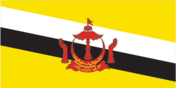
Description: yellow with a diagonal white band and second below it in black, both starting from the upper left; the national emblem in red is at the center; the state motto, "Always render service with God's guidance," appears in yellow Arabic script on the emblem's crescent; a ribbon below the crescent reads "Brunei, the Abode of Peace" meaning: yellow symbolizes the sultanate, and the white and black bands stand for the chief ministers; the emblem includes a royal umbrella (the monarchy), two wings with four feathers (justice, tranquility, prosperity, and peace), two upraised hands (the government's pledge to preserve and promote the people's welfare), and the crescent moon of Islam (the state religion)
Royal parasol
Yellow, white, black
"Allah Peliharakan Sultan" (God Bless His Majesty)
Pengiran Haji Mohamed YUSUF bin Pengiran Abdul Rahim/Awang Haji BESAR bin Sagap
Adopted 1951
💹 Economy⬆️ Top
Almost exclusively an oil and gas economy; high income country; expansive and robust welfare system; the majority of the population works for the government; promulgating a nationalized halal brand; considering establishment of a bond market and stock exchange
$36.64 billion (2024 est.)
$35.163 billion (2023 est.)
$34.771 billion (2022 est.)
4.2% (2024 est.)
1.1% (2023 est.)
-1.6% (2022 est.)
$79,200 (2024 est.)
$76,600 (2023 est.)
$76,400 (2022 est.)
$15.463 billion (2024 est.)
-0.4% (2024 est.)
0.4% (2023 est.)
3.7% (2022 est.)
1.2% (2024 est.)
61.7% (2024 est.)
38.7% (2024 est.)
28.5% (2024 est.)
23% (2024 est.)
28.2% (2024 est.)
0.2% (2024 est.)
74.3% (2024 est.)
-58.9% (2024 est.)
Chicken, eggs, fruits, vegetables, rice, bananas, beans, cucumbers/gherkins, pineapples, beef (2023)
Petroleum, petroleum refining, liquefied natural gas, construction, agriculture, aquaculture, transportation
5.7% (2024 est.)
233,500 (2024 est.)
5.2% (2024 est.)
5.2% (2023 est.)
5.2% (2022 est.)
18.5% (2024 est.)
16.5% (2024 est.)
21.6% (2024 est.)
0% of GDP (2023 est.)
0% of GDP (2022 est.)
0% of GDP (2021 est.)
$1.058 billion (2020 est.)
$3.189 billion (2020 est.)
2.8% of GDP (2017 est.)
$2.23 billion (2024 est.)
$1.944 billion (2023 est.)
$3.256 billion (2022 est.)
$11.483 billion (2024 est.)
$11.573 billion (2023 est.)
$14.405 billion (2022 est.)
Australia 21%, Japan 17%, China 17%, Singapore 16%, Malaysia 6% (2023)
Refined petroleum, natural gas, crude petroleum, hydrocarbons, fertilizers (2023)
$9.11 billion (2024 est.)
$9.077 billion (2023 est.)
$10.099 billion (2022 est.)
Malaysia 23%, UAE 10%, China 10%, UK 10%, Australia 6% (2023)
Crude petroleum, gold, refined petroleum, coal, cars (2023)
$4.414 billion (2024 est.)
$4.483 billion (2023 est.)
$5.035 billion (2022 est.)
Bruneian dollars (BND) per US dollar -
1.336 (2024 est.)
1.343 (2023 est.)
1.379 (2022 est.)
1.344 (2021 est.)
1.38 (2020 est.)
⚡ Energy⬆️ Top
100% (2022 est.)
904,000 kW (2023 est.)
5.081 billion kWh (2023 est.)
502.188 million kWh (2023 est.)
99.9% of total installed capacity (2023 est.)
0.1% of total installed capacity (2023 est.)
841,000 metric tons (2023 est.)
841,000 metric tons (2023 est.)
95,000 bbl/day (2023 est.)
15,000 bbl/day (2023 est.)
1.1 billion barrels (2021 est.)
10.093 billion cubic meters (2023 est.)
3.911 billion cubic meters (2023 est.)
5.733 billion cubic meters (2023 est.)
260.515 billion cubic meters (2021 est.)
403.365 million Btu/person (2023 est.)
📡 Communications⬆️ Top
122,000 (2023 est.)
26 (2023 est.)
582,919 (2023 est.)
118 (2024 est.)
State-controlled Radio Television Brunei (RTB) operates 5 channels; 3 Malaysian TV stations are available; foreign TV broadcasts are available via satellite systems; RTB operates 5 radio networks and broadcasts on multiple frequencies; British Forces Broadcast Service (BFBS) provides radio broadcasts on 2 FM stations; some radio broadcast stations from Malaysia are available via repeaters
.bn
99% (2023 est.)
93,000 (2023 est.)
20 (2023 est.)
🚚 Transportation⬆️ Top
V8
2 (2025)
14 (2025)
97 (2023)
General cargo 18, oil tanker 2, other 77
5 (2024)
0
0
2
3
5
Bandar Seri Begawan, Kuala Belait, Lumut, Muara Harbor, Seria Oil Loading Terminal
🛡️ Military and Security⬆️ Top
Royal Brunei Armed Forces (RBAF) or Angkatan Bersenjata Diraja Brunei (ABDB): Royal Brunei Land Force (RBLF), Royal Brunei Navy (RBN), Royal Brunei Air Force (RBAirF) (2025)
3% of GDP (2023 est.)
2.6% of GDP (2022 est.)
3.1% of GDP (2021 est.)
3.7% of GDP (2020 est.)
3.1% of GDP (2019 est.)
Approximately 7,000 active Armed Forces (2025)
The military's s inventory includes equipment and weapons systems from a variety of suppliers from Asia, Europe, and the US (2025)
18-25 years of age for voluntary military service (2025)
The Royal Brunei Armed Forces (RBAF) are responsible for ensuring the country’s sovereignty and territorial integrity, as well as countering outside aggression, terrorism, and insurgency Brunei has a long-standing defense relationship with the UK and hosts a British Army garrison, which includes a Gurkha battalion and a jungle warfare school; Brunei also has close security ties with Singapore and hosts a Singaporean military training detachment the RBAF was formed in 1961 with British support as the Brunei Malay Regiment; "Royal" was added as an honorary title in 1965 and its current name was given in 1984 (2025)
🌐 Transnational Issues⬆️ Top
20,863 (2024 est.)
Tier 2 Watch List — Brunei does not fully meet the minimum standards for the elimination of trafficking but is making significant efforts to do so, therefore Brunei was upgraded to Tier 2 Watch List; for more details, go to: https://www.state.gov/reports/2025-trafficking-in-persons-report/brunei/
Source: Factbook JSON archive.