Gaborone
 Botswana
Key facts and a structured country profile. 🧾 Change log 📐 True Size
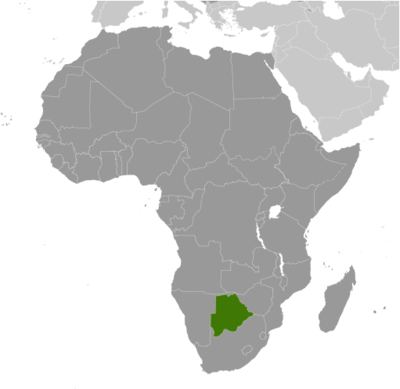
Locator 🗺️ Map
2,521,534 (2025 est.)
581,730 sq km
Southern Africa, north of South Africa
🧭 Background
In the early 1800s, multiple political entities in what is now Botswana were destabilized or destroyed by a series of conflicts and population movements in southern Africa. By the end of this period, the Tswana ethnic group, who also live across the border in South Africa, had become the most prominent group in the area. In 1852, Tswana forces halted the expansion of white Afrikaner settlers who were seeking to expand their territory northwards into what is now Botswana. In 1885, Great Britain claimed territory that roughly corresponds with modern day Botswana as a protectorate called Bechuanaland. Upon independence in 1966, the British protectorate of Bechuanaland adopted the new name of Botswana, which means "land of the Tswana." More than five decades of uninterrupted civilian leadership, progressive social policies, and significant capital investment have created an enduring democracy and upper-middle-income economy. The ruling Botswana Democratic Party has won every national election since independence; President Mokgweetsi Eric Keabetswe MASISI assumed the presidency in 2018 after the retirement of former President Ian KHAMA due to constitutional term limits. MASISI won his first election as president in 2019, and he is Botswana’s fifth president since independence. Mineral extraction, principally diamond mining, dominates economic activity, though tourism is a growing sector due to the country's conservation practices and extensive nature preserves. Botswana has one of the world's highest rates of HIV/AIDS infection but also one of Africa's most progressive and comprehensive programs for dealing with the disease.
🗺️ Geography
Southern Africa, north of South Africa
22 00 S, 24 00 E
Africa
581,730 sq km
566,730 sq km
15,000 sq km
Slightly smaller than Texas; almost four times the size of Illinois
4,347.15 km
Namibia 1,544 km; South Africa 1,969 km; Zambia 0.15 km; Zimbabwe 834 km
0 km (landlocked)
None (landlocked)
Semiarid; warm winters and hot summers
Predominantly flat to gently rolling tableland; Kalahari Desert in southwest
Manyelanong Hill 1,495 m
Junction of the Limpopo and Shashe Rivers 513 m
1,013 m
Diamonds, copper, nickel, salt, soda ash, potash, coal, iron ore, silver
45.6% (2023 est.)
Arable land: 0.5% (2023 est.)
Permanent crops: 0% (2023 est.)
Permanent pasture: 45.2% (2023 est.)
27.8% (2023 est.)
26.6% (2023 est.)
25 sq km (2014)
Zambezi (shared with Zambia [s]), Angola, Namibia, Zimbabwe, and Mozambique [m]) - 2,740 km; Limpopo (shared with South Africa [s], Zimbabwe, and Mozambique [m]) - 1,800 km; Okavango river mouth (shared with Angola [s], and Namibia) - 1,600 km note: [s] after country name indicates river source; [m] after country name indicates river mouth
Orange (941,351 sq km)
Zambezi (1,332,412 sq km)
Okavango Basin (863,866 sq km)
Lower Kalahari-Stampriet Basin, Upper Kalahari-Cuvelai-Upper Zambezi Basin
The population is primarily concentrated in the east, with a focus in and around the capital of Gaborone and the eastern city of Francistown; population density remains low in other areas in the country, especially in the Kalahari Desert to the west.
Periodic droughts; seasonal August winds blow from the west, carrying sand and dust across the country, which can obscure visibility
Landlocked; sparsely populated with most settlement concentrated in the southern and eastern parts of the country; geography dominated by the Kalahari Desert, which covers about 70% of the country, although the Okavango Delta brings considerable biodiversity as one of the largest inland deltas in the World
👥 People and Society⬆️ Top
2,521,534 (2025 est.)
1,234,898
1,286,636
Motswana (singular), Batswana (plural)
Motswana (singular), Batswana (plural)
Tswana (or Setswana) 79%, Kalanga 11%, Basarwa 3%, other, including Kgalagadi and people of European ancestry 7%
Setswana 77.3%, Sekalanga 7.4%, Shekgalagadi 3.4%, English (official) 2.8%, Zezuru/Shona 2%, Sesarwa 1.7%, Sembukushu 1.6%, Ndebele 1%, other 2.8% (2011 est.)
Christian 79.1%, Badimo 4.1%, other 1.4% (includes Baha'i, Hindu, Muslim, Rastafarian), none 15.2%, unspecified 0.3% (2011 est.)
28.7% (male 355,583/female 348,863)
65.2% (male 759,210/female 837,752)
6.1% (2024 est.) (male 59,513/female 89,747)
60.9 (2025 est.)
52.1 (2025 est.)
8.8 (2025 est.)
11.4 (2025 est.)
25.8 years (2025 est.)
26 years
28.3 years
1.32% (2025 est.)
21.16 births/1,000 population (2025 est.)
6.8 deaths/1,000 population (2025 est.)
-1.14 migrant(s)/1,000 population (2025 est.)
The population is primarily concentrated in the east, with a focus in and around the capital of Gaborone and the eastern city of Francistown; population density remains low in other areas in the country, especially in the Kalahari Desert to the west.
72.9% of total population (2023)
2.47% annual rate of change (2020-25 est.)
269,000 GABORONE (capital) (2018)
1.03 male(s)/female
1.02 male(s)/female
0.91 male(s)/female
0.66 male(s)/female
0.92 male(s)/female (2024 est.)
155 deaths/100,000 live births (2023 est.)
27.8 deaths/1,000 live births (2025 est.)
25.9 deaths/1,000 live births
21.4 deaths/1,000 live births
66.4 years (2024 est.)
64.4 years
68.6 years
2.73 children born/woman (2025 est.)
1.34 (2025 est.)
Urban: 97.5% of population (2022 est.)
Rural: 79.6% of population (2022 est.)
Total: 92.6% of population (2022 est.)
Urban: 2.5% of population (2022 est.)
Rural: 20.4% of population (2022 est.)
Total: 7.4% of population (2022 est.)
6.3% of GDP (2021)
14.6% of national budget (2022 est.)
0.38 physicians/1,000 population (2023)
2.2 beds/1,000 population (2021 est.)
Urban: 94.9% of population (2022 est.)
Rural: 63% of population (2022 est.)
Total: 86% of population (2022 est.)
Urban: 5.1% of population (2022 est.)
Rural: 37% of population (2022 est.)
Total: 14% of population (2022 est.)
18.9% (2016)
5.98 liters of pure alcohol (2019 est.)
2.93 liters of pure alcohol (2019 est.)
0.46 liters of pure alcohol (2019 est.)
0.96 liters of pure alcohol (2019 est.)
1.64 liters of pure alcohol (2019 est.)
17.1% (2025 est.)
29.2% (2025 est.)
5.5% (2025 est.)
41.5% (2017 est.)
8.1% of GDP (2020 est.)
21.5% national budget (2020 est.)
12 years (2021 est.)
12 years (2021 est.)
13 years (2021 est.)
🌿 Environment⬆️ Top
Overgrazing; desertification; limited freshwater resources; air pollution
Biodiversity, Climate Change, Climate Change-Kyoto Protocol, Climate Change-Paris Agreement, Desertification, Endangered Species, Hazardous Wastes, Law of the Sea, Nuclear Test Ban, Ozone Layer Protection, Wetlands
None of the selected agreements
Semiarid; warm winters and hot summers
45.6% (2023 est.)
Arable land: 0.5% (2023 est.)
Permanent crops: 0% (2023 est.)
Permanent pasture: 45.2% (2023 est.)
27.8% (2023 est.)
26.6% (2023 est.)
72.9% of total population (2023)
2.47% annual rate of change (2020-25 est.)
5.897 million metric tonnes of CO2 (2023 est.)
2.818 million metric tonnes of CO2 (2023 est.)
3.079 million metric tonnes of CO2 (2023 est.)
12.5 micrograms per cubic meter (2019 est.)
26 kt (2022-2024 est.)
144 kt (2019-2021 est.)
841.4 kt (2019-2021 est.)
1.7 kt (2019-2021 est.)
210,900 tons (2024 est.)
21% (2022 est.)
129.327 million cubic meters (2022)
24.295 million cubic meters (2022)
59.661 million cubic meters (2022)
12.24 billion cubic meters (2022 est.)
🏛️ Government⬆️ Top
Republic of Botswana
Botswana
Republic of Botswana
Botswana
Bechuanaland
The name Botswana means "Land of the Tswana," referring to the country's largest ethnic group
Parliamentary republic
Gaborone
24 38 S, 25 54 E
UTC+2 (7 hours ahead of Washington, DC, during Standard Time)
Named after GABORONE (ca. 1825-1931), a chief of the Tlokwa tribe, whose name means "it is not unbecoming"
10 districts and 6 town councils*; Central, Chobe, Francistown*, Gaborone*, Ghanzi, Jwaneng*, Kgalagadi, Kgatleng, Kweneng, Lobatse*, North East, North West, Selebi-Phikwe*, South East, Southern, Sowa Town*
Mixed legal system of civil law influenced by the Roman-Dutch model, including customary and common law
Previous 1960 (pre-independence); latest adopted March 1965, effective 30 September 1966
Proposed by the National Assembly; passage requires approval in two successive Assembly votes with at least two-thirds majority in the final vote; proposals to amend constitutional provisions on fundamental rights and freedoms, the structure and branches of government, and public services also requires approval by majority vote in a referendum and assent by the president of the republic
Accepts compulsory ICJ jurisdiction with reservations; accepts ICCt jurisdiction
No
At least one parent must be a citizen of Botswana
No
10 years
18 years of age; universal
President Duma BOKO (since 1 November 2024)
President Duma BOKO (since 1 November 2024)
Cabinet appointed by the president
President indirectly elected by the National Assembly for a 5-year term (eligible for a second term); vice president appointed by the president
31 October 2024
BOKO's UDC won 35 seats in the National Assembly, which then selected BOKO as president
October 2029
Parliament
Unicameral
National Assembly
69 (61 directly elected; 6 indirectly elected)
Plurality/majority
Full renewal
5 years
10/30/2024
Umbrella for Democratic Change (UDC) (36); Botswana Congress Party (BCP) (15); Botswana Patriotic Front (BPF) (5); Botswana Democratic Party (BDP) (4); Other (1)
9%
October 2029
Court of Appeal, High Court (each consists of a chief justice and a number of other judges as prescribed by the Parliament)
Court of Appeal and High Court chief justices appointed by the president and other judges appointed by the president upon the advice of the Judicial Service Commission; all judges appointed to serve until age 70
Industrial Court (with circuits scheduled monthly in the capital city and in 3 districts); Magistrates Courts (1 in each district); Customary Court of Appeal; Paramount Chief's Court/Urban Customary Court; Senior Chief's Representative Court; Chief's Representative’s Court; Headman's Court
Alliance of Progressives or AP Botswana Congress Party or BCP Botswana Democratic Party or BDP Botswana National Front or BNF [Duma BOKO]Botswana Patriotic Front or BPF Botswana Peoples Party or BPP Botswana Republic Party or BRP Umbrella for Democratic Change or UDC (various times the coalition has included the BPP, BCP, BNF and other parties)
Ambassador Mpho Churchill MOPHUTING (since 18 September 2024)
1531-1533 New Hampshire Avenue NW, Washington, DC 20036
[1] (202) 244-4990
[1] (202) 244-4164
Info@botswanaembassy.org http://www.botswanaembassy.org/
Ambassador Howard A. VAN VRANKEN (since 24 May 2023)
Embassy Drive, Government Enclave (off Khama Crescent), Gaborone
2170 Gaborone Place, Washington DC 20521-2170
[267] 395-3982
[267] 318-0232
ConsularGaborone@state.gov https://bw.usembassy.gov/
ACP, AfDB, AU, C, CD, FAO, G-77, IAEA, IBRD, ICAO, ICCt, ICRM, IDA, IFAD, IFC, IFRCS, ILO, IMF, Interpol, IOC, IOM, IPU, ISO, ITSO, ITU, ITUC (NGOs), MIGA, MONUSCO, NAM, OPCW, SACU, SADC, UN, UNCTAD, UNESCO, UNIDO, UNWTO, UPU, WCO, WFTU (NGOs), WHO, WIPO, WMO, WTO
30 September 1966 (from the UK)
Independence Day (Botswana Day), 30 September (1966)
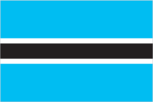
Description: light blue with a horizontal white-edged black stripe across the middle meaning: the blue symbolizes rainwater, and the black and white bands represent racial harmony
Zebra
Light blue, white, black
The two zebras, the country’s national symbol, support an elephant tusk that represents the country's fauna and a head of sorghum that signifies agriculture; the three wavy blue bands stand for the country’s reliance on water, the cog wheels for industry, and the bull’s head for the cattle industry; the coat of arms also features the national colors of light blue, white, and black; the motto reflects the scarcity of rain in the country: pula means “let there be rain” in Setswana, the national language
"Fatshe leno la rona" (Our Land)
Kgalemang Tumedisco MOTSETE
Adopted 1966
2 (1 cultural, 1 natural)
Tsodilo Hills (c); Okavango Delta (n)
💹 Economy⬆️ Top
Good economic governance and financial management; diamond-driven growth model declining; rapid poverty reductions; high unemployment, particularly among youth; COVID-19 sharply contracted the economy and recovery is slow; public sector wages have posed fiscal challenges
$45.553 billion (2024 est.)
$46.957 billion (2023 est.)
$45.498 billion (2022 est.)
-3% (2024 est.)
3.2% (2023 est.)
5.5% (2022 est.)
$18,100 (2024 est.)
$18,900 (2023 est.)
$18,600 (2022 est.)
$19.401 billion (2024 est.)
2.8% (2024 est.)
5.1% (2023 est.)
11.7% (2022 est.)
1.7% (2024 est.)
29.4% (2024 est.)
63.5% (2024 est.)
45.3% (2024 est.)
32.1% (2024 est.)
28.5% (2024 est.)
7.7% (2024 est.)
26% (2024 est.)
-40.9% (2024 est.)
Root vegetables, beef, vegetables, sorghum, maize, game meat, milk, watermelons, goat milk, sunflower seeds (2023)
Diamonds, copper, nickel, salt, soda ash, potash, coal, iron ore, silver; beef processing; textiles
-13.5% (2024 est.)
1.173 million (2024 est.)
23.2% (2024 est.)
23.4% (2023 est.)
23.7% (2022 est.)
43.9% (2024 est.)
39.8% (2024 est.)
48.6% (2024 est.)
16.1% (2015 est.)
54.9 (2015 est.)
1.4% (2015 est.)
42.9% (2015 est.)
0.4% of GDP (2023 est.)
0.3% of GDP (2022 est.)
0.3% of GDP (2021 est.)
$5.474 billion (2024 est.)
$6.296 billion (2024 est.)
19.6% of GDP (2020 est.)
19.6% (of GDP) (2022 est.)
-$116.727 million (2023 est.)
-$232.122 million (2022 est.)
-$314.583 million (2021 est.)
$6.398 billion (2023 est.)
$8.914 billion (2022 est.)
$7.861 billion (2021 est.)
UAE 27%, India 17%, Belgium 16%, South Africa 8%, USA 7% (2023)
Diamonds, copper ore, insulated wire, carbonates, cattle (2023)
$7.228 billion (2023 est.)
$8.826 billion (2022 est.)
$9.25 billion (2021 est.)
South Africa 65%, Namibia 8%, Canada 5%, China 3%, India 3% (2023)
Refined petroleum, diamonds, cars, flavored water, electricity (2023)
$3.456 billion (2024 est.)
$4.756 billion (2023 est.)
$4.279 billion (2022 est.)
$1.761 billion (2023 est.)
Pulas (BWP) per US dollar -
13.563 (2024 est.)
13.596 (2023 est.)
12.369 (2022 est.)
11.087 (2021 est.)
11.456 (2020 est.)
⚡ Energy⬆️ Top
75.9% (2022 est.)
95.5%
25%
758,000 kW (2023 est.)
3.879 billion kWh (2023 est.)
2 million kWh (2023 est.)
1.923 billion kWh (2023 est.)
625.694 million kWh (2023 est.)
99.8% of total installed capacity (2023 est.)
0.2% of total installed capacity (2023 est.)
2.242 million metric tons (2023 est.)
1.351 million metric tons (2023 est.)
891,000 metric tons (2023 est.)
300 metric tons (2023 est.)
1.66 billion metric tons (2023 est.)
22,000 bbl/day (2023 est.)
32.443 million Btu/person (2023 est.)
📡 Communications⬆️ Top
83,200 (2024 est.)
3 (2024 est.)
4.13 million (2024 est.)
164 (2024 est.)
2 TV stations, 1 state-owned and 1 privately owned; privately owned satellite TV subscription service is available; 2 state-owned national radio stations; 4 privately owned radio stations broadcast locally (2019)
.bw
81% (2023 est.)
85,000 (2023 est.)
3 (2023 est.)
🚚 Transportation⬆️ Top
A2
122 (2025)
888 km (2014)
888 km (2014) 1.067-m gauge
🛡️ Military and Security⬆️ Top
Botswana Defense Force (BDF): Ground Forces Command, Air Arm Command, Defense Logistics Command (2025)
3% of GDP (2024 est.)
2.6% of GDP (2023 est.)
2.8% of GDP (2022 est.)
3% of GDP (2021 est.)
3% of GDP (2020 est.)
Estimated 10,000 active Botswana Defense Force (2025)
The BDF has a mix of mostly older weapons and equipment, largely of Western/European origin; in recent years, it has received limited amounts of newer armaments from several European countries and the US (2025)
18-24 years of age (men and women) for general recruits and officer candidates; 18-40 for special entrant officers; no conscription (2025)
The key responsibilities of the Botswana Defense Force (BDF) are defending the country's sovereignty and territorial integrity on land and in the air, ensuring national security and stability, and aiding civil authorities in support of domestic missions such as disaster relief and anti-poaching; the BDF also participates in regional and international security operations Bechuanaland/Botswana did not have a permanent military during colonial times, with the British colonial administrators relying instead on small, lightly armed constabularies such as the Bechuanaland Mounted Police, the Bechuanaland Border Police, and by the early 1960s, the Police Mobile Unit (PMU); after independence in 1966, Botswana militarized the PMU and gave it responsibility for the country’s defense rather than create a conventional military force; however, turmoil in neighboring countries and numerous cross-border incursions by Rhodesian and South African security forces in the 1960s and 1970s demonstrated that the PMU was inadequate for defending the country and led to the establishment of the BDF in 1977 (2025)
🌐 Transnational Issues⬆️ Top
823 (2024 est.)
99 (2023 est.)
Source: Factbook JSON archive.