Yerevan
 Armenia
Key facts and a structured country profile. 🧾 Change log 📐 True Size
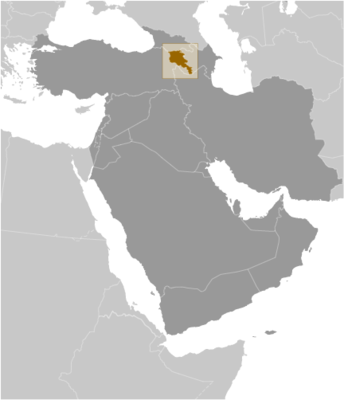
Locator 🗺️ Map
2,963,837 (2025 est.)
29,743 sq km
Southwestern Asia, between Turkey (to the west) and Azerbaijan; note - Armenia views itself as part of Europe; geopolitically, it can be classified as falling within Europe, the Middle East, or both
🧭 Background
Armenia prides itself on being the first state to formally adopt Christianity (early 4th century). Armenia has existed as a political entity for centuries, but for much of its history it was under the sway of various empires, including the Roman, Byzantine, Arab, Persian, Ottoman, and Russian. During World War I, the Ottoman Empire instituted a policy of forced resettlement that, coupled with other harsh practices targeting its Armenian subjects, resulted in at least 1 million deaths; these actions have been widely recognized as constituting genocide. During the early 19th century, significant Armenian populations fell under Russian rule. Armenia declared its independence in 1918 in the wake of the Bolshevik Revolution in Russia, but it was conquered by the Soviet Red Army in 1920. Armenia, along with Azerbaijan and Georgia, was initially incorporated into the USSR as part of the Transcaucasian Federated Soviet Socialist Republic; in 1936, the republic was separated into its three constituent entities, which were maintained until the dissolution of the Soviet Union in 1991. For over three decades, Armenia had a longstanding conflict with neighboring Azerbaijan about the status of the Nagorno-Karabakh region, which historically had a mixed Armenian and Azerbaijani population, although ethnic Armenians have constituted the majority since the late 19th century. In 1921, Moscow placed Nagorno-Karabakh within Soviet Azerbaijan as an autonomous oblast. In the late Soviet period, a separatist movement developed that sought to end Azerbaijani control over the region. Fighting over Nagorno-Karabakh began in 1988 and escalated after Armenia and Azerbaijan declared independence from the Soviet Union in 1991. By the time a cease-fire took effect in 1994, separatists with Armenian support controlled Nagorno‑Karabakh and seven surrounding Azerbaijani territories. Armenia and Azerbaijan engaged in a second military conflict over Nagorno-Karabakh in 2020; Armenia lost control over much of the territory it had previously captured, returning the southern part of Nagorno-Karabakh and the territories around it to Azerbaijan. In September 2023, Azerbaijan took military action to regain control over Nagorno-Karabakh; after an armed conflict that lasted only one day, nearly the entire ethnic Armenian population of Nagorno-Karabakh fled to Armenia. Turkey closed its border with Armenia in 1993 in support of Azerbaijan during the first period of conflict with Armenia and has since maintained a closed border, leaving Armenia with closed borders both in the west (with Turkey) and east (with Azerbaijan). Armenia and Turkey engaged in intensive diplomacy to normalize relations and open the border in 2009, but the signed agreement was not ratified in either country. In 2015, Armenia joined the Eurasian Economic Union alongside Russia, Belarus, Kazakhstan, and Kyrgyzstan. In 2017, Armenia signed a Comprehensive and Enhanced Partnership Agreement (CEPA) with the EU. In 2018, former President of Armenia (2008-18) Serzh SARGSIAN of the Republican Party of Armenia (RPA) tried to extend his time in power, prompting protests that became known as the “Velvet Revolution.” After SARGSIAN resigned, the National Assembly elected the leader of the protests, Civil Contract party chief Nikol PASHINYAN, as the new prime minister. PASHINYAN’s party has prevailed in subsequent legislative elections, most recently in 2021.
🗺️ Geography
Southwestern Asia, between Turkey (to the west) and Azerbaijan; note - Armenia views itself as part of Europe; geopolitically, it can be classified as falling within Europe, the Middle East, or both
40 00 N, 45 00 E
Asia
29,743 sq km
28,203 sq km
1,540 sq km
Slightly smaller than Maryland
1,570 km
Azerbaijan 996 km; Georgia 219 km; Iran 44 km; Turkey 311 km
0 km (landlocked)
None (landlocked)
Highland continental, hot summers, cold winters
Armenian Highland with mountains; little forest land; fast flowing rivers; good soil in Aras River valley
Aragats Lerrnagagat' 4,090 m
Debed River 400 m
1,792 m
Small deposits of gold, copper, molybdenum, zinc, bauxite
58.6% (2023 est.)
Arable land: 15.7% (2023 est.)
Permanent crops: 2.2% (2023 est.)
Permanent pasture: 41.5% (2023 est.)
11.8% (2023 est.)
13.5% (2023 est.)
1,559 sq km (2022)
Lake Sevan - 1,360 sq km
Most of the population is located in the northern half of the country; the capital of Yerevan is home to more than five times as many people as Gyumri, the second-largest city in the country
Occasionally severe earthquakes; droughts
Landlocked in the Lesser Caucasus Mountains; Sevana Lich (Lake Sevan) is the largest lake in this mountain range
👥 People and Society⬆️ Top
2,963,837 (2025 est.)
1,451,842
1,511,995
Armenian(s)
Armenian
Armenian 98.1%, Yezidi 1.1%; less than 1%: Russian, other, Assyrian, Kurd, Ukrainian, Greek (2022 est.)
Armenian 97.2%, Russian 1.4%, Ezidian 1.0%; less than 1%: other, unknown (2022)
Աշխարհի Փաստագիրք, Անփոխարինելի Աղբյւր Հիմնական Տեղեկատվւթյան. (Armenian) The World Factbook, the indispensable source for basic information.
Armenian Apostolic 95.2%, not stated 1.7%; less than 1%: Catholic, no religion, Evangelical, Shar-fadinian, other, Armenian Orthodox, Jehovah's Witness, Pagan, Molokan (2022 est.)
17.7% (male 275,589/female 250,630)
67% (male 991,490/female 1,004,101)
15.3% (2024 est.) (male 189,336/female 265,619)
50.4 (2025 est.)
26.1 (2025 est.)
24.3 (2025 est.)
4.1 (2025 est.)
39.5 years (2025 est.)
37.6 years
40.3 years
-0.45% (2025 est.)
10.24 births/1,000 population (2025 est.)
9.6 deaths/1,000 population (2025 est.)
-5.1 migrant(s)/1,000 population (2025 est.)
Most of the population is located in the northern half of the country; the capital of Yerevan is home to more than five times as many people as Gyumri, the second-largest city in the country
63.7% of total population (2023)
0.23% annual rate of change (2020-25 est.)
1.095 million YEREVAN (capital) (2023)
1.07 male(s)/female
1.1 male(s)/female
0.99 male(s)/female
0.71 male(s)/female
0.96 male(s)/female (2024 est.)
25.2 years (2019 est.)
19 deaths/100,000 live births (2023 est.)
11.3 deaths/1,000 live births (2025 est.)
13.1 deaths/1,000 live births
10 deaths/1,000 live births
76.7 years (2024 est.)
73.4 years
80.1 years
1.66 children born/woman (2025 est.)
0.8 (2025 est.)
Urban: 100% of population (2022 est.)
Rural: 100% of population (2022 est.)
Total: 100% of population (2022 est.)
Urban: 0% of population (2022 est.)
Rural: 0% of population (2022 est.)
Total: 0% of population (2022 est.)
12.3% of GDP (2021)
6.5% of national budget (2022 est.)
3.36 physicians/1,000 population (2022)
4.6 beds/1,000 population (2020 est.)
Urban: 100% of population (2022 est.)
Rural: 84.6% of population (2022 est.)
Total: 94.4% of population (2022 est.)
Urban: 0% of population (2022 est.)
Rural: 15.4% of population (2022 est.)
Total: 5.6% of population (2022 est.)
20.2% (2016)
3.77 liters of pure alcohol (2019 est.)
0.52 liters of pure alcohol (2019 est.)
0.46 liters of pure alcohol (2019 est.)
2.78 liters of pure alcohol (2019 est.)
0.01 liters of pure alcohol (2019 est.)
21.5% (2025 est.)
47.6% (2025 est.)
1.6% (2025 est.)
2.6% (2016 est.)
61.5% (2022 est.)
0% (2016)
5.3% (2016)
0.4% (2016)
2.4% of GDP (2023 est.)
8.7% national budget (2025 est.)
99.8% (2023 est.)
99.8% (2023 est.)
99.9% (2023 est.)
14 years (2023 est.)
14 years (2023 est.)
14 years (2023 est.)
🌿 Environment⬆️ Top
Soil pollution from toxic chemicals; deforestation; river pollution; threats to drinking water supplies from use of hydropower; nuclear power plant located in earthquake zone
Air Pollution, Biodiversity, Climate Change, Climate Change-Kyoto Protocol, Climate Change-Paris Agreement, Comprehensive Nuclear Test Ban, Desertification, Endangered Species, Environmental Modification, Hazardous Wastes, Law of the Sea, Nuclear Test Ban, Ozone Layer Protection, Wetlands
Air Pollution-Heavy Metals, Air Pollution-Multi-effect Protocol, Air Pollution-Persistent Organic Pollutants
Highland continental, hot summers, cold winters
58.6% (2023 est.)
Arable land: 15.7% (2023 est.)
Permanent crops: 2.2% (2023 est.)
Permanent pasture: 41.5% (2023 est.)
11.8% (2023 est.)
13.5% (2023 est.)
63.7% of total population (2023)
0.23% annual rate of change (2020-25 est.)
7.144 million metric tonnes of CO2 (2023 est.)
48,000 metric tonnes of CO2 (2023 est.)
1.934 million metric tonnes of CO2 (2023 est.)
5.162 million metric tonnes of CO2 (2023 est.)
28.4 micrograms per cubic meter (2019 est.)
492,800 tons (2024 est.)
13.5% (2022 est.)
542 million cubic meters (2022)
150 million cubic meters (2022)
2.38 billion cubic meters (2022)
7.769 billion cubic meters (2022 est.)
🏛️ Government⬆️ Top
Republic of Armenia
Armenia
Hayastani Hanrapetut'yun
Hayastan
Armenian Soviet Socialist Republic, Armenian Republic
The etymology of the country's name remains obscure; according to tradition, the local name for the country, Hayastan, comes from Hayk, the legendary patriarch of the Armenians and the great-great-grandson of Noah; the name Armenia was first recorded in a rock inscription from A.D. 521 in modern-day Iran
Parliamentary democracy; note - constitutional changes adopted in December 2015 transformed the government to a parliamentary system
Yerevan
40 10 N, 44 30 E
UTC+4 (9 hours ahead of Washington, DC, during Standard Time)
Name origin is unclear; it may derive from the name of a local ethnic group, or from the ancient fortress of Erebuni that was built on the current site of Yerevan in 782 B.C.
11 provinces (marzer, singular - marz); Aragatsotn, Ararat, Armavir, Geghark'unik', Kotayk', Lorri, Shirak, Syunik', Tavush, Vayots' Dzor, Yerevan
Civil law system
Previous 1915, 1978; latest adopted 5 July 1995
Proposed by the president of the republic or by the National Assembly; passage requires approval by the president, the National Assembly, and a referendum with at least 25% registered-voter participation and more than 50% of votes; constitutional articles on the form of government and democratic procedures are not amendable
Has not submitted an ICJ jurisdiction declaration; non-party state to the ICCt
No
At least one parent must be a citizen of Armenia
Yes
3 years
18 years of age; universal
President Vahagn KHACHATURYAN (since 13 March 2022)
Prime Minister Nikol PASHINYAN (since 10 September 2021)
Council of Ministers appointed by the prime minister
President indirectly elected by the National Assembly in 3 rounds, if needed, for a single 7-year term; prime minister indirectly elected by majority vote in two rounds, if needed, by the National Assembly
3 March 2022
2022: Vahagn KHACHATURYAN elected president in second round; note - Vahagn KHACHATURYAN (independent) ran unopposed and won the Assembly vote 71-0 2018: Armen SARKISSIAN elected president in first round; note - Armen SARKISSIAN (indpendent) ran unopposed and won the Assembly vote 90-10
2029
National Assembly (Azgayin Zhoghov)
Unicameral
107 (all directly elected)
Proportional representation
Full renewal
5 years
6/20/2021
Civil Contract Party (71); Armenia Alliance (29); I Have the Honour Alliance (7)
38.3%
June 2026
Court of Cassation or Appeals Court (consists of the Criminal Chamber with a chairman and 5 judges and the Civil and Administrative Chamber with a chairman and 10 judges – with both civil and administrative specializations); Constitutional Court (consists of 9 judges)
Court of Cassation judges nominated by the Supreme Judicial Council, a 10-member body of selected judges and legal scholars; judges appointed by the president; judges can serve until age 65; Constitutional Court judges - 4 appointed by the president, and 5 elected by the National Assembly; judges can serve until age 70
Criminal and civil appellate courts; administrative appellate court; first instance courts; specialized administrative and bankruptcy courts
Armenia Alliance or HD Armenian National Congress or ANC Bright Armenia or BA Civil Contract or KP Hanrapetutyun Party or HP Heritage I Have Honor Alliance (formerly known as the Republican Party of Armenia) PUD Orinats Yerkir or OY Prosperous Armenia or PAP
Ambassador Narek MKRTCHYAN (since 19 September 2025)
2225 R Street NW, Washington, DC 20008
[1] (202) 319-1976
[1] (202) 319-2982
Armembassyusa@mfa.am https://usa.mfa.am/en/
Glendale (CA)
Ambassador Kristina A. KVIEN (since 21 February 2023)
1 American Ave., Yerevan 0082
7020 Yerevan Place, Washington, DC 20521-7020
[374] (10) 464-700
[374] (10) 464-742
Acsyerevan@state.gov https://am.usembassy.gov/
ADB, BSEC, CD, CE, CIS, CSTO, EAEC (observer), EAEU, EAPC, EBRD, FAO, GCTU, IAEA, IBRD, ICAO, ICC, ICRM, IDA, IFAD, IFC, IFRCS, ILO, IMF, Interpol, IOC, IOM, IPU, ISO, ITSO, ITU, MIGA, NAM (observer), OAS (observer), OIF, OPCW, OSCE, PFP, UN, UNCTAD, UNESCO, UNIDO, UNIFIL, UNOOSA, UNWTO, UPU, WCO, WFTU (NGOs), WHO, WIPO, WMO, WTO
21 September 1991 (from the Soviet Union); notable earlier dates: 321 B.C. (Kingdom of Armenia established under the Orontid Dynasty), A.D. 884 (Armenian Kingdom reestablished under the Bagratid Dynasty); 1198 (Cilician Kingdom established); 28 May 1918 (Democratic Republic of Armenia declared)
Independence Day, 21 September (1991)
Description: three equal horizontal bands of red (top), blue, and orange meaning: red stands for the blood shed for liberty, blue for the Armenian skies and hope, and orange for the land and the courage of the workers who farm it
Mount Ararat, eagle, lion
Red, blue, orange
"Mer Hayrenik" (Our Fatherland)
Mikael NALBANDIAN/Barsegh KANACHYAN
Adopted 1991; based on the anthem of the Democratic Republic of Armenia (1918-1922), but with different lyrics
3 (3 cultural)
Monasteries of Haghpat and Sanahin; Monastery of Geghard and the Upper Azat Valley; Cathedral and Churches of Echmiatsin
💹 Economy⬆️ Top
Upper-middle income, fast-growing Caucasus economy; stable fiscal and monetary regime but vulnerable to geopolitical shocks; economic and energy ties to Russia but seeking more EU and US trade; key copper and gold exporter; business-friendly and anti-corruption reforms; persistent unemployment; influx of migrants from Ukraine war easing
$60.909 billion (2024 est.)
$57.516 billion (2023 est.)
$53.108 billion (2022 est.)
5.9% (2024 est.)
8.3% (2023 est.)
12.6% (2022 est.)
$20,100 (2024 est.)
$19,400 (2023 est.)
$17,900 (2022 est.)
$25.787 billion (2024 est.)
0.3% (2024 est.)
2% (2023 est.)
8.6% (2022 est.)
7.9% (2024 est.)
23.2% (2024 est.)
61.5% (2024 est.)
66.5% (2024 est.)
10.7% (2024 est.)
21.7% (2024 est.)
0.5% (2024 est.)
76.3% (2024 est.)
-75.8% (2024 est.)
Milk, potatoes, grapes, vegetables, wheat, tomatoes, watermelons, apricots, apples, barley (2023)
Brandy, mining, diamond processing, metal-cutting machine tools, forging and pressing machines, electric motors, knitted wear, hosiery, shoes, silk fabric, chemicals, trucks, instruments, microelectronics, jewelry, software, food processing
6.2% (2024 est.)
1.51 million (2024 est.)
13.4% (2024 est.)
13.3% (2023 est.)
13.4% (2022 est.)
26.2% (2024 est.)
24.8% (2024 est.)
27.9% (2024 est.)
24.8% (2022 est.)
27.2 (2023 est.)
4% (2023 est.)
22.9% (2023 est.)
4.6% of GDP (2024 est.)
6% of GDP (2023 est.)
10.4% of GDP (2022 est.)
$5.812 billion (2023 est.)
$6.27 billion (2023 est.)
48.3% of GDP (2023 est.)
22.5% (of GDP) (2023 est.)
-$997.086 million (2024 est.)
-$556.329 million (2023 est.)
$64.725 million (2022 est.)
$18.618 billion (2024 est.)
$14.338 billion (2023 est.)
$10.118 billion (2022 est.)
Russia 37%, UAE 25%, Hong Kong 7%, China 5%, Georgia 4% (2023)
Gold, diamonds, copper ore, broadcasting equipment, jewelry (2023)
$19.087 billion (2024 est.)
$14.532 billion (2023 est.)
$10.265 billion (2022 est.)
Russia 29%, China 12%, Vietnam 6%, Georgia 5%, Iran 4% (2023)
Cars, gold, diamonds, broadcasting equipment, natural gas (2023)
$3.685 billion (2024 est.)
$3.607 billion (2023 est.)
$4.112 billion (2022 est.)
$6.002 billion (2023 est.)
Drams (AMD) per US dollar -
392.73 (2024 est.)
392.476 (2023 est.)
435.666 (2022 est.)
503.77 (2021 est.)
489.009 (2020 est.)
⚡ Energy⬆️ Top
100% (2022 est.)
4.265 million kW (2023 est.)
7.012 billion kWh (2023 est.)
1.3 billion kWh (2023 est.)
194.045 million kWh (2023 est.)
530.327 million kWh (2023 est.)
43% of total installed capacity (2023 est.)
29% of total installed capacity (2023 est.)
8.9% of total installed capacity (2023 est.)
19% of total installed capacity (2023 est.)
1 (2025)
0.42GW (2025 est.)
31.1% (2023 est.)
1 (2025)
300 metric tons (2023 est.)
19,000 metric tons (2023 est.)
24 metric tons (2023 est.)
23,000 metric tons (2023 est.)
317 million metric tons (2023 est.)
15,000 bbl/day (2023 est.)
2.631 billion cubic meters (2023 est.)
2.631 billion cubic meters (2023 est.)
54.689 million Btu/person (2023 est.)
📡 Communications⬆️ Top
297,000 (2024 est.)
10 (2024 est.)
4.01 million (2024 est.)
135 (2024 est.)
Government-run Public Television network operates alongside 100 privately owned TV stations that provide local to near-nationwide coverage; three Russian TV companies are broadcast under interstate agreements; subscription cable TV services are available in most regions; several major international broadcasters are available, including CNN; Armenian TV completed conversion from analog to digital broadcasting in 2016; Public Radio of Armenia is a national, state-run broadcast network that operates alongside 18 privately owned radio stations (2024)
.am
80% (2023 est.)
546,000 (2023 est.)
19 (2023 est.)
🚚 Transportation⬆️ Top
EK
11 (2025)
1 (2025)
686 km (2017)
🛡️ Military and Security⬆️ Top
Armenian Republic Armed Forces: Armenian Army (includes land, air, air defense forces) (2025)
5.5% of GDP (2024 est.)
5.5% of GDP (2023 est.)
4.3% of GDP (2022 est.)
4.4% of GDP (2021 est.)
5% of GDP (2020 est.)
Approximately 40-50,000 active Armenian Armed Forces (2025)
The military's inventory includes mostly Russian and Soviet-era equipment; in recent years however, Armenia has looked to other countries besides Russia to provide military hardware, including France and India (2025)
18-27 for voluntary (men and women), contract (men and women) or compulsory (men) military service; contract military service is 3-12 months or up to 5 years; conscripts serve 24 months; all citizens aged 27-50 are registered in the military reserve and may be called to serve if mobilization is declared (2025)
The Armenian Armed Forces were officially established in 1992, although their origins go back to 1918; the modern military’s missions include deterrence, territorial defense, crisis management, humanitarian assistance, and disaster response, as well as socio-economic development projects; territorial defense is its primary focus, particularly in regards to tensions with neighboring Azerbaijan; Armenia and Azerbaijan engaged in open conflicts over the disputed Nagorno-Karabakh enclave in 1991-94 and 2020; Azerbaijan seized the entire enclave in 2023 Armenia has traditionally had close military ties with Russia; it has been a member of the Russian-led Collective Security Treaty Organization (CSTO) since 1994 and committed troops to CSTO's rapid reaction force until suspending its engagement in 2024; Armenia has relations with NATO going back to 1992 when Armenia joined the North Atlantic Cooperation Council; in 1994, it joined NATO’s Partnership for Peace program and has contributed to the NATO force in Kosovo, as well as the former NATO deployment in Afghanistan (2025)
🌐 Transnational Issues⬆️ Top
145,354 (2024 est.)
4 (2024 est.)
373 (2024 est.)
Source: Factbook JSON archive.