Tirana (Tirane)
 Albania
Key facts and a structured country profile. 🧾 Change log 📐 True Size
Locator 🗺️ Map
2,551,837 (2025 est.)
28,748 sq km
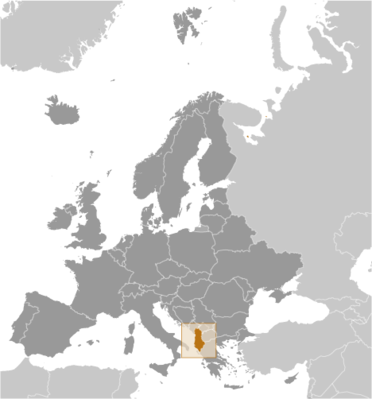
Southeastern Europe, bordering the Adriatic Sea and Ionian Sea, between Greece to the south and Montenegro and Kosovo to the north
🧭 Background
After declaring independence from the Ottoman Empire in 1912, Albania experienced a period of political upheaval that led to a short-lived monarchy, which ended in 1939 when Italy conquered the country. Germany then occupied Albania in 1943, and communist partisans took over the country in 1944. Albania allied itself first with the USSR (until 1960) and then with China (until 1978). In the early 1990s, Albania ended communist rule and established a multiparty democracy. Government-endorsed pyramid schemes in 1997 led to economic collapse and civil disorder, which only ended when UN peacekeeping troops intervened. In 1999, some 450,000 ethnic Albanians fled from Kosovo to Albania to escape the war with the Serbs. Albania joined NATO in 2009 and became an official candidate for EU membership in 2014.
🗺️ Geography
Southeastern Europe, bordering the Adriatic Sea and Ionian Sea, between Greece to the south and Montenegro and Kosovo to the north
41 00 N, 20 00 E
Europe
28,748 sq km
27,398 sq km
1,350 sq km
Slightly smaller than Maryland
691 km
Greece 212 km; Kosovo 112 km; North Macedonia 181 km; Montenegro 186 km
362 km
12 nm
200-m depth or to the depth of exploitation
Mild temperate; cool, cloudy, wet winters; hot, clear, dry summers; interior is cooler and wetter
Mostly mountains and hills; small plains along coast
Maja e Korabit (Golem Korab) 2,764 m
Adriatic Sea 0 m
708 m
Petroleum, natural gas, coal, bauxite, chromite, copper, iron ore, nickel, salt, timber, hydropower, arable land
38.1% (2023 est.)
Arable land: 21.6% (2023 est.)
Permanent crops: 3.2% (2023 est.)
Permanent pasture: 13.4% (2023 est.)
34.3% (2023 est.)
27.5% (2023 est.)
1,907 sq km (2022)
Lake Scutari (shared with Montenegro) - 400 sq km note - largest lake in the Balkans
(Black Sea) Danube (795,656 sq km)
A fairly even distribution, with somewhat higher concentrations of people in the western and central parts of the country
Destructive earthquakes; tsunamis occur along southwestern coast; floods; drought
Strategic location along Strait of Otranto (links Adriatic Sea to Ionian Sea and Mediterranean Sea)
👥 People and Society⬆️ Top
2,551,837 (2025 est.)
1,229,151
1,322,686
Albanian(s)
Albanian
Albanian 82.6%, Greek 0.9%, other 1% (including Vlach, Romani, Macedonian, Montenegrin, and Egyptian), unspecified 15.5% (2011 est.)
Albanian 98.8% (official - derived from Tosk dialect), Greek 0.5%, other 0.6% (including Macedonian, Romani, Vlach, Turkish, Italian, and Serbo-Croatian), unspecified 0.1% (2011 est.)
Libri i fakteve boterore, burimi i pazevendesueshem per informacione elementare (Albanian) The World Factbook, the indispensable source for basic information.
Muslim 56.7%, Roman Catholic 10%, Orthodox 6.8%, atheist 2.5%, Bektashi (a Sufi order) 2.1%, other 5.7%, unspecified 16.2% (2011 est.)
18% (male 292,296/female 267,052)
66.9% (male 1,023,515/female 1,055,388)
15.1% (2024 est.) (male 215,252/female 253,597)
49 (2025 est.)
24.1 (2025 est.)
24.9 (2025 est.)
4 (2025 est.)
37.9 years (2025 est.)
34.8 years
37.8 years
-1.06% (2025 est.)
8.71 births/1,000 population (2025 est.)
7.9 deaths/1,000 population (2025 est.)
-11.37 migrant(s)/1,000 population (2025 est.)
A fairly even distribution, with somewhat higher concentrations of people in the western and central parts of the country
64.6% of total population (2023)
1.29% annual rate of change (2020-25 est.)
520,000 TIRANA (capital) (2023)
1.06 male(s)/female
1.09 male(s)/female
0.97 male(s)/female
0.85 male(s)/female
0.97 male(s)/female (2024 est.)
26.6 years (2020 est.)
7 deaths/100,000 live births (2023 est.)
10.8 deaths/1,000 live births (2025 est.)
11.3 deaths/1,000 live births
9.2 deaths/1,000 live births
79.9 years (2024 est.)
77.3 years
82.8 years
1.09 children born/woman (2025 est.)
0.52 (2025 est.)
Urban: 95.7% of population (2022 est.)
Rural: 94.1% of population (2022 est.)
Total: 95.1% of population (2022 est.)
Urban: 4.3% of population (2022 est.)
Rural: 5.9% of population (2022 est.)
Total: 4.9% of population (2022 est.)
7.3% of GDP (2021)
9.2% of national budget (2022 est.)
1.88 physicians/1,000 population (2020)
2.9 beds/1,000 population (2020 est.)
Urban: 99.8% of population (2022 est.)
Rural: 100% of population (2022 est.)
Total: 99.9% of population (2022 est.)
Urban: 0.2% of population (2022 est.)
Rural: 0% of population (2022 est.)
Total: 0.1% of population (2022 est.)
21.7% (2016)
4.4 liters of pure alcohol (2019 est.)
1.75 liters of pure alcohol (2019 est.)
1.15 liters of pure alcohol (2019 est.)
1.43 liters of pure alcohol (2019 est.)
0.08 liters of pure alcohol (2019 est.)
21.4% (2025 est.)
37% (2025 est.)
6.2% (2025 est.)
1.5% (2017 est.)
65.7% (2018 est.)
1.4% (2018)
11.8% (2018)
1.2% (2018)
3.1% of GDP (2023 est.)
10.9% national budget (2023 est.)
97.7% (2023 est.)
98.2% (2023 est.)
97.2% (2023 est.)
15 years (2023 est.)
14 years (2023 est.)
15 years (2023 est.)
🌿 Environment⬆️ Top
Deforestation; soil erosion; water pollution from industrial and domestic effluents; air pollution from industrial and power plants; loss of biodiversity
Air Pollution, Air Pollution-Nitrogen Oxides, Air Pollution-Sulphur 85, Biodiversity, Climate Change, Climate Change-Kyoto Protocol, Climate Change-Paris Agreement, Comprehensive Nuclear Test Ban, Desertification, Endangered Species, Hazardous Wastes, Law of the Sea, Ozone Layer Protection, Ship Pollution, Tropical Timber 2006, Wetlands
None of the selected agreements
Mild temperate; cool, cloudy, wet winters; hot, clear, dry summers; interior is cooler and wetter
38.1% (2023 est.)
Arable land: 21.6% (2023 est.)
Permanent crops: 3.2% (2023 est.)
Permanent pasture: 13.4% (2023 est.)
34.3% (2023 est.)
27.5% (2023 est.)
64.6% of total population (2023)
1.29% annual rate of change (2020-25 est.)
3.392 million metric tonnes of CO2 (2023 est.)
566,000 metric tonnes of CO2 (2023 est.)
2.734 million metric tonnes of CO2 (2023 est.)
93,000 metric tonnes of CO2 (2023 est.)
16.6 micrograms per cubic meter (2019 est.)
1.087 million tons (2024 est.)
20.5% (2022 est.)
221 million cubic meters (2022)
11 million cubic meters (2022)
565 million cubic meters (2022)
30.2 billion cubic meters (2022 est.)
🏛️ Government⬆️ Top
Republic of Albania
Albania
Republika e Shqiperise
Shqiperia
People's Socialist Republic of Albania
Name may be derived from the pre-Celtic word alb, meaning "hill," or from the Indo-European root word albh, meaning "white;" the local name "Shqiperia" is derived from the Albanian word shqiponje ("eagle") and is popularly interpreted to mean "Land of the Eagles"
Parliamentary republic
Tirana (Tirane)
41 19 N, 19 49 E
UTC+1 (6 hours ahead of Washington, DC, during Standard Time)
+1hr, begins last Sunday in March; ends last Sunday in October
The name "Tirana" first appears in a 1418 Venetian document; the origin of the name is unclear
12 counties (qarqe, singular - qark); Berat, Diber, Durres, Elbasan, Fier, Gjirokaster, Korce, Kukes, Lezhe, Shkoder, Tirane (Tirana), Vlore
Civil law system except in the northern rural areas where customary law known as the "Code of Leke" is still present
Several previous; latest approved by the Assembly 21 October 1998, adopted by referendum 22 November 1998, promulgated 28 November 1998
Proposed by at least one-fifth of the Assembly membership; passage requires at least a two-thirds majority vote by the Assembly; referendum required only if approved by two-thirds of the Assembly; amendments approved by referendum effective upon declaration by the president of the republic
Has not submitted an ICJ jurisdiction declaration; accepts ICCt jurisdiction
No
At least one parent must be a citizen of Albania
Yes
5 years
18 years of age; universal
President Bajram BEGAJ (since 24 July 2022)
Prime Minister Edi RAMA (since 10 September 2013)
Council of Ministers proposed by the prime minister, nominated by the president, and approved by the Assembly
President indirectly elected by the Assembly for a 5-year term (eligible for a second term); a candidate needs three-fifths majority vote of the Assembly in 1 of 3 rounds or a simple majority in 2 additional rounds to become president; prime minister appointed by the president on the proposal of the majority party or coalition of parties in the Assembly
Held in 4 rounds on 16, 23, and 30 May and 4 June 2022
2022: Bajram BEGAJ elected president in the fourth round; Assembly vote - 78-4, opposition parties boycotted 2017: Ilir META elected president in the fourth round; Assembly vote - 87-2
2027
Albanian Parliament
Unicameral
Parliament (Kuvendi)
140 (all directly elected)
Proportional representation
Full renewal
4 years
5/11/2025
Socialist Party of Albania (PS) (83); Democratic Party - Alliance for a Greater Albania (PD-ASHM) (50); Other (7)
35%
May 2029
Supreme Court (consists of 19 judges, including the chief justice); Constitutional Court (consists of 9 judges, including the chairman)
Supreme Court judges appointed by the High Judicial Council with the consent of the president to serve single 9-year terms; Supreme Court chairman is elected for a single 3-year term by the court members; appointments of Constitutional Court judges are rotated among the president, Parliament, and Supreme Court from a list of pre-qualified candidates (each institution selects 3 judges), to serve single 9-year terms; candidates are pre-qualified by a randomly selected body of experienced judges and prosecutors; Constitutional Court chairman is elected by the court members for a single, renewable 3-year term
Courts of Appeal; Courts of First Instance; specialized courts: Court for Corruption and Organized Crime, Appeals Court for Corruption and Organized Crime (responsible for corruption, organized crime, and crimes of high officials)
Alliance for Change (electoral coalition led by PD) Democratic Party or PD Party for Justice, Integration and Unity or PDIU (part of the Alliance for Change) Social Democratic Party or PSD Freedom Party of Albania or PL (formerly the Socialist Movement for Integration or LSI) Socialist Party or PS
Ambassador Ervin BUSHATI (since 15 September 2023)
2100 S Street NW, Washington, DC 20008
[1] (202) 223-4942
[1] (202) 628-7342
Embassy.washington@mfa.gov.al http://www.ambasadat.gov.al/usa/en
New York
Ambassador (vacant); Chargé d’Affaires Nancy VANHORN (since August 2024)
Rruga Stavro Vinjau, No. 14, Tirana
9510 Tirana Place, Washington DC 20521-9510
[355] 4 2247-285
[355] 4 2232-222
ACSTirana@state.gov https://al.usembassy.gov/
BSEC, CD, CE, CEI, EAPC, EBRD, EITI (compliant country), FAO, IAEA, IBRD, ICAO, ICC (national committees), ICCt, ICRM, IDA, IDB, IFAD, IFC, IFRCS, ILO, IMF, IMO, Interpol, IOC, IOM, IPU, ISO (correspondent), ITU, ITUC (NGOs), MIGA, NATO, OAS (observer), OIC, OIF, OPCW, OSCE, PCA, SELEC, UN, UNCTAD, UNESCO, UNHRC, UNIDO, UNOOSA, UNWTO, UPU, WCO, WFTU (NGOs), WHO, WIPO, WMO, WTO
28 November 1912 (from the Ottoman Empire)
Independence Day, 28 November (1912), also known as Flag Day
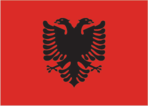
Description: red with a black two-headed eagle in the center meaning: Albanians traditionally see themselves as descendants of the eagle; they refer to themselves as "Shqiptare," which translates as "sons of the eagle" history: the design is said to originate with 15th-century Albanian hero Georgi Kastrioti SKANDERBEG, who led a successful uprising against the Ottoman Turks
Black double-headed eagle
Red, black
Adopted in 1998 and features the national symbol, the double-headed black eagle, in the national colors of red and black; red represents the courage and strength of the Albanian people, and the golden border represents the country’s wealth; the helmet above the eagle is modeled on the helmet of Skanderbeg, a 15th-century Albanian military hero who led a rebellion against the Ottoman Empire; the goat on top of the helmet represents defiance and resistance
"Hymni i Flamurit" (Hymn to the Flag)
Aleksander Stavre DRENOVA/Ciprian PORUMBESCU
Adopted 1912; only the first two stanzas of the original poem are used, with the second stanza as a chorus
4 (2 cultural, 1 natural, 1 mixed)
Butrint (c); Historic Berat and Gjirokastër (c); Primeval Beech Forests (n); Lake Ohrid Region (m)
💹 Economy⬆️ Top
Upper-middle-income Balkan economy; EU accession candidate; growth bolstered by tourism, agriculture, mining, construction, and private consumption; fiscal consolidation through revenue collection and tax compliance enhancements to address public debt; challenges include weak governance, corruption, and high emigration rates
$51.36 billion (2024 est.)
$49.403 billion (2023 est.)
$47.532 billion (2022 est.)
4% (2024 est.)
3.9% (2023 est.)
4.8% (2022 est.)
$18,900 (2024 est.)
$18,000 (2023 est.)
$17,100 (2022 est.)
$27.178 billion (2024 est.)
2.2% (2024 est.)
4.8% (2023 est.)
6.7% (2022 est.)
15.5% (2024 est.)
22.4% (2024 est.)
48.9% (2024 est.)
70.2% (2023 est.)
12% (2023 est.)
24% (2023 est.)
-1.1% (2023 est.)
38.7% (2023 est.)
-43.8% (2023 est.)
Milk, maize, tomatoes, watermelons, potatoes, wheat, grapes, onions, cucumbers/gherkins, olives (2023)
Food; footwear, apparel and clothing; lumber, oil, cement, chemicals, mining, basic metals, hydropower
-0.2% (2024 est.)
1.37 million (2024 est.)
10.3% (2024 est.)
10.2% (2023 est.)
10.2% (2022 est.)
25.1% (2024 est.)
23.9% (2024 est.)
26.9% (2024 est.)
22% (2020 est.)
29.4 (2020 est.)
3.4% (2020 est.)
22.8% (2020 est.)
8.4% of GDP (2024 est.)
8.6% of GDP (2023 est.)
9.2% of GDP (2022 est.)
$6.636 billion (2023 est.)
$6.966 billion (2023 est.)
81.9% of GDP (2021 est.)
17.8% (of GDP) (2023 est.)
-$646.107 million (2024 est.)
-$281.7 million (2023 est.)
-$1.117 billion (2022 est.)
$9.848 billion (2024 est.)
$9.099 billion (2023 est.)
$7.057 billion (2022 est.)
Italy 41%, Greece 10%, Germany 5%, Spain 5%, Serbia 4% (2023)
Garments, footwear, electricity, crude petroleum, iron alloys (2023)
$11.697 billion (2024 est.)
$10.374 billion (2023 est.)
$9.016 billion (2022 est.)
Italy 22%, China 11%, Turkey 9%, Germany 7%, Greece 6% (2023)
Cars, refined petroleum, garments, packaged medicine, iron bars (2023)
$6.516 billion (2024 est.)
$6.455 billion (2023 est.)
$5.266 billion (2022 est.)
$5.363 billion (2023 est.)
Leke (ALL) per US dollar -
93.123 (2024 est.)
100.645 (2023 est.)
113.042 (2022 est.)
103.52 (2021 est.)
108.65 (2020 est.)
⚡ Energy⬆️ Top
100% (2022 est.)
2.857 million kW (2023 est.)
7.49 billion kWh (2023 est.)
2.2 billion kWh (2023 est.)
1.922 billion kWh (2023 est.)
1.238 billion kWh (2023 est.)
3.3% of total installed capacity (2023 est.)
96.7% of total installed capacity (2023 est.)
473,000 metric tons (2023 est.)
255,000 metric tons (2023 est.)
345,000 metric tons (2023 est.)
180,000 metric tons (2023 est.)
522 million metric tons (2023 est.)
14,000 bbl/day (2023 est.)
21,000 bbl/day (2023 est.)
150 million barrels (2021 est.)
49.977 million cubic meters (2023 est.)
49.977 million cubic meters (2023 est.)
5.692 billion cubic meters (2021 est.)
27.407 million Btu/person (2023 est.)
📡 Communications⬆️ Top
165,000 (2024 est.)
6 (2024 est.)
2.49 million (2024 est.)
89 (2024 est.)
Over 65 TV stations, including several that broadcast nationally and are sometimes available to neighboring countries; many viewers have access to Italian and Greek TV via terrestrial reception; TV stations have begun a government-mandated conversion from analog to digital broadcast; cable TV service is available; 2 public radio networks and roughly 78 private radio stations; several international broadcasters are available (2024)
.al
83% (2023 est.)
632,000 (2023 est.)
22 (2023 est.)
🚚 Transportation⬆️ Top
ZA
3 (2025)
9 (2025)
424 km (2017)
69 (2023)
General cargo 46, oil tanker 1, other 22
3 (2024)
0
0
1
2
0
Durres, Shengjin, Vlores
🛡️ Military and Security⬆️ Top
Republic of Albania Armed Forces (Forcat e Armatosura të Republikës së Shqipërisë (FARSH); aka Albanian Armed Forces (AAF)): Land Forces, Naval Force (includes Coast Guard), Air Forces Ministry of Interior: Guard of the Republic, State Police (includes the Border and Migration Police) (2025)
2% of GDP (2025 est.)
1.7% of GDP (2024 est.)
1.7% of GDP (2023 est.)
1.2% of GDP (2022 est.)
1.2% of GDP (2021 est.)
Approximately 7,500 active-duty military personnel (2025)
The military is in the process of modernizing by replacing its inventory of Soviet-era weapons with NATO standard armaments; in recent years, acquisitions have included equipment from France, Israel, Italy, Turkey and the US (2025)
18-30 for voluntary military service for men and women; conscription abolished 2010 (2025)
250 Kosovo (NATO/KFOR) (2025)
The Albanian Armed Forces (AAF) are responsible for defending the country’s independence, sovereignty, and territory, assisting with internal security, providing disaster and humanitarian relief, and participating in international peacekeeping missions; the AAF is a small, lightly armed force that has been undergoing a modernization effort to improve its ability to fulfill NATO missions; the AAF has contributed small numbers of forces to several NATO missions since Albania joined NATO in 2009, including peacekeeping/stability missions in Afghanistan, Kosovo, and Iraq, and multinational battlegroups in Bulgaria and Latvia; it has also contributed to EU and UN missions (2025)
🚨 Terrorism⬆️ Top
Islamic Revolutionary Guard Corps/Qods Force; Islamic State of Iraq and ash-Sham (ISIS)
🌐 Transnational Issues⬆️ Top
9,381 (2024 est.)
2,203 (2024 est.)
Source: Factbook JSON archive.