Funafuti
 Tuvalu
Key facts and a structured country profile. 🧾 Change log 📐 True Size
Locator 🗺️ Map
11,824 (2025 est.)
26 sq km
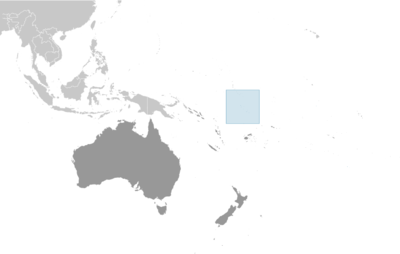
Oceania, island group consisting of nine coral atolls in the South Pacific Ocean, about half way from Hawaii to Australia
🧭 Background
Voyagers from either Samoa or Tonga first populated Tuvalu in the first millennium A.D., and the islands provided a stepping-stone for various Polynesian communities that subsequently settled in Melanesia and Micronesia. Tuvalu eventually came under Samoan and Tongan spheres of influence, although proximity to Micronesia allowed some Micronesian communities to flourish in Tuvalu, in particular on Nui Atoll. In the late 1700s and early 1800s, a series of American, British, Dutch, and Russian ships visited the islands, which were named the Ellice Islands in 1819. The UK declared a protectorate over islands in 1892 and merged them with the Micronesian Gilbert Islands. The Gilbert and Ellice Islands Protectorate became a colony in 1916. During World War II, the US set up military bases on a few islands, and in 1943, after Japan captured many of the northern Gilbert Islands, the UK transferred administration of the colony southward to Funafuti. After the war, Tarawa in the Gilbert Islands was once again made the colony’s capital, and the center of power was firmly in the Gilbert Islands, including the colony’s only secondary school. Amid growing tensions with the Gilbertese, Tuvaluans voted to secede from the colony in 1974, were granted self-rule in 1975, and gained independence in 1978 as Tuvalu. In 1979, the US relinquished its claims to the Tuvaluan islands in a treaty of friendship.
🗺️ Geography
Oceania, island group consisting of nine coral atolls in the South Pacific Ocean, about half way from Hawaii to Australia
8 00 S, 178 00 E
Oceania
26 sq km
26 sq km
0 sq km
About the size of Washington, D.C.
0 km
24 km
12 nm
24 nm
200 nm
Tropical; moderated by easterly trade winds (March to November); westerly gales and heavy rain (November to March)
Low-lying and narrow coral atolls
Unnamed location 5 m
Pacific Ocean 0 m
2 m
Fish, coconut (copra)
60% (2023 est.)
Arable land: 0% (2022 est.)
Permanent crops: 60% (2023 est.)
Permanent pasture: 0% (2022 est.)
34.3% (2023 est.)
5.7% (2023 est.)
0 sq km (2022)
Over half of the population resides on the atoll of Funafuti
Severe tropical storms are usually rare, but in 1997 there were three cyclones; low levels of islands make them sensitive to changes in sea level
One of the smallest and most remote countries on earth; six of the nine coral atolls -- Nanumea, Nui, Vaitupu, Nukufetau, Funafuti, and Nukulaelae -- have lagoons open to the ocean; Nanumaya and Niutao have landlocked lagoons; Niulakita does not have a lagoon
👥 People and Society⬆️ Top
11,824 (2025 est.)
5,865
5,959
Tuvaluan(s)
Tuvaluan
Tuvaluan 97%, Tuvaluan/I-Kiribati 1.6%, Tuvaluan/other 0.8%, other 0.6% (2017 est.)
Tuvaluan (official), English (official), Samoan, Kiribati (on the island of Nui)
Protestant 92.7% (Congregational Christian Church of Tuvalu 85.9%, Brethren 2.8%, Seventh Day Adventist 2.5%, Assemblies of God 1.5%), Baha'i 1.5%, Jehovah's Witness 1.5%, other 3.9%, none or refused 0.4% (2017 est.)
29.2% (male 1,754/female 1,672)
63.2% (male 3,736/female 3,675)
7.6% (2024 est.) (male 326/female 570)
59 (2025 est.)
46.4 (2025 est.)
12.6 (2025 est.)
7.9 (2025 est.)
28.1 years (2025 est.)
26.8 years
28.8 years
0.75% (2025 est.)
21.57 births/1,000 population (2025 est.)
7.78 deaths/1,000 population (2025 est.)
-6.26 migrant(s)/1,000 population (2025 est.)
Over half of the population resides on the atoll of Funafuti
66.2% of total population (2023)
2.08% annual rate of change (2020-25 est.)
7,000 FUNAFUTI (capital) (2018)
1.05 male(s)/female
1.05 male(s)/female
1.02 male(s)/female
0.57 male(s)/female
0.98 male(s)/female (2024 est.)
170 deaths/100,000 live births (2023 est.)
27.2 deaths/1,000 live births (2025 est.)
31.3 deaths/1,000 live births
24 deaths/1,000 live births
69 years (2024 est.)
66.5 years
71.6 years
2.76 children born/woman (2025 est.)
1.34 (2025 est.)
Urban: 99% of population (2022 est.)
Rural: 99.7% of population (2022 est.)
Total: 99.3% of population (2022 est.)
Urban: 1% of population (2022 est.)
Rural: 0.3% of population (2022 est.)
Total: 0.7% of population (2022 est.)
20% of GDP (2021)
11.2% of national budget (2022 est.)
1.35 physicians/1,000 population (2020)
Urban: 96.7% of population (2022 est.)
Rural: 93.9% of population (2022 est.)
Total: 95.8% of population (2022 est.)
Urban: 3.3% of population (2022 est.)
Rural: 6.1% of population (2022 est.)
Total: 4.2% of population (2022 est.)
51.6% (2016)
0.93 liters of pure alcohol (2019 est.)
0.01 liters of pure alcohol (2019 est.)
0.69 liters of pure alcohol (2019 est.)
0.22 liters of pure alcohol (2019 est.)
0 liters of pure alcohol (2019 est.)
32.4% (2025 est.)
46.2% (2025 est.)
18.1% (2025 est.)
2.9% (2019 est.)
64.2% (2020 est.)
0% (2020)
1.8% (2020)
1.7% (2020)
12.8% of GDP (2023 est.)
16.8% national budget (2025 est.)
100% (2022 est.)
100% (2022 est.)
100% (2022 est.)
🌿 Environment⬆️ Top
Limited freshwater resources; beach erosion; deforestation; damage to coral reefs; rising sea levels
Biodiversity, Climate Change, Climate Change-Kyoto Protocol, Climate Change-Paris Agreement, Desertification, Hazardous Wastes, Law of the Sea, Ozone Layer Protection, Ship Pollution, Whaling
Comprehensive Nuclear Test Ban
Tropical; moderated by easterly trade winds (March to November); westerly gales and heavy rain (November to March)
60% (2023 est.)
Arable land: 0% (2022 est.)
Permanent crops: 60% (2023 est.)
Permanent pasture: 0% (2022 est.)
34.3% (2023 est.)
5.7% (2023 est.)
66.2% of total population (2023)
2.08% annual rate of change (2020-25 est.)
6.8 micrograms per cubic meter (2019 est.)
4,000 tons (2024 est.)
🏛️ Government⬆️ Top
None
Tuvalu
None
Tuvalu
Ellice Islands
The name in the local language means "group of eight" or "eight standing together," referring to eight of the country's nine islands; the remaining island, Nui, was left out of the original grouping because its inhabitants spoke a different language; the former name was given in honor of Canadian shipping company owner Alexander Ellice, who owned a ship that visited the islands in 1819
Parliamentary democracy under a constitutional monarchy; a Commonwealth realm
Funafuti
8 31 S, 179 13 E
UTC+12 (17 hours ahead of Washington, DC, during Standard Time)
The town has the same name as the island it is located on; the name may either come from the Polynesian word futi (banana) or the name Futi, one of the wives of a local ruler, with the word funa added as a feminine prefix
7 island councils and 1 town council*; Funafuti*, Nanumaga, Nanumea, Niutao, Nui, Nukufetau, Nukulaelae, Vaitupu
Mixed system of English common law and local customary law
Previous 1978 (at independence); latest effective 1 October 1986
Proposed by the House of Assembly; passage requires at least two-thirds majority vote by the Assembly membership in the final reading
Has not submitted an ICJ jurisdiction declaration; non-party state to the ICCt
Yes
Yes; for a child born abroad, at least one parent must be a citizen of Tuvalu
Yes
Na
18 years of age; universal
King CHARLES III (since 8 September 2022); represented by Governor General Tofiga Vaevalu FALANI (since 29 August 2021)
Prime Minister Feleti Penitala TEO (since 27 February 2024)
Cabinet members selected by the prime minister
The monarchy is hereditary; governor general appointed by the monarch on recommendation of the prime minister and the parliament; prime minister and deputy prime minister elected by and from members of House of Assembly following parliamentary elections
2024: TEO was the only candidate nominated by the House of Assembly 2019: Kausea NATANO elected prime minister by House of Assembly; House of Assembly vote - 10 to 6
Parliament (Palamene)
Unicameral
Parliament of Tuvalu (Palamene o Tuvalu)
16 (all directly elected)
Plurality/majority
Full renewal
4 years
1/26/2024
0%
January 2028
Court of Appeal (consists of the chief justice and not less than 3 appeals judges); High Court (consists of the chief justice); appeals beyond the Court of Appeal are heard by the Judicial Committee of the Privy Council (in London)
Court of Appeal judges appointed by the governor general on the advice of the Cabinet; judge tenure based on terms of appointment; High Court chief justice appointed by the governor general on the advice of the Cabinet; chief justice serves for life; other judges appointed by the governor general on the advice of the Cabinet after consultation with chief justice; judge tenure set by terms of appointment
Magistrates' courts; island courts; land courts
Note: no political parties, but members of parliament usually align in informal groupings
Ambassador Tapugao FALEFOU (since 19 April 2023); note - also Permanent Representative to UN
685 Third Avenue, Suite 1104, New York, NY 10017
[1] (212) 490-0534
[1] (212) 808-4975
Tuvalumission.un@gmail.com tuvalu.unmission@gov.tv https://www.un.int/tuvalu/about
The US does not have an embassy in Tuvalu; the US Ambassador to Fiji is accredited to Tuvalu
ACP, ADB, AOSIS, C, FAO, IBRD, IDA, IFAD, IFRCS (observer), ILO, IMF, IMO, IOC, ITU, OPCW, PIF, Sparteca, SPC, UN, UNCTAD, UNESCO, UNIDO, UPU, WHO, WIPO, WMO
1 October 1978 (from the UK)
Independence Day, 1 October (1978)
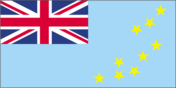
Description: light blue with the UK flag in the upper-left quadrant; the right half of the flag has nine five-pointed yellow stars meaning: the stars represent a map of the country, with each symbolizing an atoll in the ocean
Maneapa (native meeting house)
Light blue, yellow
"God Save the King"
Unknown
Used since 1745
💹 Economy⬆️ Top
Upper middle-income Pacific island economy; extremely environmentally fragile; currency pegged to Australian dollar; large international aid recipient; subsistence agrarian sector; Te Kakeega sustainable development; domain name licensing incomes
$57.055 million (2023 est.)
$54.938 million (2022 est.)
$54.568 million (2021 est.)
3.9% (2023 est.)
0.7% (2022 est.)
1.8% (2021 est.)
$5,800 (2023 est.)
$5,500 (2022 est.)
$5,400 (2021 est.)
$62.28 million (2023 est.)
11.5% (2022 est.)
6.2% (2021 est.)
1.9% (2020 est.)
15.9% (2015 est.)
7% (2015 est.)
70% (2012 est.)
Coconuts, vegetables, tropical fruits, bananas, root vegetables, pork, chicken, eggs, pork fat, pork offal (2023)
Fishing
4.2% of GDP (2023 est.)
4.2% of GDP (2022 est.)
4.9% of GDP (2021 est.)
$87 million (2019 est.)
$88 million (2019 est.)
47.2% of GDP (2016 est.)
$2.713 million (2022 est.)
$14.533 million (2021 est.)
$8.46 million (2020 est.)
$2.232 million (2022 est.)
$2.745 million (2021 est.)
$3.089 million (2020 est.)
Thailand 88%, Japan 6%, Philippines 3%, Ireland 1%, USA 1% (2023)
Fish (2023)
$57.388 million (2022 est.)
$63.962 million (2021 est.)
$56.947 million (2020 est.)
China 42%, Fiji 24%, Japan 11%, Australia 11%, NZ 4% (2023)
Ships, refined petroleum, iron structures, fish, hand tools (2023)
Tuvaluan dollars or Australian dollars (AUD) per US dollar -
1.515 (2024 est.)
1.505 (2023 est.)
1.442 (2022 est.)
1.331 (2021 est.)
1.453 (2020 est.)
⚡ Energy⬆️ Top
100% (2022 est.)
100%
99.1%
📡 Communications⬆️ Top
2,000 (2021 est.)
21 (2022 est.)
9,880 (2022 est.)
99 (2022 est.)
No TV stations; many households use satellite dishes to watch foreign TV; 1 state-owned radio station, Radio Tuvalu, includes relays from international broadcasters (2019)
.tv
74% (2023 est.)
0 (2022 est.)
5 (2022 est.)
🚚 Transportation⬆️ Top
T2
1 (2025)
270 (2023)
Bulk carrier 21, container ship 3, general cargo 29, oil tanker 19, other 198
1 (2024)
0
0
0
1
1
Funafuti Atoll
🛡️ Military and Security⬆️ Top
No regular military forces; Tuvalu Police Force
As part of the Falepili Union treaty between Australia and Tuvalu, which entered into force in August 2024, Australia committed to assist Tuvalu in response to a major natural disaster, health pandemic, or military aggression; Tuvalu pledged to mutually agree with Australia any partnership, arrangement, or engagement with any other State or entity on security and defense-related matters in Tuvalu Tuvalu has a "shiprider" agreement with the US, which allows local maritime law enforcement officers to embark on US Coast Guard (USCG) and US Navy (USN) vessels, including to board and search vessels suspected of violating laws or regulations within Tuvalu's designated exclusive economic zone (EEZ) or on the high seas; "shiprider" agreements also enable USCG personnel and USN vessels with embarked USCG law enforcement personnel to work with host nations to protect critical regional resources (2025)
Source: Factbook JSON archive.