No permanent inhabitants
 Spratly Islands
Key facts and a structured country profile. 🧾 Change log 📐 True Size
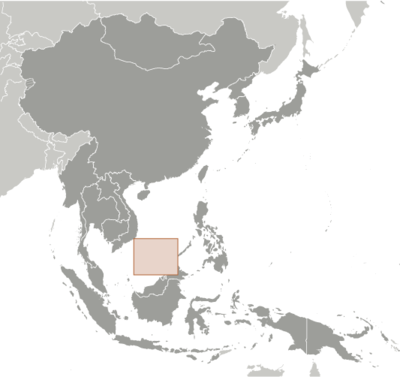
Locator 🗺️ Map
5 sq km less than
Southeastern Asia, group of reefs and islands in the South China Sea, about two-thirds of the way from southern Vietnam to the southern Philippines
🧭 Background
The Spratly Islands consist of more than 100 small islands or reefs surrounded by rich fishing grounds -- and potentially by gas and oil deposits. China, Taiwan, and Vietnam all claim the islands in their entirety, while portions are claimed by Malaysia and the Philippines. Around 70 disputed islets and reefs in the Spratly Islands are occupied by China, Malaysia, the Philippines, Taiwan, and Vietnam. Since 1985, Brunei has claimed a continental shelf that overlaps a southern reef but has not made any formal claim to the reef. Brunei claims an exclusive economic zone over this area.
🗺️ Geography
Southeastern Asia, group of reefs and islands in the South China Sea, about two-thirds of the way from southern Vietnam to the southern Philippines
8 38 N, 111 55 E
Southeast Asia
5 sq km less than
5 sq km less than
0 sq km
Land area is about seven times the size of the National Mall in Washington, D.C.
0 km
926 km
Tropical
Small, flat islands, islets, cays, and reefs
Unnamed location on Southwest Cay 6 m
South China Sea 0 m
Fish, guano, undetermined oil and natural gas potential
100% (2018 est.)
Typhoons; numerous reefs and shoals pose a serious maritime hazard
Strategically located near several primary shipping lanes in the central South China Sea; includes numerous small islands, atolls, shoals, and coral reefs
👥 People and Society⬆️ Top
No permanent inhabitants
🌿 Environment⬆️ Top
Harm to reefs from China's use of dredged sand and coral to build artificial islands; illegal fishing practices
Tropical
100% (2018 est.)
🏛️ Government⬆️ Top
None
Spratly Islands
Named after British whaling captain Richard SPRATLY, who sighted the islands in 1843
🛡️ Military and Security⬆️ Top
Around 70 disputed islets and reefs in the Spratly Islands are occupied by China, Malaysia, the Philippines, Taiwan, and Vietnam China: occupies seven outposts (Fiery Cross, Mischief, Subi, Cuarteron, Gavin, Hughes, and Johnson reefs); the outposts on Fiery Cross, Mischief, and Subi include air bases with helipads and aircraft hangers, naval port facilities, surveillance radars, air defense and anti-ship missile sites, and other military infrastructure such as communications, barracks, maintenance facilities, and ammunition and fuel bunkers Malaysia: occupies five outposts in the southern portion of the archipelago, closest to the Malaysian state of Sabah (Ardasier Reef, Eric Reef, Mariveles Reef, Shallow Reef, and Investigator Shoal); all the outposts have helicopter landing pads, while Shallow Reef also has an airstrip Philippines: occupies nine features (Commodore Reef, Second Thomas Shoal, Flat Island, Loaita Cay, Loaita Island, Nanshan Island, Northeast Cay, Thitu Island, and West York Island); Thitu Island has an airstrip and a coast guard station Taiwan: maintains a coast guard outpost with an airstrip on Itu Aba Island Vietnam: occupies about 50 outposts, plus some 14 platforms known as “economic, scientific, and technological service stations” (Dịch vụ-Khoa) that sit on underwater banks to the southeast that Vietnam does not consider part of the disputed island chain, although China and Taiwan disagree; Spratly Islands outposts are on Alison Reef, Amboyna Cay, Barque Canada Reef, Central Reef, Collins Reef, Cornwallis South Reef, Discovery Great Reef, East Reef, Grierson Reef, Ladd Reef, Landsdowne Reef, Namyit Island, Pearson Reef, Petley Reef, Sand Cay, Sin Cowe Island, South Reef, Southwest Cay, Spratly Island, Tennent Reef, West Reef; the underwater banks with stations include Vanguard, Rifleman, Prince of Wales, Prince Consort, Grainger, and Alexandra; in recent years, Vietnam has continued to make improvements to its outposts, including defensive positions and infrastructure (2025)
Source: Factbook JSON archive.