Juba
 South Sudan
Key facts and a structured country profile. 🧾 Change log 📐 True Size
Locator 🗺️ Map
12,703,714 (2024 est.)
644,329 sq km
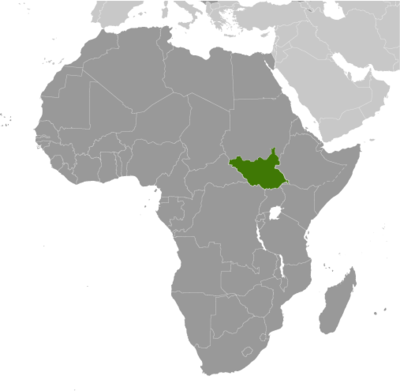
East-Central Africa; south of Sudan, north of Uganda and Kenya, west of Ethiopia
🧭 Background
South Sudan, which gained independence from Sudan in 2011, is the world’s newest country. Home to a diverse array of mainly Nilotic ethnolinguistic groups that settled in the territory in the 15th through 19th centuries, South Sudanese society is heavily dependent on seasonal migration and seasonal fluctuations in precipitation. Modern-day South Sudan was conquered first by Egypt and later ruled jointly by Egyptian-British colonial administrators in the late 19th century. Christian missionaries helped spread the English language and Christianity in the area, leading to significant cultural differences with the northern part of Sudan, where Arabic and Islam are dominant. When Sudan gained its independence in 1956, the southern region received assurances that it would participate fully in the political system. However, the Arab government in Khartoum reneged on its promises, prompting two periods of civil war (1955-1972 and 1983-2005) in which as many as 2.5 million people died -- mostly civilians -- due largely to starvation and drought. The second Sudanese civil war was one of the deadliest since WWII and left southern Sudanese society devastated. Peace talks resulted in a US-backed Comprehensive Peace Agreement in 2005, which granted the South six years of autonomy followed by a referendum on final status. The result of this referendum, held in 2011, was a vote of 98% in favor of secession. Since independence, South Sudan has struggled to form a viable governing system and has been plagued by widespread corruption, political conflict, and communal violence. In 2013, conflict erupted between forces loyal to President Salva KIIR, a Dinka, and forces loyal to Vice President Riek MACHAR, a Nuer. The conflict quickly spread through the country along ethnic lines, killing tens of thousands and creating a humanitarian crisis with millions of South Sudanese displaced. KIIR and MACHAR signed a peace agreement in 2015 that created a Transitional Government of National Unity the next year. However, renewed fighting broke out in Juba between KIIR and MACHAR’s forces, plunging the country back into conflict and drawing in additional armed opposition groups. A "revitalized" peace agreement was signed in 2018, mostly ending the fighting and laying the groundwork for a unified national army, a transitional government, and elections. The transitional government was formed in 2020, when MACHAR returned to Juba as first vice president. Since 2020, implementation of the peace agreement has been stalled amid wrangling over power-sharing, which has contributed to an uptick in communal violence and the country’s worst food crisis since independence, with 7 of 11 million South Sudanese citizens in need of humanitarian assistance. The transitional period was extended an additional two years in 2022, pushing elections to late 2024.
🗺️ Geography
East-Central Africa; south of Sudan, north of Uganda and Kenya, west of Ethiopia
8 00 N, 30 00 E
Africa
644,329 sq km
NA
NA
More than four times the size of Georgia; slightly smaller than Texas
6,018 km
Central African Republic 1,055 km; Democratic Republic of the Congo 714 km; Ethiopia 1,299 km; Kenya 317 km; Sudan 2,158 km; Uganda 475 km
0 km (landlocked)
None (landlocked)
Hot with seasonal rainfall influenced by the annual shift of the Inter-Tropical Convergence Zone; rainfall heaviest in upland areas of the south and diminishes to the north
Plains in the north and center rise to southern highlands along the border with Uganda and Kenya; the White Nile, flowing north out of the uplands of Central Africa, is the major geographic feature of the country; The Sudd (a name derived from floating vegetation that hinders navigation) is a large swampy area of more than 100,000 sq km fed by the waters of the White Nile that dominates the center of the country
Kinyeti 3,187 m
White Nile 381 m
Hydropower, fertile agricultural land, gold, diamonds, petroleum, hardwoods, limestone, iron ore, copper, chromium ore, zinc, tungsten, mica, silver
44.9% (2023 est.)
Arable land: 3.9% (2023 est.)
Permanent crops: 0.1% (2023 est.)
Permanent pasture: 40.8% (2023 est.)
11.3% (2023 est.)
43.8% (2023 est.)
1,000 sq km (2012)
Nile (shared with Rwanda [s], Tanzania, Uganda, Sudan, and Egypt [m]) - 6,650 km note: [s] after country name indicates river source; [m] after country name indicates river mouth
Congo (3,730,881 sq km), (Mediterranean Sea) Nile (3,254,853 sq km)
Clusters found in urban areas, particularly in the western interior and around the White Nile, as shown in this population distribution map
Landlocked; The Sudd is a vast swamp in the north central region of South Sudan, formed by the White Nile; its size is variable but can reach some 15% of the country's total area during the rainy season; it is one of the world's largest wetlands
👥 People and Society⬆️ Top
12,703,714 (2024 est.)
6,476,341
6,227,373
South Sudanese (singular and plural)
South Sudanese
Dinka (Jieng) approximately 35-40%, Nuer (Naath) approximately 15%, Shilluk (Chollo), Azande, Bari, Kakwa, Kuku, Murle, Mandari, Didinga, Ndogo, Bviri, Lndi, Anuak, Bongo, Lango, Dungotona, Acholi, Baka, Fertit (2011 est.)
English (official), Arabic (includes Juba and Sudanese variants), ethnic languages include Dinka, Nuer, Bari, Zande, Shilluk
The World Factbook, the indispensable source for basic information. (English) كتاب حقائق العالم، المصدر الذي لا يمكن الاستغناء عنه للمعلومات الأساسية (Arabic)
Christian 60.5%, folk religion 32.9%, Muslim 6.2%, other <1%, unaffiliated <1% (2020 est.)
42.1% (male 2,725,520/female 2,619,035)
55.3% (male 3,568,064/female 3,458,804)
2.6% (2024 est.) (male 182,757/female 149,534)
80.8 (2024 est.)
76.1 (2024 est.)
4.7 (2024 est.)
21.1 (2024 est.)
18.7 years (2025 est.)
18.7 years
18.7 years
4.52% (2025 est.)
35.68 births/1,000 population (2025 est.)
8.65 deaths/1,000 population (2025 est.)
18.2 migrant(s)/1,000 population (2025 est.)
Clusters found in urban areas, particularly in the western interior and around the White Nile, as shown in this population distribution map
21.2% of total population (2023)
4.12% annual rate of change (2020-25 est.)
459,000 JUBA (capital) (2023)
1.05 male(s)/female
1.04 male(s)/female
1.03 male(s)/female
1.22 male(s)/female
1.04 male(s)/female (2024 est.)
692 deaths/100,000 live births (2023 est.)
58.6 deaths/1,000 live births (2025 est.)
65.8 deaths/1,000 live births
54.1 deaths/1,000 live births
60.3 years (2024 est.)
58.4 years
62.2 years
4.98 children born/woman (2025 est.)
2.43 (2025 est.)
Urban: 70% of population (2022 est.)
Rural: 33.6% of population (2022 est.)
Total: 41.2% of population (2022 est.)
Urban: 30% of population (2022 est.)
Rural: 66.4% of population (2022 est.)
Total: 58.8% of population (2022 est.)
5.9% of GDP (2021)
2.1% of national budget (2022 est.)
0.04 physicians/1,000 population (2022)
Urban: 60.6% of population (2022 est.)
Rural: 15.5% of population (2022 est.)
Total: 24.9% of population (2022 est.)
Urban: 39.4% of population (2022 est.)
Rural: 84.5% of population (2022 est.)
Total: 75.1% of population (2022 est.)
6.6% (2014)
1.6% of GDP (2016 est.)
3.3% national budget (2015 est.)
🌿 Environment⬆️ Top
Water pollution; inadequate supplies of potable water; wildlife conservation and loss of biodiversity; deforestation; soil erosion; desertification; drought
Biodiversity, Climate Change, Climate Change-Paris Agreement, Desertification, Ozone Layer Protection, Wetlands
None of the selected agreements
Hot with seasonal rainfall influenced by the annual shift of the Inter-Tropical Convergence Zone; rainfall heaviest in upland areas of the south and diminishes to the north
44.9% (2023 est.)
Arable land: 3.9% (2023 est.)
Permanent crops: 0.1% (2023 est.)
Permanent pasture: 40.8% (2023 est.)
11.3% (2023 est.)
43.8% (2023 est.)
21.2% of total population (2023)
4.12% annual rate of change (2020-25 est.)
1.725 million metric tonnes of CO2 (2023 est.)
1.725 million metric tonnes of CO2 (2023 est.)
20.6 micrograms per cubic meter (2019 est.)
59.4 kt (2022-2024 est.)
696 kt (2019-2021 est.)
120.2 kt (2019-2021 est.)
12.7 kt (2019-2021 est.)
2.681 million tons (2024 est.)
193 million cubic meters (2022 est.)
225 million cubic meters (2022 est.)
240 million cubic meters (2022 est.)
49.5 billion cubic meters (2022 est.)
🏛️ Government⬆️ Top
Republic of South Sudan
South Sudan
Self-descriptive name from the country's geographic position within Sudan prior to independence; the name Sudan derives from the Arabic balad-as-sudan, meaning "Land of the Black [peoples]"
Presidential republic
Juba
04 51 N, 31 37 E
UTC+2 (8 hours ahead of Washington, DC, during Standard Time)
The name comes from the name of a small Bari village that was located near the present-day city
10 states; Central Equatoria, Eastern Equatoria, Jonglei, Lakes, Northern Bahr el Ghazal, Unity, Upper Nile, Warrap, Western Bahr el Ghazal, Western Equatoria
Previous 2005 (pre-independence); latest signed 7 July 2011, effective 9 July 2011 (Transitional Constitution of the Republic of South Sudan, 2011)
Proposed by the National Legislature or by the president of the republic; passage requires submission of the proposal to the Legislature at least one month prior to consideration, approval by at least two-thirds majority vote in both houses of the Legislature, and assent of the president
No
At least one parent must be a citizen of South Sudan
Yes
10 years
18 years of age; universal
President Salva KIIR Mayardit (since 9 July 2011)
President Salva KIIR Mayardit (since 9 July 2011)
National Council of Ministers appointed by the president, approved by the Transitional National Legislative Assembly
President directly elected by simple-majority popular vote for a 4-year term (eligible for a second term)
11-15 April 2010
2010: Salva KIIR Mayardit elected leader of then-Southern Sudan; percent of vote - Salva KIIR Mayardit (SPLM) 93%, Lam AKOL (SPLM-DC) 7%
Scheduled for 2015 but has been postponed multiple times, currently to be held in December 2026
Législature nationale (National Legislature)
Bicameral
Transitional National Legislative Assembly (Al-Majlis Al-Tachirii)
550 (all appointed)
Full renewal
5/10/2021
32.4%
December 2026
Council of States (Al-Watani)
100 (all appointed)
Full renewal
8/2/2021
32.1%
December 2026
Supreme Court of South Sudan (consists of a chief justice, deputy chief justice, and 5 additional justices); the 2011 Transitional Constitution of South Sudan calls for 9, rather than 5 additional justices
The 2011 Transitional Constitution of South Sudan calls for the establishment of a Judicial Service Council to recommend prospective justices to the president, and for the justices' tenures to be set by the National Legislature
National level - Courts of Appeal; High Courts; County Courts; state level - High Courts; County Courts; customary courts; other specialized courts and tribunals
Democratic Change or DC Democratic Forum or DF Labour Party or LPSS South Sudan Opposition Alliance or SSOA Sudan African National Union or SANU Sudan People's Liberation Movement or SPLM Sudan People’s Liberation Movement-In Opposition or SPLM-IO United Democratic Salvation Front or UDSF United South Sudan African Party or USSAP United South Sudan Party or USSP
Ambassador Santino Fardol Watod DICKEN (since 18 September 2024)
1015 31st Street NW, Suite 300, Washington, DC 20007
[1] (202) 600-2238
[1] (202) 644-9910
Info.ssdembassy@gmail.com https://www.ssembassydc.org/
Ambassador Michael J. ADLER (since 24 August 2022)
Kololo Road adjacent to the EU's compound, Juba
4420 Juba Place, Washington DC 20521-4420
[211] 912-105-188
ACSJuba@state.gov https://ss.usembassy.gov/
AU, EAC, FAO, G-77, IBRD, ICAO, IDA, IFAD, IFC, IFRCS, IGAD, ILO, IMF, Interpol, IOM, IPU, ITU, MIGA, UN, UNCTAD, UNESCO, UPU, WCO, WHO, WMO
9 July 2011 (from Sudan)
Independence Day, 9 July (2011)
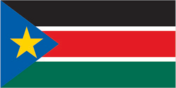
Description: three equal horizontal bands of black (top), red, and green; the red band is edged in white; a five-pointed gold star is in the middle of a blue isosceles triangle based on the left side meaning: black stands for the people, red for the blood shed in the struggle for freedom, green for the land, and blue for the Nile; the gold star represents the unity of the country's states
African fish eagle
Red, green, blue, yellow, black, white
"South Sudan Oyee!" (South Sudan, Hooray!)
Collective/Mido SAMUEL and Juba University students
Adopted 2011; anthem selected in a national contest
💹 Economy⬆️ Top
Low-income, oil-based Sahelian economy; extreme poverty and food insecurity; COVID-19 and ongoing violence threaten socioeconomic potential; environmentally fragile; ongoing land and property rights issues; natural resource rich but lacks infrastructure
$6.752 billion (2023 est.)
$6.585 billion (2022 est.)
$6.945 billion (2021 est.)
-5.2% (2017 est.)
-13.9% (2016 est.)
-10.8% (2015 est.)
$400 (2023 est.)
$400 (2022 est.)
$400 (2021 est.)
$4.629 billion (2023 est.)
91.4% (2024 est.)
2.4% (2023 est.)
-6.7% (2022 est.)
10.4% (2015 est.)
33.1% (2015 est.)
56.6% (2015 est.)
Milk, cassava, sorghum, goat milk, vegetables, fruits, groundnuts, sesame seeds, beef, maize (2023)
-36.8% (2015 est.)
5.091 million (2023 est.)
12.5% (2023 est.)
12.6% (2022 est.)
14.1% (2021 est.)
18.5% (2023 est.)
19.4% (2023 est.)
17.6% (2023 est.)
82.3% (2016 est.)
44 (2016 est.)
1.8% (2016 est.)
33% (2016 est.)
9.5% of GDP (2015 est.)
0% of GDP (2014 est.)
0% of GDP (2013 est.)
$2.513 billion (2023 est.)
$1.984 billion (2023 est.)
86.6% of GDP (2016 est.)
$577.9 million (2023 est.)
-$596.748 million (2022 est.)
-$6.55 million (2021 est.)
$4.499 billion (2023 est.)
$5.811 billion (2022 est.)
$4.652 billion (2021 est.)
China 51%, Singapore 29%, UAE 10%, Germany 4%, Uganda 3% (2023)
Crude petroleum, refined petroleum, forage crops, gold, scrap iron (2023)
$4.443 billion (2023 est.)
$6.402 billion (2022 est.)
$4.037 billion (2021 est.)
Uganda 33%, UAE 26%, Kenya 14%, China 10%, USA 3% (2023)
Garments, cement, other foods, iron bars, cereal flours (2023)
$72.881 million (2023 est.)
$94.914 million (2022 est.)
$341.932 million (2021 est.)
South Sudanese pounds (SSP) per US dollar -
2,163.104 (2024 est.)
930.331 (2023 est.)
534.511 (2022 est.)
306.355 (2021 est.)
165.907 (2020 est.)
⚡ Energy⬆️ Top
8.4% (2022 est.)
15%
1.7%
136,000 kW (2023 est.)
566.034 million kWh (2023 est.)
23.966 million kWh (2023 est.)
93.2% of total installed capacity (2023 est.)
6.8% of total installed capacity (2023 est.)
100 metric tons (2022 est.)
146,000 bbl/day (2023 est.)
11,000 bbl/day (2023 est.)
3.75 billion barrels (2021 est.)
2.092 million Btu/person (2023 est.)
📡 Communications⬆️ Top
0 (2023 est.)
(2023 est.) less than 1
6.17 million (2023 est.)
30 (2022 est.)
1 state-controlled TV channel and radio station; several community and commercial FM stations, mostly sponsored by outside aid donors; some foreign radio broadcasts available (2019)
.ss
9% (2022 est.)
0 (2023 est.)
(2023 est.) less than 1
🚚 Transportation⬆️ Top
Z8
89 (2025)
2 (2025)
248 km (2018)
🛡️ Military and Security⬆️ Top
South Sudan People’s Defense Force (SSPDF): Land Forces (includes Presidential Guard), Air Forces, Marine (Riverine) Forces, Reserve Forces; National (or Necessary) Unified Forces (NUF) Ministry of Interior: South Sudan National Police Service (SSNPS) (2025)
2% of GDP (2024 est.)
2% of GDP (2023 est.)
2% of GDP (2022 est.)
2% of GDP (2021 est.)
2% of GDP (2020 est.)
Information varies; estimated 150-200,000 active Defense Forces (2025)
The SSPDF inventory is a mix of primarily of Soviet-era armaments alongside limited quantities of more modern equipment such as armored personnel carriers from UAE (2025)
18 (legal minimum age)-35 for voluntary military service for men and women; 12-24 months service (2025)
The South Sudan People's Defense Forces (SSPDF) are largely focused on border and internal security; areas of concern include disputed national borders, conflict spillover from neighboring Sudan, banditry, and armed rebel groups and militias that continue to operate in the country since the civil war ended in 2020 the SSPDF, formerly the Sudan People’s Liberation Army (SPLA), was founded as a guerrilla movement against the Sudanese Government in 1983 and participated in the Second Sudanese Civil War (1983-2005); the Juba Declaration that followed the Comprehensive Peace Agreement of 2005 unified the SPLA and the South Sudan Defense Forces (SSDF), the second-largest rebel militia remaining from the civil war, under the SPLA name; in 2017, the SPLA was renamed the South Sudan Defense Forces (SSDF) and in September 2018 was renamed again as the SSPDF the UN Mission in South Sudan (UNMISS) has operated in the country since 2011 with the objectives of consolidating peace and security and helping establish conditions for the successful economic and political development of South Sudan; UNMISS has about 18,000 personnel assigned; the UN Interim Security Force for Abyei (UNISFA) has operated in the disputed Abyei region along the border between Sudan and South Sudan since 2011; its mission includes ensuring security, protecting civilians, strengthening the capacity of the Abyei Police Service, de-mining, monitoring/verifying the redeployment of armed forces from the area, and facilitating the flow of humanitarian aid; UNISFA has approximately 3,800 personnel assigned (2025)
🌐 Transnational Issues⬆️ Top
517,471 (2024 est.)
1,359,795 (2024 est.)
18,000 (2024 est.)
Tier 3 — South Sudan does not fully meet the minimum standards for the elimination of trafficking and is not making significant efforts to do so, therefore, South Sudan remained on Tier 3; for more details, go to: https://www.state.gov/reports/2025-trafficking-in-persons-report/south-sudan/
Source: Factbook JSON archive.