Bratislava
 Slovakia
Key facts and a structured country profile. 🧾 Change log 📐 True Size
Locator 🗺️ Map
5,563,649 (2024 est.)
49,035 sq km
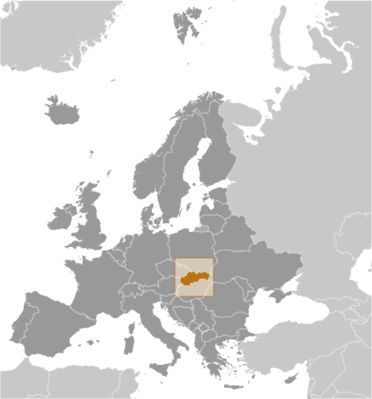
Central Europe, south of Poland
🧭 Background
Slovakia traces its roots to the 9th century state of Great Moravia. The Slovaks then became part of the Hungarian Kingdom, where they remained for the next 1,000 years. After the formation of the dual Austro-Hungarian monarchy in 1867, language and education policies favoring the use of Hungarian (known as "Magyarization") led to a public backlash that boosted Slovak nationalism and strengthened Slovak cultural ties with the closely related Czechs, who fell administratively under the Austrian half of the empire. When the Austro-Hungarian Empire dissolved at the end of World War I, the Slovaks joined the Czechs to form Czechoslovakia. During the interwar period, Slovak nationalist leaders pushed for autonomy within Czechoslovakia, and in 1939, in the wake of Germany's annexation of the Sudetenland, the newly established Slovak Republic became a German client state for the remainder of World War II. After World War II, Czechoslovakia was reconstituted and came under communist rule within Soviet-dominated Eastern Europe. In 1968, Warsaw Pact troops invaded and ended the efforts of Czechoslovakia's leaders to liberalize communist rule and create "socialism with a human face," ushering in a period of repression known as "normalization." The peaceful Velvet Revolution swept the Communist Party from power at the end of 1989 and inaugurated a return to democratic rule and a market economy. On 1 January 1993, Czechoslovakia underwent a nonviolent "velvet divorce" into its two national components, Slovakia and the Czech Republic. Slovakia joined both NATO and the EU in 2004 and the euro zone in 2009.
🗺️ Geography
Central Europe, south of Poland
48 40 N, 19 30 E
Europe
49,035 sq km
48,105 sq km
930 sq km
About 1.5 times the size of Maryland; about twice the size of New Hampshire
1,587 km
Austria 105 km; Czechia 241 km; Hungary 627 km; Poland 517 km; Ukraine 97 km
0 km (landlocked)
None (landlocked)
Temperate; cool summers; cold, cloudy, humid winters
Rugged mountains in the central and northern part and lowlands in the south
Gerlachovsky Stit 2,655 m
Bodrok River 94 m
458 m
Lignite, small amounts of iron ore, copper and manganese ore; salt; arable land
38% (2023 est.)
Arable land: 27.2% (2023 est.)
Permanent crops: 0.4% (2023 est.)
Permanent pasture: 10.4% (2023 est.)
40.3% (2023 est.)
21.4% (2023 est.)
259 sq km (2022)
Dunaj (Danube) (shared with Germany [s], Austria, Hungary, Croatia, Serbia, Bulgaria, Ukraine, Moldova, and Romania [m]) - 2,888 km note – [s] after country name indicates river source; [m] after country name indicates river mouth
(Black Sea) Danube (795,656 sq km)
A fairly even distribution throughout most of the country; slightly larger concentration in the west in proximity to the Czech border
Flooding
Landlocked; most of the country is rugged and mountainous; the Tatra Mountains in the north are interspersed with many scenic lakes and valleys
👥 People and Society⬆️ Top
5,563,649 (2024 est.)
2,684,747
2,878,902
Slovak(s)
Slovak
Slovak 83.8%, Hungarian 7.8%, Romani 1.2%, other 1.8% (includes Czech, Ruthenian, Ukrainian, Russian, German, Polish), unspecified 5.4% (2021 est.)
Slovak (official) 81.8%, Hungarian 8.5%, Roma 1.8%, other 2.2%, unspecified 5.7% (2021 est.)
Svetova Kniha Faktov, nenahraditelny zdroj zakladnej informacie. (Slovak) The World Factbook, the indispensable source for basic information.
Roman Catholic 55.8%, Evangelical Church of the Augsburg Confession 5.3%, Greek Catholic 4%, Reformed Christian 1.6%, other 3%, none 23.8%, unspecified 6.5% (2021 est.)
15.3% (male 444,033/female 408,902)
66.5% (male 1,834,359/female 1,867,158)
18.1% (2024 est.) (male 406,355/female 602,842)
50.3 (2024 est.)
23 (2024 est.)
27.3 (2024 est.)
3.7 (2024 est.)
43.1 years (2025 est.)
41.3 years
44.4 years
-0.07% (2025 est.)
9.77 births/1,000 population (2025 est.)
11.18 deaths/1,000 population (2025 est.)
0.7 migrant(s)/1,000 population (2025 est.)
A fairly even distribution throughout most of the country; slightly larger concentration in the west in proximity to the Czech border
54% of total population (2023)
0.17% annual rate of change (2020-25 est.)
441,000 BRATISLAVA (capital) (2023)
1.07 male(s)/female
1.09 male(s)/female
0.98 male(s)/female
0.67 male(s)/female
0.93 male(s)/female (2024 est.)
27.2 years (2020 est.)
4 deaths/100,000 live births (2023 est.)
5 deaths/1,000 live births (2025 est.)
5.7 deaths/1,000 live births
4.5 deaths/1,000 live births
77.2 years (2024 est.)
73.7 years
81 years
1.6 children born/woman (2025 est.)
0.77 (2025 est.)
Urban: 99.6% of population (2022 est.)
Rural: 100% of population (2022 est.)
Total: 99.8% of population (2022 est.)
Urban: 0.4% of population (2022 est.)
Rural: 0% of population (2022 est.)
Total: 0.2% of population (2022 est.)
7.8% of GDP (2021)
14.6% of national budget (2022 est.)
3.7 physicians/1,000 population (2022)
5.7 beds/1,000 population (2020 est.)
Urban: 99.9% of population (2022 est.)
Rural: 100% of population (2022 est.)
Total: 100% of population (2022 est.)
Urban: 0.1% of population (2022 est.)
Rural: 0% of population (2022 est.)
Total: 0% of population (2022 est.)
20.5% (2016)
10.3 liters of pure alcohol (2019 est.)
4.14 liters of pure alcohol (2019 est.)
2.01 liters of pure alcohol (2019 est.)
4.14 liters of pure alcohol (2019 est.)
0 liters of pure alcohol (2019 est.)
30.3% (2025 est.)
34.5% (2025 est.)
26.3% (2025 est.)
49.2% (2023 est.)
4.7% of GDP (2022 est.)
11% national budget (2022 est.)
15 years (2023 est.)
15 years (2023 est.)
16 years (2023 est.)
🌿 Environment⬆️ Top
Air pollution and acid rain; land erosion from agricultural and mining practices; water pollution
Air Pollution, Air Pollution-Heavy Metals, Air Pollution-Multi-effect Protocol, Air Pollution-Nitrogen Oxides, Air Pollution-Persistent Organic Pollutants, Air Pollution-Sulphur 85, Air Pollution-Sulphur 94, Air Pollution-Volatile Organic Compounds, Antarctic Treaty, Biodiversity, Climate Change, Climate Change-Kyoto Protocol, Climate Change-Paris Agreement, Comprehensive Nuclear Test Ban, Desertification, Endangered Species, Environmental Modification, Hazardous Wastes, Law of the Sea, Nuclear Test Ban, Ozone Layer Protection, Ship Pollution, Tropical Timber 2006, Wetlands, Whaling
Antarctic-Environmental Protection
Temperate; cool summers; cold, cloudy, humid winters
38% (2023 est.)
Arable land: 27.2% (2023 est.)
Permanent crops: 0.4% (2023 est.)
Permanent pasture: 10.4% (2023 est.)
40.3% (2023 est.)
21.4% (2023 est.)
54% of total population (2023)
0.17% annual rate of change (2020-25 est.)
30.087 million metric tonnes of CO2 (2023 est.)
9.607 million metric tonnes of CO2 (2023 est.)
12.112 million metric tonnes of CO2 (2023 est.)
8.368 million metric tonnes of CO2 (2023 est.)
16.6 micrograms per cubic meter (2019 est.)
2.296 million tons (2024 est.)
13.2% (2022 est.)
306.21 million cubic meters (2022)
224.562 million cubic meters (2022)
32.851 million cubic meters (2022)
50.1 billion cubic meters (2022 est.)
1
Novohrad-Nógrád (includes Hungary) (2023)
🏛️ Government⬆️ Top
Slovak Republic
Slovakia
Slovenska republika
Slovensko
The country takes its name from the local Slav ethnic group; the origin of the group's name is unclear, although early forms were used in Medieval Latin (Sclavus) and Byzantine Greek (Sklabos)
Parliamentary republic
Bratislava
48 09 N, 17 07 E
UTC+1 (6 hours ahead of Washington, DC, during Standard Time)
+1hr, begins last Sunday in March; ends last Sunday in October
The meaning is unclear but has medieval Slavic origins; the name was adopted in 1919 after Czechoslovakia gained its independence, replacing the name Prešporok
8 regions (kraje, singular - kraj); Banska Bystrica, Bratislava, Kosice, Nitra, Presov, Trencin, Trnava, Zilina
Civil law system based on Austro-Hungarian codes
Several previous (pre-independence); latest passed by the National Council 1 September 1992, signed 3 September 1992, effective 1 October 1992
Proposed by the National Council; passage requires at least three-fifths majority vote of Council members
Accepts compulsory ICJ jurisdiction with reservations; accepts ICCt jurisdiction
No
At least one parent must be a citizen of Slovakia
No
5 years
18 years of age; universal
President Peter PELLEGRINI (since 15 June 2024)
Prime Minister Robert FICO (since 25 October 2023)
Cabinet appointed by the president on the recommendation of the prime minister
President directly elected by absolute-majority popular vote in 2 rounds, if needed, for a 5-year term (eligible for a second term); following National Council elections, the president designates a prime minister candidate, usually the leader of the party or coalition that wins the most votes, who must win a vote of confidence in the National Council
23 March 2024, with a runoff on 6 April 2024
2024: Peter PELLEGRINI elected president in the second round; percent of vote in second round Peter PELLEGRINI 53.1%; Ivan KORCOK 46.9%; percent of vote in first round - Ivan KORCOK (independent) 42.5%; Peter PELLEGRINI (Hlas-SD) 37%; Stefan HARABIN (independent) 11.7%, other 8.8%; 2019: Zuzana CAPUTOVA elected president in second round; percent of vote - Zuzana CAPUTOVA (PS) 58.4%, Maros SEFCOVIC (independent) 41.6%
2029
National Council (Narodna rada Slovenskej republiky)
Unicameral
National Council (Národná rada)
150 (all directly elected)
Proportional representation
Full renewal
4 years
9/30/2023
Smer - Social Democracy (Smer-SD) (42); Progressive Slovakia (PS) (32); Hlas (“Voice”) - SD (27); Coalition OĽaNO and Friends, 'For the People' and 'Christian Union' (16); Christian Democratic Movement (KDH) (12); Freedom and Solidarity (SaS) (11); Slovak National Party (SNS) (10)
23.3%
September 2027
Supreme Court of the Slovak Republic (consists of the court president, vice president, and approximately 80 judges organized into criminal, civil, commercial, and administrative divisions with 3- and 5-judge panels); Constitutional Court of the Slovak Republic (consists of 13 judges organized into 3-judge panels)
Supreme Court judge candidates nominated by the Judicial Council of the Slovak Republic, an 18-member self-governing body that includes the Supreme Court chief justice and presidential, governmental, parliamentary, and judiciary appointees; judges appointed by the president serve for life, subject to removal by the president at age 65; Constitutional Court judges nominated by the National Council of the Republic and appointed by the president; judges serve 12-year terms
Regional and district civil courts; Special Criminal Court; Higher Military Court; military district courts; Court of Audit
Direction - Social Democracy or SMER-SD Freedom and Solidarity or SaS Progressive Slovakia or PS Republic Slovakia The Slovak National Party or SNS The Christian Democratic Movement or KDH Voice - Social Democracy or HLAS-SD
Ambassador Andrej DROBA (since 16 December 2025)
3523 International Court NW, Washington, DC 20008
[1] (202) 237-1054
[1] (202) 237-6438
Emb.washington@mzv.sk https://www.mzv.sk/web/washington-en
New York
Ambassador Gautam A. RANA (since 28 September 2022)
P.O. Box 309, 814 99 Bratislava
5840 Bratislava Place, Washington DC 20521-5840
[421] (2) 5443-3338
[421] (2) 5441-8861
Consulbratislava@state.gov https://sk.usembassy.gov/
Australia Group, BIS, BSEC (observer), CBSS (observer), CD, CE, CEI, CERN, EAPC, EBRD, ECB, EIB, EMU, EU, FAO, IAEA, IBRD, ICAO, ICC (national committees), ICRM, IDA, IEA, IFC, IFRCS, ILO, IMF, IMO, IMSO, Interpol, IOC, IOM, IPU, ISO, ITU, ITUC (NGOs), MIGA, NATO, NEA, NSG, OAS (observer), OECD, OIF (observer), OPCW, OSCE, PCA, Schengen Convention, SELEC (observer), UN, UNCTAD, UNESCO, UNFICYP, UNIDO, UNOOSA, UNTSO, UNWTO, UPU, Wassenaar Arrangement, WCO, WFTU (NGOs), WHO, WIPO, WMO, WTO, ZC
1 January 1993 (Czechoslovakia split into the Czech Republic and Slovakia)
Constitution Day, 1 September (1992)
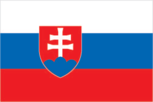
Description: three equal horizontal bands of white (top), blue, and red; the national coat of arms (a red shield bordered in white, with a white double-barred cross of St. Cyril and St. Methodius on top of three blue hills) is centered over the bands but offset to the left meaning: white, blue, and red are the pan-Slav colors
Double-barred cross (Cross of St. Cyril and St. Methodius) over three peaks
White, blue, red
"Nad Tatrou sa blyska" (Storm Over the Tatras)
Janko MATUSKA/traditional
Adopted 1993; music based on an 1843 Slovak folk song "Kopala studienku" (She Was Digging a Well)
8 (6 cultural, 2 natural)
Historic Town of Banská Štiavnica (c); Levoča, Spišský Hrad, and the Associated Cultural Monuments (c); Vlkolínec (c); Caves of Aggtelek Karst and Slovak Karst (n); Bardejov Town (c); Ancient and Primeval Beech Forests of the Carpathians (n); Wooden Churches of the Slovak Carpathians (c); Frontiers of the Roman Empire - The Danube Limes (Western Segment) (c)
💹 Economy⬆️ Top
High-income EU and eurozone economy; manufacturing and exports led by automotive sector; growth supported by private consumption and public investment from EU funds, tempered by trade risks; increased taxes and withdrawal of energy subsidies contributing to rising but manageable inflation; strong labor demand and influx of foreign labor offsets aging workforce
$218.762 billion (2024 est.)
$214.343 billion (2023 est.)
$209.794 billion (2022 est.)
2.1% (2024 est.)
2.2% (2023 est.)
0.4% (2022 est.)
$40,300 (2024 est.)
$39,500 (2023 est.)
$38,600 (2022 est.)
$141.776 billion (2024 est.)
2.8% (2024 est.)
10.5% (2023 est.)
12.8% (2022 est.)
2% (2024 est.)
28.5% (2024 est.)
60% (2024 est.)
58.4% (2023 est.)
20% (2023 est.)
21.1% (2023 est.)
-1.3% (2023 est.)
91.3% (2023 est.)
-89.8% (2023 est.)
Wheat, sugar beets, maize, milk, barley, rapeseed, sunflower seeds, potatoes, soybeans, pork (2023)
Automobiles; metal and metal products; electricity, gas, coke, oil, nuclear fuel; chemicals, synthetic fibers, wood and paper products; machinery; earthenware and ceramics; textiles; electrical and optical apparatus; rubber products; food and beverages; pharmaceutical
0.3% (2024 est.)
2.779 million (2024 est.)
5.3% (2024 est.)
5.9% (2023 est.)
6.2% (2022 est.)
18.2% (2024 est.)
20.1% (2024 est.)
15% (2024 est.)
13.7% (2021 est.)
24.1 (2022 est.)
19.4% of household expenditures (2023 est.)
4.9% of household expenditures (2023 est.)
2.8% (2022 est.)
18.2% (2022 est.)
1.9% of GDP (2024 est.)
2% of GDP (2023 est.)
2% of GDP (2022 est.)
$43.882 billion (2022 est.)
$46.056 billion (2022 est.)
64.3% of GDP (2022 est.)
19.4% (of GDP) (2022 est.)
-$3.895 billion (2024 est.)
-$1.169 billion (2023 est.)
-$11.126 billion (2022 est.)
$120.355 billion (2024 est.)
$122.04 billion (2023 est.)
$114.519 billion (2022 est.)
Germany 20%, Czechia 10%, Hungary 7%, USA 6%, Poland 6% (2023)
Cars, vehicle parts/accessories, video displays, broadcasting equipment, refined petroleum (2023)
$120.29 billion (2024 est.)
$119.739 billion (2023 est.)
$121.473 billion (2022 est.)
Germany 16%, Czechia 14%, Poland 8%, China 7%, Hungary 6% (2023)
Vehicle parts/accessories, broadcasting equipment, cars, plastic products, insulated wire (2023)
$14.452 billion (2024 est.)
$11.288 billion (2023 est.)
$10.28 billion (2022 est.)
Euros (EUR) per US dollar -
0.924 (2024 est.)
0.925 (2023 est.)
0.95 (2022 est.)
0.845 (2021 est.)
0.876 (2020 est.)
⚡ Energy⬆️ Top
100% (2022 est.)
8.138 million kW (2023 est.)
24.18 billion kWh (2023 est.)
14.078 billion kWh (2023 est.)
10.671 billion kWh (2023 est.)
1.233 billion kWh (2023 est.)
14.4% of total installed capacity (2023 est.)
63.7% of total installed capacity (2023 est.)
2.1% of total installed capacity (2023 est.)
13.9% of total installed capacity (2023 est.)
5.9% of total installed capacity (2023 est.)
5 (2025)
1 (2025)
2.3GW (2025 est.)
61.3% (2023 est.)
3 (2025)
2.315 million metric tons (2023 est.)
6.066 million metric tons (2023 est.)
13,000 metric tons (2023 est.)
3.658 million metric tons (2023 est.)
19 million metric tons (2023 est.)
7,000 bbl/day (2023 est.)
90,000 bbl/day (2024 est.)
9 million barrels (2021 est.)
46.585 million cubic meters (2023 est.)
4.277 billion cubic meters (2023 est.)
4.56 billion cubic meters (2023 est.)
14.158 billion cubic meters (2021 est.)
127.582 million Btu/person (2023 est.)
📡 Communications⬆️ Top
505,000 (2023 est.)
9 (2023 est.)
7.63 million (2023 est.)
132 (2022 est.)
State-owned public broadcaster, Radio and Television of Slovakia (RTVS), has 2 national TV stations; roughly 50 privately owned national, regional, and local TV stations; about 40% of households connected to multi-channel cable or satellite TV; multiple RTVS national and regional radio networks; 32 privately owned radio stations
.sk
90% (2024 est.)
1.83 million (2023 est.)
33 (2023 est.)
🚚 Transportation⬆️ Top
OM
116 (2025)
2 (2025)
3,627 km (2020) 1,585 km electrified
🛡️ Military and Security⬆️ Top
Armed Forces of the Slovak Republic (Ozbrojene Sily Slovenskej Republiky): Ground Forces (Slovenské Pozemné Sily), Air Forces (Slovenské Vzdušné Sily), Special Operations Forces (Sily Pre Speciálne Operácie) Ministry of Interior: Slovak Police Force (SPF or Policajný Zbor) (2025)
2% of GDP (2025 est.)
2% of GDP (2024 est.)
1.8% of GDP (2023 est.)
1.8% of GDP (2022 est.)
1.7% of GDP (2021 est.)
Approximately 17,000 active-duty military personnel (2025)
The military's inventory is a mix of domestically produced, Soviet-era, and more modern/NATO-compatible armaments from suppliers such as Germany and the US (2025)
Minimum age is 18 for voluntary service for men and women; citizens 18-65 can volunteer for the military reserves (2026)
200 Cyprus (UNFICYP); up to 150 Latvia (NATO) (2025)
The Slovak military is responsible for external defense and fulfilling Slovakia’s commitments to European and international security; Slovakia has been a member of both the EU and NATO since 2004; a key focus of the Slovak military is fulfilling the country’s security responsibilities to NATO, including modernizing and acquiring NATO-compatible equipment, participating in training exercises, and providing forces for security missions such as NATO’s Enhanced Forward Presence in the Baltic States; since 2022, Slovakia has hosted a multinational NATO ground force battlegroup as part of the NATO effort to boost the defenses of Eastern Europe since the Russian invasion of Ukraine; Slovakia also contributes to EU and UN peacekeeping missions the Slovak Air Force has only a handful of fighter aircraft and is assisted by NATO’s air policing mission over Slovakia, which includes fighter aircraft from Czechia and Poland; in 2022, Slovakia signed a defense agreement with the US that allows the US to use two Slovak military air bases (2025)
🌐 Transnational Issues⬆️ Top
144,349 (2024 est.)
65 (2024 est.)
Source: Factbook JSON archive.