Tbilisi
 Georgia
Key facts and a structured country profile. 🧾 Change log 📐 True Size
Locator 🗺️ Map
4,900,961 (2024 est.)
69,700 sq km
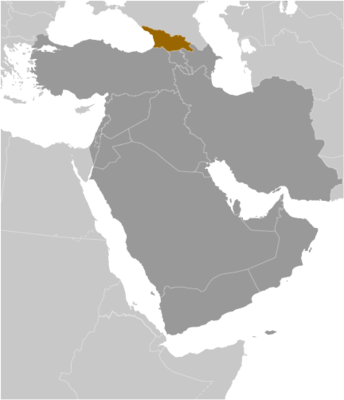
Southwestern Asia, bordering the Black Sea, between Turkey and Russia, with a sliver of land north of the Caucasus extending into Europe; note - Georgia views itself as part of Europe; geopolitically, it can be classified as falling within Europe, the Middle East, or both
🧭 Background
The region of present-day Georgia once contained the ancient kingdoms of Colchis (known as Egrisi locally) and Kartli-Iberia. The area came under Roman influence in the first centuries A.D., and Christianity became the state religion in the 330s. Persian, Arab, and Turk domination was followed by a Georgian golden age (11th-13th centuries) that was cut short when the Mongols invaded in 1236. Subsequently, the Ottoman and Persian empires competed for influence in the region. Georgia was absorbed into the Russian Empire in the 19th century. Independent for three years (1918-1921) following the Russian revolution, it was forcibly incorporated into the USSR in 1921 and regained its independence when the Soviet Union dissolved in 1991. In 2003, mounting public discontent over rampant corruption, ineffective government services, and a government attempt to manipulate parliamentary elections touched off widespread protests that led to the resignation of Eduard SHEVARDNADZE, who had been president since 1995. In the aftermath of this "Rose Revolution," new elections in 2004 swept Mikheil SAAKASHVILI and his United National Movement (UNM) party into power. SAAKASHVILI made progress on market reforms and governance, but he faced accusations of abuse of office. Progress was further complicated when Russian support for the separatist regions of Abkhazia and South Ossetia led to a five-day conflict between Russia and Georgia in August 2008, which included Russia invading large portions of Georgian territory. Russia initially pledged to pull back from most Georgian territory but then unilaterally recognized the independence of Abkhazia and South Ossetia, and Russian military forces have remained in those regions. Billionaire Bidzina IVANISHVILI's unexpected entry into politics in 2011 brought the divided opposition together under his Georgian Dream coalition, which won a majority of seats in the 2012 parliamentary elections and removed UNM from power. Conceding defeat, SAAKASHVILI named IVANISHVILI as prime minister and left the country after his presidential term ended in 2013. IVANISHVILI voluntarily resigned from office after the presidential succession, and in the years since, the prime minister position has seen frequent turnover. In 2021, SAAKASHVILI returned to Georgia, where he was immediately arrested to serve six years in prison on outstanding abuse-of-office convictions. Popular support for integration with the West is high in Georgia. Joining the EU and NATO are among the country's top foreign policy goals, and Georgia applied for EU membership in 2022, becoming a candidate country in December 2023. Georgia and the EU have a Deep and Comprehensive Free Trade Agreement, and since 2017, Georgian citizens have been able to travel to the Schengen area without a visa.
🗺️ Geography
Southwestern Asia, bordering the Black Sea, between Turkey and Russia, with a sliver of land north of the Caucasus extending into Europe; note - Georgia views itself as part of Europe; geopolitically, it can be classified as falling within Europe, the Middle East, or both
42 00 N, 43 30 E
Asia
69,700 sq km
69,700 sq km
0 sq km
Slightly smaller than South Carolina; slightly larger than West Virginia
1,814 km
Armenia 219 km; Azerbaijan 428 km; Russia 894 km; Turkey 273 km
310 km
12 nm
200 nm
Warm and pleasant; Mediterranean-like on Black Sea coast
Largely mountainous with Great Caucasus Mountains in the north and Lesser Caucasus Mountains in the south; Kolkhet'is Dablobi (Kolkhida Lowland) opens to the Black Sea in the west; Mtkvari River Basin in the east; fertile soils in river valley flood plains and foothills of Kolkhida Lowland
Mt'a Shkhara 5,193 m
Black Sea 0 m
1,432 m
Timber, hydropower, manganese deposits, iron ore, copper, minor coal and oil deposits; coastal climate and soils allow for important tea and citrus growth
34.1% (2023 est.)
Arable land: 4.4% (2023 est.)
Permanent crops: 1.8% (2023 est.)
Permanent pasture: 27.9% (2023 est.)
44.6% (2023 est.)
21.2% (2023 est.)
4,330 sq km (2012)
Settlement concentrated in the central valley, particularly in the capital city of Tbilisi in the east; smaller urban agglomerations dot the Black Sea coast, with Bat'umi being the largest
Earthquakes
Note 1: strategically located east of the Black Sea, Georgia controls much of the Caucasus Mountains and the routes through them note 2: the world's four deepest caves are all in Georgia, including two that are the only known caves on earth deeper than 2,000 m: Krubera Cave at -2,197 m (-7,208 ft; reached in 2012) and Veryovkina Cave at -2,212 (-7,257 ft; reached in 2018)
👥 People and Society⬆️ Top
4,900,961 (2024 est.)
2,343,068
2,557,893
Georgian(s)
Georgian
Georgian 86.8%, Azeri 6.3%, Armenian 4.5%, other 2.3% (includes Russian, Ossetian, Yazidi, Ukrainian, Kist, Greek) (2014 est.)
Georgian (official) 87.6%, Azeri 6.2%, Armenian 3.9%, Russian 1.2%, other 1% (including Abkhaz, the official language in Abkhazia) (2014 est.)
მსოფლიო ფაქტების წიგნი, ძირითადი ინფორმაციის აუცილებელი წყარო. (Georgian) The World Factbook, the indispensable source for basic information.
Eastern Orthodox Christian (official) 83.4%, Muslim 10.7%, Armenian Apostolic Christian 2.9%, other 1.2% (includes Roman Catholic Christian, Jehovah's Witness, Yazidi, Protestant Christian, Jewish), none 0.5%, unspecified/no answer 1.2% (2014 est.)
20.6% (male 520,091/female 489,882)
62.7% (male 1,500,036/female 1,572,637)
16.7% (2024 est.) (male 322,941/female 495,374)
59.5 (2024 est.)
32.9 (2024 est.)
26.6 (2024 est.)
3.8 (2024 est.)
38.6 years (2025 est.)
35.9 years
40.6 years
-0.45% (2025 est.)
11.74 births/1,000 population (2025 est.)
12.89 deaths/1,000 population (2025 est.)
-3.33 migrant(s)/1,000 population (2025 est.)
Settlement concentrated in the central valley, particularly in the capital city of Tbilisi in the east; smaller urban agglomerations dot the Black Sea coast, with Bat'umi being the largest
60.7% of total population (2023)
0.35% annual rate of change (2020-25 est.)
1.082 million TBILISI (capital) (2023)
1.07 male(s)/female
1.06 male(s)/female
0.95 male(s)/female
0.65 male(s)/female
0.92 male(s)/female (2024 est.)
25.9 years (2019 est.)
20 deaths/100,000 live births (2023 est.)
20.9 deaths/1,000 live births (2025 est.)
23.6 deaths/1,000 live births
19.7 deaths/1,000 live births
72.8 years (2024 est.)
68.7 years
77.2 years
1.94 children born/woman (2025 est.)
0.94 (2025 est.)
Urban: 99.2% of population (2022 est.)
Rural: 88.5% of population (2022 est.)
Total: 95% of population (2022 est.)
Urban: 0.8% of population (2022 est.)
Rural: 11.5% of population (2022 est.)
Total: 5% of population (2022 est.)
7.4% of GDP (2022)
10.5% of national budget (2022 est.)
5.64 physicians/1,000 population (2023)
4.9 beds/1,000 population (2020 est.)
Urban: 96.6% of population (2022 est.)
Rural: 72.5% of population (2022 est.)
Total: 87.1% of population (2022 est.)
Urban: 3.4% of population (2022 est.)
Rural: 27.5% of population (2022 est.)
Total: 12.9% of population (2022 est.)
21.7% (2016)
7.45 liters of pure alcohol (2019 est.)
1.71 liters of pure alcohol (2019 est.)
3.19 liters of pure alcohol (2019 est.)
2.52 liters of pure alcohol (2019 est.)
0.02 liters of pure alcohol (2019 est.)
28.7% (2025 est.)
53.9% (2025 est.)
7.5% (2025 est.)
2.1% (2018 est.)
65.3% (2018 est.)
0.3% (2018)
13.9% (2018)
0.5% (2018)
4% of GDP (2024 est.)
12.2% national budget (2024 est.)
99.7% (2024 est.)
99.8% (2024 est.)
99.6% (2024 est.)
16 years (2023 est.)
16 years (2023 est.)
17 years (2023 est.)
🌿 Environment⬆️ Top
Air pollution, particularly in Rust'avi; heavy water pollution of Mtkvari River and the Black Sea; inadequate supplies of potable water; soil pollution from toxic chemicals; land and forest degradation; biodiversity loss; waste management
Air Pollution, Biodiversity, Climate Change, Climate Change-Kyoto Protocol, Climate Change-Paris Agreement, Comprehensive Nuclear Test Ban, Desertification, Endangered Species, Hazardous Wastes, Law of the Sea, Marine Dumping-London Protocol, Ozone Layer Protection, Ship Pollution, Wetlands
None of the selected agreements
Warm and pleasant; Mediterranean-like on Black Sea coast
34.1% (2023 est.)
Arable land: 4.4% (2023 est.)
Permanent crops: 1.8% (2023 est.)
Permanent pasture: 27.9% (2023 est.)
44.6% (2023 est.)
21.2% (2023 est.)
60.7% of total population (2023)
0.35% annual rate of change (2020-25 est.)
10.7 million metric tonnes of CO2 (2023 est.)
812,000 metric tonnes of CO2 (2023 est.)
4.469 million metric tonnes of CO2 (2023 est.)
5.419 million metric tonnes of CO2 (2023 est.)
18.6 micrograms per cubic meter (2019 est.)
800,000 tons (2024 est.)
19.6% (2022 est.)
504.96 million cubic meters (2022)
354.46 million cubic meters (2022)
433.96 million cubic meters (2022)
63.33 billion cubic meters (2022 est.)
🏛️ Government⬆️ Top
None
Georgia
Republic of Georgia
Sak'art'velo
Georgian Soviet Socialist Republic
The Western name probably derives from the name of the local people, the Gurz, whose name origin is uncertain; the native name "Sak'art'velo" means "Land of the Kartvelians" and refers to the core central Georgian region of Kartli
Semi-presidential republic
Tbilisi
41 41 N, 44 50 E
UTC+4 (9 hours ahead of Washington, DC, during Standard Time)
The name comes from the Georgian word tbili, meaning "warm" and referring to the hot sulfur springs in the area
9 regions (mkharebi, singular - mkhare), 1 city (kalaki), and 2 autonomous republics (avtomnoy respubliki, singular - avtom respublika) regions: Guria, Imereti, Kakheti, Kvemo Kartli, Mtskheta Mtianeti, Racha-Lechkhumi and Kvemo Svaneti, Samegrelo and Zemo Svaneti, Samtskhe-Javakheti, Shida Kartli; note - the breakaway region of South Ossetia consists of the northern part of Shida Kartli, eastern slivers of the Imereti region and Racha-Lechkhumi and Kvemo Svaneti, and part of western Mtskheta-Mtianeti city: Tbilisi autonomous republics: Abkhazia or Ap'khazet'is Avtonomiuri Respublika (Sokhumi), Ajaria or Acharis Avtonomiuri Respublika (Bat'umi)
Civil law system
Previous 1921, 1978 (based on 1977 Soviet Union constitution); latest approved 24 August 1995, effective 17 October 1995
Proposed as a draft law supported by more than one half of the Parliament membership or by petition of at least 200,000 voters; passage requires support by at least three fourths of the Parliament membership in two successive sessions three months apart and the signature and promulgation by the president of Georgia
Accepts compulsory ICJ jurisdiction; accepts ICCt jurisdiction
No
At least one parent must be a citizen of Georgia
No
10 years
18 years of age; universal
President Mikheil KAVELASHVILI (since 29 December 2024)
Prime Minister Irakli KOBAKHIDZE (since 8 February 2024)
Cabinet of Ministers
President elected by a 300-member College of Electors; prime minister nominated by Parliament, appointed by the president
14 December 2024
2024: Mikheil KAVELASHVILI (Georgian Dream Party) was formally inaugurated on 29 December 2024 2024: Irakli KOBAKHIDZE approved as prime minister by Parliamentary vote 84-10 2018: Salome ZOURABICHVILI elected president in second round; percent of vote in second round - Salome ZOURABICHVILI (independent, backed by Georgian Dream) 59.5%, Grigol VASHADZE (UNM) 40.5%; Irakli GARIBASHVILI approved as prime minister by Parliamentary vote 89-2
2029
Parliament (Sakartvelos Parlamenti)
Unicameral
150 (all directly elected)
Proportional representation
Full renewal
4 years
10/26/2024
Georgian Dream (89); Coalition for Changes (19); Unity - National Movement (16); Strong Georgia – Lelo, For people, For Liberty! (14); For Georgia (12)
16.8%
October 2028
Supreme Court (consists of 28 judges organized into several specialized judicial chambers; number of judges determined by the president of Georgia); Constitutional Court (consists of 9 judges)
Supreme Court judges nominated by the High Council of Justice (a 14-member body consisting of the Supreme Court chairperson, common court judges, and appointees of the president of Georgia) and appointed by Parliament; judges appointed for life; Constitutional Court judges appointed 3 each by the president, by Parliament, and by the Supreme Court judges; judges appointed for 10-year terms
Courts of Appeal; regional (town) and district courts
Ahali Citizens Conservative Party Droa European Georgia - Movement for Liberty For Georgia For the People Freedom Square Georgian Dream Girchi - More Freedom Law and Justice Lelo for Georgia National Democratic Party People's Power Progress and Freedom Republican Party State for the People Strategy Aghmashenebeli United National Movement or UNM
Ambassador Tamar TALIASHVILI (since 24 July 2025)
1824 R Street NW, Washington, DC 20009
[1] (202) 387-2390
[1] (202) 387-0864
Embgeo.usa@mfa.gov.ge https://georgiaembassyusa.org/contact/
New York, San Francisco
Ambassador (vacant); Chargé d’Affaires Alan S. PURCELL (since 16 July 2025)
29 Georgian-American Friendship Avenue, Didi Dighomi, Tbilisi, 0131
7060 Tbilisi Place, Washington, DC 20521-7060
[995] (32) 227-70-00
[995] (32) 253-23-10
Askconsultbilisi@state.gov https://ge.usembassy.gov/
ADB, BSEC, CD, CE, CPLP (associate), EAPC, EBRD, FAO, G-11, GCTU, GUAM, IAEA, IBRD, ICAO, ICC (national committees), ICCt, ICRM, IDA, IFAD, IFC, IFRCS, ILO, IMF, IMO, Interpol, IOC, IOM, IPU, ISO (correspondent), ITSO, ITU, ITUC (NGOs), MIGA, OAS (observer), OIF (observer), OPCW, OSCE, PFP, SELEC (observer), UN, UNCTAD, UNESCO, UNIDO, UNWTO, UPU, WCO, WHO, WIPO, WMO, WTO
9 April 1991 (from the Soviet Union); notable earlier date: A.D. 1008 (Georgia unified under King BAGRAT III)
Independence Day, 26 May (1918)
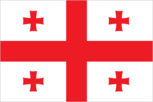
Description: white rectangle with a central red cross extending to all four sides of the flag; each of the four quadrants displays a small red bolnur-katskhuri cross (also known as Bolnisi cross), which has equal-length arms that are slightly wider at the end than in the center history: sometimes referred to as the Five-Cross Flag, the design is based on a 14th-century banner of the Kingdom of Georgia
Saint George, lion
Red, white
"Tavisupleba" (Liberty)
Davit MAGRADSE/Zakaria PALIASHVILI (adapted by Joseb KETSCHAKMADSE)
Adopted 2004, after the Rose Revolution; based on music from the operas "Abesalom da Eteri" and "Daisi"
4 (3 cultural, 1 natural)
Gelati Monastery (c); Historical Monuments of Mtskheta (c); Upper Svaneti (c); Colchic Rainforests and Wetlands (n)
💹 Economy⬆️ Top
Upper-middle income, fast-growing South Caucasus economy; regionally focused exporter of cars, metal ores, and energy; financial and migrant inflows resulting from Ukraine conflict; EU accession talks suspended over disputed election and foreign influence law; low inflation but persistent high unemployment
$91.849 billion (2024 est.)
$83.935 billion (2023 est.)
$77.838 billion (2022 est.)
9.4% (2024 est.)
7.8% (2023 est.)
11% (2022 est.)
$25,000 (2024 est.)
$22,600 (2023 est.)
$21,000 (2022 est.)
$33.776 billion (2024 est.)
1.1% (2024 est.)
2.5% (2023 est.)
11.9% (2022 est.)
5.4% (2024 est.)
19.1% (2024 est.)
62.8% (2024 est.)
71.3% (2024 est.)
13.4% (2024 est.)
22% (2024 est.)
0.8% (2024 est.)
48.4% (2024 est.)
-56% (2024 est.)
Milk, grapes, potatoes, maize, wheat, tangerines/mandarins, tomatoes, barley, apples, eggs (2023)
Steel, machine tools, electrical appliances, mining (manganese, copper, gold), chemicals, wood products, wine
5.4% (2024 est.)
1.833 million (2024 est.)
11.5% (2024 est.)
11.6% (2023 est.)
11.7% (2022 est.)
29.9% (2024 est.)
28.4% (2024 est.)
32.4% (2024 est.)
11.8% (2023 est.)
34.8 (2023 est.)
39% of household expenditures (2023 est.)
3.8% of household expenditures (2023 est.)
2.7% (2023 est.)
26.9% (2023 est.)
11.8% of GDP (2024 est.)
13.7% of GDP (2023 est.)
15.4% of GDP (2022 est.)
$8.686 billion (2023 est.)
$9.307 billion (2023 est.)
43.4% of GDP (2023 est.)
23.6% (of GDP) (2023 est.)
-$1.491 billion (2024 est.)
-$1.709 billion (2023 est.)
-$1.105 billion (2022 est.)
$16.321 billion (2024 est.)
$15.173 billion (2023 est.)
$13.24 billion (2022 est.)
Azerbaijan 13%, Turkey 11%, Armenia 11%, Russia 10%, Kyrgyzstan 8% (2023)
Cars, copper ore, electricity, garments, wine (2023)
$18.915 billion (2024 est.)
$17.816 billion (2023 est.)
$15.665 billion (2022 est.)
Turkey 16%, USA 13%, Russia 11%, China 8%, Germany 6% (2023)
Cars, refined petroleum, packaged medicine, natural gas, garments (2023)
$4.447 billion (2024 est.)
$5.002 billion (2023 est.)
$4.886 billion (2022 est.)
$9.085 billion (2023 est.)
Laris (GEL) per US dollar -
2.721 (2024 est.)
2.628 (2023 est.)
2.916 (2022 est.)
3.222 (2021 est.)
3.109 (2020 est.)
⚡ Energy⬆️ Top
100% (2022 est.)
4.526 million kW (2023 est.)
12.569 billion kWh (2023 est.)
4.913 billion kWh (2023 est.)
4.234 billion kWh (2023 est.)
1.148 billion kWh (2023 est.)
23.9% of total installed capacity (2023 est.)
0.6% of total installed capacity (2023 est.)
75.5% of total installed capacity (2023 est.)
148,000 metric tons (2023 est.)
384,000 metric tons (2023 est.)
80 metric tons (2023 est.)
223,000 metric tons (2023 est.)
900.999 million metric tons (2023 est.)
300 bbl/day (2023 est.)
34,000 bbl/day (2023 est.)
35 million barrels (2021 est.)
10.77 million cubic meters (2023 est.)
2.775 billion cubic meters (2023 est.)
2.764 billion cubic meters (2023 est.)
8.495 billion cubic meters (2021 est.)
56.076 million Btu/person (2023 est.)
📡 Communications⬆️ Top
278,000 (2023 est.)
7 (2023 est.)
5.91 million (2023 est.)
156 (2022 est.)
State-owned Georgian Public Broadcaster (GPB) includes Channel 1, Channel 2, and Adjara TV; independent commercial TV broadcasters include Imedi, Rustavi 2, Pirveli TV, Maestro, Kavkasia, Georgian Dream Studios (GDS), Obiektivi, Mtavari Arkhi, and TOK TV (Russian language); Tabula and Post TV are web-based TV outlets; Georgian Orthodox Church operates a satellite-based television station called Unanimity; 26 regional TV broadcasters; TV shifted to digital in 2015; several dozen private radio stations; GPB operates 2 radio stations (2019)
.ge
82% (2023 est.)
1.1 million (2023 est.)
29 (2023 est.)
🚚 Transportation⬆️ Top
4L
21 (2025)
4 (2025)
1,363 km (2014)
37 km (2014) 0.912-m gauge (37 km electrified)
1,326 km (2014) 1.520-m gauge (1,251 km electrified)
26 (2023)
General cargo 3, other 23
3 (2024)
0
0
1
2
2
Batumi, Sokhumi, Supsa Marine Terminal
🛡️ Military and Security⬆️ Top
Georgian Defense Forces (GDF; aka Defense Forces of Georgia, DFG): Ground Forces, Air Force, Special Operations Forces, National Guard Ministry of Internal Affairs: Police, Border Police of Georgia, Coast Guard of Georgia (includes naval forces, which were merged with the Coast Guard in 2009) (2025)
1.7% of GDP (2024 est.)
1.7% of GDP (2023 est.)
1.6% of GDP (2022 est.)
1.5% of GDP (2021 est.)
1.6% of GDP (2020 est.)
The Georgia Defense Forces are authorized up to 37,000 personnel (2025)
The majority of the military's inventory consists of Soviet-era weapons and equipment, some of which has been upgraded; it has smaller quantities of mostly secondhand material from such countries as Israel, Poland, Türkiye, and the US, as well as some domestically produced equipment; Georgia has a small defense industry which produces such items as small arms and light armored vehicles (2025)
18-35 years of age for voluntary military service for men and women; conscription was abolished in 2016, but reinstated in 2017 for men 18-27 years of age; conscript service obligation is up to 11 months depending on the assigned ministry, job specialty, and if the service is carried out in a combat unit (2025)
The Defense Forces of Georgia (DFG) are responsible for protecting the independence, sovereignty, and territorial integrity of the country; the DFG also provides units for multinational military operations abroad and supports the Border Police in border protection and civil authorities in counter-terrorist operations, if requested; it is focused primarily on Russia, which maintains military bases and troops in occupied Abkhazia and South Ossetia; a five-day conflict with Russian forces in 2008 resulted in the defeat and expulsion of Georgian forces from the breakaway regions Georgia is not a member of NATO but has had a relationship with the Alliance since 1992 and declared its aspiration to join in 2002; the military is working to make itself more compatible with NATO and has participated in multinational exercises and security operations abroad with NATO, such as Afghanistan, where it was one of the top non-NATO contributors, and Kosovo; the DFG has also contributed troops to EU and UN missions (2025)
🌐 Transnational Issues⬆️ Top
31,791 (2024 est.)
347,754 (2024 est.)
488 (2024 est.)
Source: Factbook JSON archive.