Roseau
 Dominica
Key facts and a structured country profile. 🧾 Change log 📐 True Size
Locator 🗺️ Map
74,661 (2024 est.)
751 sq km
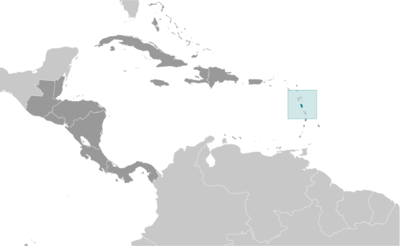
Caribbean, island between the Caribbean Sea and the North Atlantic Ocean, about halfway between Puerto Rico and Trinidad and Tobago
🧭 Background
Dominica was the last of the Caribbean islands to be colonized by Europeans, due chiefly to the fierce resistance of the native Caribs. France ceded possession to Britain in 1763, and Dominica became a British colony in 1805. Slavery ended in 1833, and in 1835, the first three men of African descent were elected to the legislative assembly of Dominica. In 1871, Dominica became first part of the British Leeward Islands and then the British Windward Islands until 1958. In 1967, Dominica became an associated state of the UK, formally taking responsibility for its internal affairs, and the country gained its independence in 1978. In 1980, Dominica's fortunes improved when Mary Eugenia CHARLES -- the first female prime minister in the Caribbean -- replaced a corrupt and tyrannical administration, and she served for the next 15 years. In 2017, Hurricane Maria passed over the island, causing extensive damage to structures, roads, communications, and the power supply, and largely destroying critical agricultural areas.
🗺️ Geography
Caribbean, island between the Caribbean Sea and the North Atlantic Ocean, about halfway between Puerto Rico and Trinidad and Tobago
15 25 N, 61 20 W
Central America and the Caribbean
751 sq km
751 sq km
NEGL
Slightly more than four times the size of Washington, D.C.
0 km
148 km
12 nm
24 nm
200 nm
Tropical; moderated by northeast trade winds; heavy rainfall
Rugged mountains of volcanic origin
Morne Diablotins 1,447 m
Caribbean Sea 0 m
Timber, hydropower, arable land
33.3% (2023 est.)
Arable land: 8% (2023 est.)
Permanent crops: 22.7% (2023 est.)
Permanent pasture: 2.7% (2023 est.)
76.6% (2023 est.)
0% (2023 est.)
NA
Population is mostly clustered along the coast, with roughly a third living in the parish of St. George, in or around the capital of Roseau; the volcanic interior is sparsely populated
Flash floods are a constant threat; destructive hurricanes can be expected during the late summer months volcanism: Dominica lies in the middle of the volcanic-island arc of the Lesser Antilles that extends from the island of Saba in the north to Grenada in the south; of the 16 volcanoes that make up this arc, five are located on Dominica, more than any other island in the Caribbean: Morne aux Diables (861 m), Morne Diablotins (1,430 m), Morne Trois Pitons (1,387 m), Watt Mountain (1,224 m), which last erupted in 1997, and Morne Plat Pays (940 m); the two best-known volcanic features on Dominica, the Valley of Desolation and the Boiling Lake thermal areas, lie on the flanks of Watt Mountain, and both are popular tourist destinations
Known as "The Nature Island of the Caribbean" due to its lush and varied flora and fauna, which are protected by an extensive natural park system; the most mountainous of the Lesser Antilles, its volcanic peaks are cones of lava craters and include Boiling Lake, the second-largest thermally active lake in the world
👥 People and Society⬆️ Top
74,661 (2024 est.)
37,753
36,908
Dominican(s)
Dominican
African descent 84.5%, mixed 9%, Indigenous 3.8%, other 2.1%, unspecified 0.6% (2011 est.)
English (official), French patois
Roman Catholic 52.7%, Protestant 29.7% (includes Seventh Day Adventist 6.7%, Pentecostal 6.1%, Baptist 5.2%, Christian Union Church 3.9%, Methodist 2.6%, Gospel Mission 2.1%, other Protestant 3.1%), Jehovah's Witness 1.3%, Rastafarian 1.1%, other 4.3%, none 9.4%, unspecified 1.4% (2011 est.)
20.7% (male 7,891/female 7,530)
65.6% (male 25,000/female 24,009)
13.7% (2024 est.) (male 4,862/female 5,369)
52.3 (2024 est.)
31.5 (2024 est.)
20.9 (2024 est.)
4.8 (2024 est.)
37.5 years (2025 est.)
36.5 years
37.6 years
-0.04% (2025 est.)
13.02 births/1,000 population (2025 est.)
8.15 deaths/1,000 population (2025 est.)
-5.31 migrant(s)/1,000 population (2025 est.)
Population is mostly clustered along the coast, with roughly a third living in the parish of St. George, in or around the capital of Roseau; the volcanic interior is sparsely populated
72% of total population (2023)
0.84% annual rate of change (2020-25 est.)
15,000 ROSEAU (capital) (2018)
1.05 male(s)/female
1.05 male(s)/female
1.04 male(s)/female
0.91 male(s)/female
1.02 male(s)/female (2024 est.)
36 deaths/100,000 live births (2023 est.)
10.5 deaths/1,000 live births (2025 est.)
14.5 deaths/1,000 live births
6.8 deaths/1,000 live births
78.7 years (2024 est.)
75.8 years
81.8 years
2.01 children born/woman (2025 est.)
0.98 (2025 est.)
6.5% of GDP (2021)
6.2% of national budget (2022 est.)
1.16 physicians/1,000 population (2018)
3 beds/1,000 population (2021 est.)
27.9% (2016)
6.32 liters of pure alcohol (2019 est.)
1.64 liters of pure alcohol (2019 est.)
0.29 liters of pure alcohol (2019 est.)
4.39 liters of pure alcohol (2019 est.)
0 liters of pure alcohol (2019 est.)
5.4% of GDP (2024 est.)
5.8% national budget (2025 est.)
3,000-3,500 Kalinago (Carib) still living on Dominica are the only pre-Columbian population remaining in the Caribbean; only 70-100 may be "pure" Kalinago because of years of integration into the broader population
🌿 Environment⬆️ Top
Pollution from agrochemicals and from untreated sewage; forests endangered by the expansion of farming; soil erosion; pollution of the coastal zone from agricultural/industrial chemicals and untreated sewage
Biodiversity, Climate Change, Climate Change-Kyoto Protocol, Climate Change-Paris Agreement, Desertification, Endangered Species, Environmental Modification, Hazardous Wastes, Law of the Sea, Ozone Layer Protection, Ship Pollution, Whaling
None of the selected agreements
Tropical; moderated by northeast trade winds; heavy rainfall
33.3% (2023 est.)
Arable land: 8% (2023 est.)
Permanent crops: 22.7% (2023 est.)
Permanent pasture: 2.7% (2023 est.)
76.6% (2023 est.)
0% (2023 est.)
72% of total population (2023)
0.84% annual rate of change (2020-25 est.)
168,000 metric tonnes of CO2 (2023 est.)
168,000 metric tonnes of CO2 (2023 est.)
7.9 micrograms per cubic meter (2019 est.)
13,200 tons (2024 est.)
12.6% (2022 est.)
19 million cubic meters (2022 est.)
0 cubic meters (2022 est.)
1 million cubic meters (2022 est.)
200 million cubic meters (2022 est.)
🏛️ Government⬆️ Top
Commonwealth of Dominica
Dominica
The island was named by explorer Christopher COLUMBUS for the day of the week on which he spotted it, Sunday (Domingo in Spanish, dominica dies in Latin), 3 November 1493
Parliamentary republic
Roseau
15 18 N, 61 24 W
UTC-4 (1 hour ahead of Washington, DC, during Standard Time)
The name is French for "reed;" the first settlement was named after the river reeds that grew in the area
10 parishes; Saint Andrew, Saint David, Saint George, Saint John, Saint Joseph, Saint Luke, Saint Mark, Saint Patrick, Saint Paul, Saint Peter
Common law based on the English model
Previous 1967 (pre-independence); latest presented 25 July 1978, entered into force 3 November 1978
Proposed by the House of Assembly; passage of amendments to constitutional sections such as fundamental rights and freedoms, the government structure, and constitutional amendment procedures requires approval by three fourths of the Assembly membership in the final reading of the amendment bill, approval by simple majority in a referendum, and assent of the president
Accepts compulsory ICJ jurisdiction; accepts ICCt jurisdiction
Yes
Yes
Yes
5 years
18 years of age; universal
President Sylvanie BURTON (since 2 October 2023)
Prime Minister Roosevelt SKERRIT (since 8 January 2004)
Cabinet appointed by the president on the advice of the prime minister
President nominated by the prime minister and leader of the opposition party and elected by the House of Assembly for a 5-year term (eligible for a second term); prime minister appointed by the president
27 September 2023
2023: parliament elects Sylvanie BURTON (DLP) with 20 votes for and five against 2018: Charles A. SAVARIN (DLP) reelected president unopposed
October 2028
House of Assembly
Unicameral
32 (21 directly elected; 9 appointed)
Proportional representation
Full renewal
5 years
12/6/2022
Dominica Labor Party (DLP) (19); Independents (2)
40.6%
December 2027
The Eastern Caribbean Supreme Court (ECSC) is the superior court of the Organization of Eastern Caribbean States; the ECSC is headquartered on St. Lucia and consists of the Court of Appeal -- headed by the chief justice and 4 judges -- and the High Court with 18 judges; the Court of Appeal travels to member states on a schedule to hear appeals from the High Court and subordinate courts; the Caribbean Court of Justice is the final court of appeal
Chief justice of Eastern Caribbean Supreme Court appointed by the British monarch; other justices and judges appointed by the Judicial and Legal Services Commission, an independent body of judicial officials; Court of Appeal justices appointed for life with mandatory retirement at age 65; High Court judges appointed for life with mandatory retirement at age 62
Court of Summary Jurisdiction; magistrates' courts
Dominica Freedom Party or DFP Dominica Labor Party or DLP Dominica United Workers Party or UWP
Ambassador Steve FERROL (since 15 September 2023)
3216 New Mexico Ave NW Washington, DC 20016
[1] (202) 364-6781
[1] (202) 364-6791
Embdomdc@gmail.com
New York
The US does not have an embassy in Dominica; the US Ambassador to Barbados is accredited to Dominica
ACP, ACS, AOSIS, C, Caricom, CD, CDB, CELAC, Commonwealth of Nations, ECCU, FAO, G-77, IAEA, IBRD, ICCt, ICRM, IDA, IFAD, IFC, IFRCS, ILO, IMF, IMO, Interpol, IOC, ISO (correspondent), ITU, ITUC (NGOs), MIGA, NAM, OAS, OECS, OIF, OPANAL, OPCW, Petrocaribe, UN, UNCTAD, UNESCO, UNIDO, UPU, WFTU, WHO, WIPO, WMO, WTO
3 November 1978 (from the UK)
Independence Day, 3 November (1978)
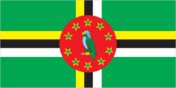
Description: green with a centered cross of three equal bands in yellow, black, and white; in the center of the cross is a red disk with a Sisserou parrot surrounded by 10 five-pointed green stars edged in yellow meaning: the stars represent the 10 administrative divisions (parishes); green symbolizes the island's lush vegetation; the tricolor cross represents the Christian Trinity; yellow stands for sunshine, the primary agricultural products (citrus and bananas), and the Carib people; black for the rich soil and the African heritage of most citizens; white for rivers, waterfalls, and the purity of aspirations; the red disc for social justice
Sisserou parrot, Carib wood flower
Green, yellow, black, white, red
The coat of arms was adopted on July 21, 1961, and features two sisserou parrots supporting a shield that is divided into four sections by a cross, a reference to the island’s discovery on a Sunday; the quadrants feature a palm tree, a banana tree, a frog that is native to the island, and a canoe on the Caribbean Sea; the golden lion symbolizes Dominica’s past colonial ties with the UK; below the shield is the national motto, which means "After God is the Earth"
"Isle of Beauty"
Wilfred Oscar Morgan POND/Lemuel McPherson CHRISTIAN
Adopted 1967
💹 Economy⬆️ Top
Highly agrarian OECS island economy; ECCU-member state; large banana exporter; improved oversight of its citizenship-by-investment program; emerging ecotourism, information and communications, and education industries
$1.241 billion (2024 est.)
$1.216 billion (2023 est.)
$1.173 billion (2022 est.)
2.1% (2024 est.)
3.7% (2023 est.)
10.4% (2022 est.)
$18,700 (2024 est.)
$18,300 (2023 est.)
$17,600 (2022 est.)
$688.881 million (2024 est.)
2.6% (2024 est.)
5.1% (2023 est.)
2.9% (2022 est.)
12.2% (2024 est.)
13.9% (2024 est.)
56.9% (2024 est.)
87.7% (2018 est.)
27.4% (2018 est.)
32.7% (2018 est.)
0% (2018 est.)
29.2% (2018 est.)
-77.8% (2018 est.)
Taro, grapefruits, yams, bananas, coconuts, plantains, milk, yautia, sugarcane, oranges (2023)
Soap, coconut oil, tourism, copra, furniture, cement blocks, shoes
8.8% (2024 est.)
5.6% of GDP (2024 est.)
5.2% of GDP (2023 est.)
6.1% of GDP (2022 est.)
$233.831 million (2017 est.)
$164.673 million (2017 est.)
71.7% of GDP (2016 est.)
-$160.12 million (2024 est.)
-$223.632 million (2023 est.)
-$163.746 million (2022 est.)
$212.753 million (2024 est.)
$188.818 million (2023 est.)
$173.93 million (2022 est.)
Bahamas, The 13%, Saudi Arabia 11%, Iceland 10%, Guyana 7%, Antigua & Barbuda 7% (2023)
Iron blocks, medical instruments, excavation machinery, power equipment, soap (2023)
$387.532 million (2024 est.)
$417.164 million (2023 est.)
$354.27 million (2022 est.)
USA 24%, China 11%, Indonesia 8%, Trinidad & Tobago 7%, Italy 7% (2023)
Refined petroleum, ships, plastic products, semi-finished iron, cars (2023)
$155.971 million (2024 est.)
$183.53 million (2023 est.)
$204.343 million (2022 est.)
$301.191 million (2023 est.)
East Caribbean dollars (XCD) per US dollar -
2.7 (2024 est.)
2.7 (2023 est.)
2.7 (2022 est.)
2.7 (2021 est.)
2.7 (2020 est.)
⚡ Energy⬆️ Top
100% (2022 est.)
41,000 kW (2023 est.)
145.827 million kWh (2023 est.)
8 million kWh (2023 est.)
84.3% of total installed capacity (2023 est.)
0.1% of total installed capacity (2023 est.)
0.7% of total installed capacity (2023 est.)
15% of total installed capacity (2023 est.)
1,000 bbl/day (2023 est.)
36.395 million Btu/person (2023 est.)
📡 Communications⬆️ Top
7,000 (2021 est.)
11 (2021 est.)
56,929 (2022 est.)
85 (2022 est.)
No terrestrial TV service; subscription cable TV provider offers some locally produced programming, plus channels from the US, Latin America, and the Caribbean; state-operated radio broadcasts on 6 stations; privately owned radio broadcasts on about 15 stations (2019)
.dm
84% (2023 est.)
14,000 (2022 est.)
21 (2022 est.)
🚚 Transportation⬆️ Top
J7
2 (2025)
77 (2023)
General cargo 26, oil tanker 10, other 41
2 (2024)
0
0
0
2
1
Portsmouth, Roseau
🛡️ Military and Security⬆️ Top
No regular military forces; Commonwealth of Dominica Police Force (CDPF) under the Ministry of National Security and Legal Affairs
Dominica has been a member of the Caribbean Regional Security System (RSS) since its creation in 1982; RSS signatories (Antigua and Barbuda, Barbados, Grenada, Guyana, St. Kitts and Nevis, St. Lucia, and St. Vincent and the Grenadines) agreed to prepare contingency plans and assist one another, on request, in national emergencies, prevention of smuggling, search and rescue, immigration control, fishery protection, customs and excise control, maritime policing duties, protection of off-shore installations, pollution control, national and other disasters, and threats to national security (2025)
🌐 Transnational Issues⬆️ Top
5 (2024 est.)
Source: Factbook JSON archive.