Yaounde
 Cameroon
Key facts and a structured country profile. 🧾 Change log 📐 True Size
Locator 🗺️ Map
31,518,954 (2025 est.)
475,440 sq km
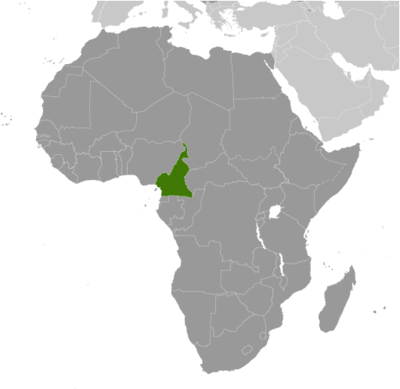
Central Africa, bordering the Bight of Biafra, between Equatorial Guinea and Nigeria
🧭 Background
Powerful chiefdoms ruled much of the area of present-day Cameroon before it became a German colony known as Kamerun in 1884. After World War I, the territory was divided between France and the UK as League of Nations mandates. French Cameroon became independent in 1960 as the Republic of Cameroon. The following year, the southern portion of neighboring British Cameroon voted to merge with the new country to form the Federal Republic of Cameroon. In 1972, a new constitution replaced the federation with a unitary state, the United Republic of Cameroon. The country has generally enjoyed stability, which has enabled the development of agriculture, roads, and railways, as well as a petroleum industry. Nonetheless, unrest and violence in the country's two western, English-speaking regions have persisted since 2016. Movement toward democratic reform is slow, and political power remains firmly in the hands of President Paul BIYA.
🗺️ Geography
Central Africa, bordering the Bight of Biafra, between Equatorial Guinea and Nigeria
6 00 N, 12 00 E
Africa
475,440 sq km
472,710 sq km
2,730 sq km
Slightly larger than California; about four times the size of Pennsylvania
5,018 km
Central African Republic 901 km; Chad 1,116 km; Republic of the Congo 494 km; Equatorial Guinea 183 km; Gabon 349 km; Nigeria 1975 km
402 km
12 nm
24 nm
Varies with terrain, from tropical along coast to semiarid and hot in north
Diverse, with coastal plain in southwest, dissected plateau in center, mountains in west, plains in north
Fako on Mont Cameroun 4,045 m
Atlantic Ocean 0 m
667 m
Petroleum, bauxite, iron ore, timber, hydropower
20.9% (2023 est.)
Arable land: 13.1% (2023 est.)
Permanent crops: 3.6% (2023 est.)
Permanent pasture: 4.2% (2023 est.)
41% (2023 est.)
38.1% (2023 est.)
290 sq km (2012)
Lake Chad (endorheic lake shared with Niger, Nigeria, and Chad) - 10,360-25,900 sq km note - area varies by season and year to year
Congo (3,730,881 sq km), Niger (2,261,741 sq km)
Lake Chad (2,497,738 sq km)
Lake Chad Basin
Population concentrated in the west and north, with the interior of the country sparsely populated, as shown in this population distribution map
Volcanic activity with periodic releases of poisonous gases from Lake Nyos and Lake Monoun volcanoes volcanism: Mt. Cameroon (4,095 m), which last erupted in 2000, is the most frequently active volcano in West Africa; lakes in the Oku volcanic field sometimes release fatal levels of gas, which killed about 1,700 people in 1986
Sometimes referred to as the hinge of Africa because of its central location on the continent and its position at the west-south juncture of the Gulf of Guinea; areas of thermal springs and indications of current or prior volcanic activity; Mount Cameroon, the highest mountain in Sub-Saharan west Africa, is an active volcano
👥 People and Society⬆️ Top
31,518,954 (2025 est.)
15,683,611
15,835,343
Cameroonian(s)
Cameroonian
Bamileke-Bamu 22.2%, Biu-Mandara 16.4%, Arab-Choa/Hausa/Kanuri 13.5%, Beti/Bassa, Mbam 13.1%, Grassfields 9.9%, Adamawa-Ubangi, 9.8%, Cotier/Ngoe/Oroko 4.6%, Southwestern Bantu 4.3%, Kako/Meka 2.3%, foreign/other ethnic group 3.8% (2022 est.)
24 major African language groups, English (official), French (official)
The World Factbook, the indispensable source for basic information. (English) The World Factbook, une source indispensable d'informations de base. (French)
Roman Catholic 33.1%, Muslim 30.6%, Protestant 27.1% other Christian 6.1%, animist 1.3%, other 0.7%, none 1.2% (2022 est.)
41.5% (male 6,477,438/female 6,364,987)
55.3% (male 8,488,522/female 8,638,519)
3.2% (2024 est.) (male 463,628/female 533,011)
77.6 (2025 est.)
71.8 (2025 est.)
5.8 (2025 est.)
17.3 (2025 est.)
19.4 years (2025 est.)
18.6 years
19.2 years
2.37% (2025 est.)
30.79 births/1,000 population (2025 est.)
6.73 deaths/1,000 population (2025 est.)
-0.32 migrant(s)/1,000 population (2025 est.)
Population concentrated in the west and north, with the interior of the country sparsely populated, as shown in this population distribution map
59.3% of total population (2023)
3.43% annual rate of change (2020-25 est.)
4.509 million YAOUNDE (capital), 4.063 million Douala (2023)
1.03 male(s)/female
1.02 male(s)/female
0.98 male(s)/female
0.87 male(s)/female
0.99 male(s)/female (2024 est.)
20.1 years (2018 est.)
258 deaths/100,000 live births (2023 est.)
44.6 deaths/1,000 live births (2025 est.)
50.8 deaths/1,000 live births
41.3 deaths/1,000 live births
64.2 years (2024 est.)
62.3 years
66.1 years
3.87 children born/woman (2025 est.)
1.91 (2025 est.)
Urban: 81.6% of population (2022 est.)
Rural: 52.5% of population (2022 est.)
Total: 69.6% of population (2022 est.)
Urban: 18.4% of population (2022 est.)
Rural: 47.5% of population (2022 est.)
Total: 30.4% of population (2022 est.)
3.8% of GDP (2021)
3.9% of national budget (2022 est.)
0.14 physicians/1,000 population (2022)
2.6 beds/1,000 population (2016 est.)
Urban: 83.2% of population (2022 est.)
Rural: 27.4% of population (2022 est.)
Total: 60.2% of population (2022 est.)
Urban: 16.8% of population (2022 est.)
Rural: 72.6% of population (2022 est.)
Total: 39.8% of population (2022 est.)
11.4% (2016)
4.09 liters of pure alcohol (2019 est.)
2.36 liters of pure alcohol (2019 est.)
0.16 liters of pure alcohol (2019 est.)
0.01 liters of pure alcohol (2019 est.)
1.56 liters of pure alcohol (2019 est.)
5% (2025 est.)
9.2% (2025 est.)
0.9% (2025 est.)
11% (2018 est.)
58.1% (2018 est.)
10.7% (2018)
29.8% (2018)
2.9% (2018)
2.8% of GDP (2023 est.)
13.8% national budget (2024 est.)
72.6% (2018 est.)
79.7% (2018 est.)
66.2% (2018 est.)
11 years (2023 est.)
12 years (2023 est.)
10 years (2023 est.)
🌿 Environment⬆️ Top
Deforestation; overgrazing; soil erosion; desertification; poaching; overfishing; overhunting
Biodiversity, Climate Change, Climate Change-Kyoto Protocol, Climate Change-Paris Agreement, Comprehensive Nuclear Test Ban, Desertification, Endangered Species, Environmental Modification, Hazardous Wastes, Law of the Sea, Ozone Layer Protection, Ship Pollution, Tropical Timber 2006, Wetlands, Whaling
Nuclear Test Ban
Varies with terrain, from tropical along coast to semiarid and hot in north
20.9% (2023 est.)
Arable land: 13.1% (2023 est.)
Permanent crops: 3.6% (2023 est.)
Permanent pasture: 4.2% (2023 est.)
41% (2023 est.)
38.1% (2023 est.)
59.3% of total population (2023)
3.43% annual rate of change (2020-25 est.)
6.707 million metric tonnes of CO2 (2023 est.)
200 metric tonnes of CO2 (2023 est.)
5.658 million metric tonnes of CO2 (2023 est.)
1.049 million metric tonnes of CO2 (2023 est.)
62 micrograms per cubic meter (2019 est.)
293.3 kt (2022-2024 est.)
278.2 kt (2019-2021 est.)
166.4 kt (2019-2021 est.)
24 kt (2019-2021 est.)
3.271 million tons (2024 est.)
4.6% (2022 est.)
246.8 million cubic meters (2022 est.)
104.6 million cubic meters (2022 est.)
737 million cubic meters (2022 est.)
283.15 billion cubic meters (2022 est.)
🏛️ Government⬆️ Top
Republic of Cameroon
Cameroon
République du Cameroun (French)/Republic of Cameroon (English)
Cameroun/Cameroon
Kamerun, French Cameroon, British Cameroon, Federal Republic of Cameroon, United Republic of Cameroon
In the 16th century, Portuguese explorers named an estuary near the mouth of the Wouri River the Rio dos Camaroes (River of Prawns) after the abundant shrimp in the water; the name Camaroes evolved into "Cameroon"
Presidential republic
Yaounde
3 52 N, 11 31 E
UTC+1 (6 hours ahead of Washington, DC, during Standard Time)
Germans founded the city in 1888, but the name comes from the native Ewondo people; the meaning of the name is unclear
10 regions (régions, singular - région); Adamaoua, Centre, East (Est), Far North (Extrême-Nord), Littoral, North (Nord), North-West (Nord-Ouest), West (Ouest), South (Sud), South-West (Sud-Ouest)
Mixed system of English common law, French civil law, and customary law
Several previous; latest effective 18 January 1996
Proposed by the president of the republic or by Parliament; amendment drafts require approval of at least one third of the membership in either house of Parliament; passage requires absolute majority vote of the Parliament membership; passage of drafts requested by the president for a second reading in Parliament requires two-thirds majority vote of its membership; the president can opt to submit drafts to a referendum, in which case passage requires a simple majority; constitutional articles on Cameroon’s unity and territorial integrity and its democratic principles cannot be amended
Accepts compulsory ICJ jurisdiction; non-party state to the ICCt
No
At least one parent must be a citizen of Cameroon
No
5 years
20 years of age; universal
President Paul BIYA (since 6 November 1982)
Prime Minister Joseph NGUTE (since 4 January 2019)
Cabinet proposed by the prime minister, appointed by the president
President directly elected by simple-majority popular vote for a 7-year term (no term limits); prime minister appointed by the president
12 October 2025
2025- Paul BIYA reelected president; percent of vote - Paul BIYA (CPDM) 53.7%, Issa Tchiroma BAKARY (CNSF) 35.2%, Cabral LIBII (PCRN) 3.4%, Bello Boubou MAIGARI (UNDP)2.4%, other 5.3% 2018: Paul BIYA reelected president; percent of vote - Paul BIYA (CPDM) 71.3%, Maurice KAMTO (MRC) 14.2%, Cabral LIBII (Univers) 6.3%, other 8.2% (2018)
October 2032
Parlement - Parliament
Bicameral
National Assembly (Assemblée nationale - National Assembly)
180 (all directly elected)
Proportional representation
Full renewal
5 years
3/12/2023
Cameroon People's Democratic Movement (RDPC/CPDM) (152); Other (28)
33.9%
February 2026
Senate (Sénat - Senate)
100 (70 indirectly elected; 30 appointed)
Full renewal
5 years
2/9/2020 to 3/22/2020
33%
March 2027
Supreme Court of Cameroon (consists of 9 titular and 6 surrogate judges and organized into judicial, administrative, and audit chambers); Constitutional Council (consists of 11 members)
Supreme Court judges appointed by the president with the advice of the Higher Judicial Council of Cameroon, a body chaired by the president and includes the minister of justice, selected magistrates, and representatives of the National Assembly; judge term NA; Constitutional Council members appointed by the president for renewable 6-year terms
Parliamentary Court of Justice (jurisdiction limited to cases involving the president and prime minister); appellate and first instance courts; circuit and magistrates' courts
Alliance for Democracy and Development Cameroon People's Democratic Movement or CPDM Cameroon People's Party or CPP Cameroon Renaissance Movement or MRC Cameroonian Democratic Union or UDC Cameroonian Party for National Reconciliation or PCRN Front for the National Salvation of Cameroon or FSNC Movement for the Defense of the Republic or MDR Movement for the Liberation and Development of Cameroon or MLDC National Union for Democracy and Progress or UNDP Progressive Movement or MP Social Democratic Front or SDF Union of Peoples of Cameroon or UPC Union of Socialist Movements
Ambassador Henri ETOUNDI ESSOMBA (since 27 June 2016)
2349 Massachusetts Avenue NW, Washington, DC 20008
[1] (202) 265-8790
[1] (202) 387-3826
Mail@cameroonembassyusa Cameroon Embassy in Washington DC, USA (cameroonembassyusa.org)
Ambassador Christopher J. LAMORA (since 21 March 2022)
Avenue Rosa Parks, Yaoundé
2520 Yaounde Place, Washington, DC 20521-2520
[237] 22251-4000
[237] 22251-4000, Ext. 4531
YaoundeACS@state.gov https://cm.usembassy.gov/
Douala
ACP, AfDB, AU, BDEAC, C, CEMAC, EITI (compliant country), FAO, FZ, G-77, IAEA, IBRD, ICAO, ICRM, IDA, IDB, IFAD, IFC, IFRCS, IHO, ILO, IMF, IMO, IMSO, Interpol, IOC, IOM, IPU, ISO, ITSO, ITU, ITUC (NGOs), LCBC, MIGA, MNJTF, MONUSCO, NAM, OIC, OIF, OPCW, PCA, UN, UNCTAD, UNESCO, UNHRC, UNIDO, UNMISS, UNOOSA, UNWTO, UPU, WCO, WFTU (NGOs), WHO, WIPO, WMO, WTO
1 January 1960 (from French-administered UN trusteeship)
State Unification Day (National Day), 20 May (1972)
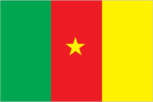
Description: three equal vertical bands of green (left side), red, and yellow, with a small five-pointed yellow star centered in the red band meaning: red stands for unity; yellow for the sun, happiness, and the northern savannahs; green for hope and the southern forests; the star is called the "star of unity;" the vertical tricolor design is similar to the French flag history: uses the colors of the Pan-African movement
Lion
Green, red, yellow
"O Cameroun, Berceau de Nos Ancêtres" (O Cameroon, Cradle of Our Forefathers)
Rene Djam AFAME, Samuel Minkio BAMBA, Moise Nyatte NKO'O [French], Benard Nsokika FONLON [English]/Rene Djam AFAME
Adopted 1957; lyrics were changed slightly to the current version in 1978
3 (two natural and one cultural)
Dja Faunal Reserve (n); Sangha Trinational Forest (n); Diy-Gid-Biy Cultural Landscape of the Mandara Mountains (c)
💹 Economy⬆️ Top
Largest CEMAC economy with many natural resources; recent political instability and terrorism reducing economic output; systemic corruption; poor property rights enforcement; increasing poverty in northern regions
$143.264 billion (2024 est.)
$138.191 billion (2023 est.)
$133.843 billion (2022 est.)
3.7% (2024 est.)
3.2% (2023 est.)
3.7% (2022 est.)
$4,900 (2024 est.)
$4,900 (2023 est.)
$4,800 (2022 est.)
$51.327 billion (2024 est.)
4.5% (2024 est.)
7.4% (2023 est.)
6.2% (2022 est.)
17.4% (2024 est.)
25.6% (2024 est.)
49.9% (2024 est.)
74.5% (2024 est.)
10.5% (2024 est.)
21.4% (2024 est.)
0% (2024 est.)
14.7% (2024 est.)
-21.1% (2024 est.)
Cassava, plantains, oil palm fruit, maize, taro, tomatoes, sorghum, sugarcane, bananas, vegetables (2023)
Petroleum production and refining, aluminum production, food processing, light consumer goods, textiles, lumber, ship repair
1.9% (2024 est.)
11.119 million (2024 est.)
3.6% (2024 est.)
3.7% (2023 est.)
3.7% (2022 est.)
6.2% (2024 est.)
5.9% (2024 est.)
6.7% (2024 est.)
42.2 (2021 est.)
45.8% of household expenditures (2023 est.)
2.9% of household expenditures (2023 est.)
2.1% (2021 est.)
31.1% (2021 est.)
1.6% of GDP (2023 est.)
1.3% of GDP (2022 est.)
1% of GDP (2021 est.)
$6.385 billion (2021 est.)
$7.624 billion (2021 est.)
32.5% of GDP (2016 est.)
11.3% (of GDP) (2021 est.)
-$2.019 billion (2023 est.)
-$1.505 billion (2022 est.)
-$1.794 billion (2021 est.)
$8.353 billion (2023 est.)
$8.641 billion (2022 est.)
$7.447 billion (2021 est.)
Netherlands 21%, France 14%, UAE 13%, India 9%, China 8% (2023)
Crude petroleum, natural gas, gold, cocoa beans, wood (2023)
$10.294 billion (2023 est.)
$9.759 billion (2022 est.)
$9.025 billion (2021 est.)
China 43%, France 6%, India 6%, Belgium 4%, UAE 4% (2023)
Garments, refined petroleum, plastic products, wheat, rice (2023)
$4.882 billion (2023 est.)
$5.133 billion (2022 est.)
$4.3 billion (2021 est.)
$11.112 billion (2023 est.)
Cooperation Financiere en Afrique Centrale francs (XAF) per US dollar -
606.345 (2024 est.)
606.57 (2023 est.)
623.76 (2022 est.)
554.531 (2021 est.)
575.586 (2020 est.)
⚡ Energy⬆️ Top
71% (2022 est.)
94%
25%
1.798 million kW (2023 est.)
6.161 billion kWh (2023 est.)
60 million kWh (2023 est.)
2.238 billion kWh (2023 est.)
36.1% of total installed capacity (2023 est.)
0.3% of total installed capacity (2023 est.)
63.1% of total installed capacity (2023 est.)
0.5% of total installed capacity (2023 est.)
300 metric tons (2023 est.)
64,000 bbl/day (2023 est.)
41,000 bbl/day (2023 est.)
200 million barrels (2021 est.)
2.356 billion cubic meters (2023 est.)
534.691 million cubic meters (2023 est.)
1.821 billion cubic meters (2023 est.)
135.071 billion cubic meters (2021 est.)
4.271 million Btu/person (2023 est.)
📡 Communications⬆️ Top
67,500 (2024 est.)
(2024 est.) less than 1
31.5 million (2024 est.)
108 (2024 est.)
Government maintains tight control over broadcast media; state-owned Cameroon Radio Television (CRTV), with both TV and radio broadcasts, was the only officially recognized and fully licensed broadcaster until 2007, when the government issued licenses to 2 private TV broadcasters and 1 private radio broadcaster; about 70 privately owned, unlicensed radio stations operate under “administrative tolerance,” meaning the stations could be subject to closure at any time (2023)
.cm
42% (2023 est.)
603,000 (2022 est.)
2 (2022 est.)
🚚 Transportation⬆️ Top
TJ
37 (2025)
1 (2025)
987 km (2014)
987 km (2014) 1.000-m gauge
198 (2023)
Bulk carrier 2, general cargo 91, oil tanker 42, other 63
7 (2024)
0
1
0
5
1
5
Douala, Ebome Marine Terminal, Kole Oil Terminal, Kome Kribi 1 Marine Terminal, Kribi Deep Sea Port, Limboh Terminal, Moudi Marine Terminal
🛡️ Military and Security⬆️ Top
Cameroon Armed Forces (Forces Armees Camerounaises, FAC): Army, Cameroon Navy (includes naval infantry or fusiliers marin), Air Force, National Gendarmerie, National Firefighting Corps General Delegation for National Security (Délégation Générale à la Sûreté Nationale or DGSN): Cameroon Police (2025)
1% of GDP (2024 est.)
1% of GDP (2023 est.)
1% of GDP (2022 est.)
1% of GDP (2021 est.)
1% of GDP (2020 est.)
Estimated 40-50,000 active FAC, including the Gendarmerie (2025)
The FAC inventory is comprised of armaments from a variety of countries, including China, Israel, Russia/former Soviet Union, South Africa, the US, and some Western European countries, particularly France (2025)
18-23 years of age for voluntary military service for men and women (18-28 for medical services); no conscription; service obligation 4 years (2025)
750 (plus about 400 police) Central African Republic (MINUSCA) (2025)
The Cameroon Armed Forces (FAC) are responsible for defending the country's territorial integrity, providing humanitarian assistance, supporting regional peacekeeping operations, and contributing to internal security; key areas of focus are the threat from the terrorist groups Boko Haram and ISIS-West Africa along its frontiers with Nigeria and Chad (Far North region) and, since 2016, an insurgency from armed Anglophone separatist groups in the North-West and South-West regions; in addition, the FAC often deploys ground units to the border region with the Central African Republic to counter intrusions from armed militias and bandits; the Navy’s missions include protecting Cameroon’s oil installations, combatting crime and piracy in the Gulf of Guinea, and patrolling the country’s lakes and rivers; the FAC's small Air Force supports both the ground and naval forces (2025)
🚨 Terrorism⬆️ Top
Boko Haram; Islamic State of Iraq and ash-Sham – West Africa
🌐 Transnational Issues⬆️ Top
443,740 (2024 est.)
1,058,405 (2024 est.)
Source: Factbook JSON archive.