Thimphu
 Bhutan
Key facts and a structured country profile. 🧾 Change log 📐 True Size
Locator 🗺️ Map
892,877 (2025 est.)
38,394 sq km
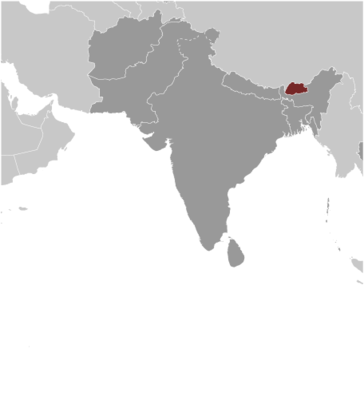
Southern Asia, between China and India
🧭 Background
After Britain’s victory in the 1865 Duar War, Britain and Bhutan signed the Treaty of Sinchulu, under which Bhutan would receive an annual subsidy in exchange for ceding land to British India. Ugyen WANGCHUCK -- who had served as the de facto ruler of an increasingly unified Bhutan and had improved relations with the British toward the end of the 19th century -- was named king in 1907. Three years later, a treaty was signed whereby the British agreed not to interfere in Bhutanese internal affairs, and Bhutan allowed Britain to direct its foreign affairs. Bhutan negotiated a similar arrangement with independent India in 1949. The Indo-Bhutanese Treaty of Friendship returned to Bhutan a small piece of the territory annexed by the British, formalized the annual subsidies the country received, and defined India's responsibilities in defense and foreign relations. Under a succession of modernizing monarchs beginning in the 1950s, Bhutan joined the UN in 1971 and slowly continued its engagement beyond its borders. In 2005, King Jigme Singye WANGCHUCK unveiled the draft of Bhutan's first constitution -- which introduced major democratic reforms -- and held a national referendum for its approval. The King abdicated the throne in 2006 in favor of his son, Jigme Khesar Namgyel WANGCHUCK. In 2007, India and Bhutan renegotiated their treaty, eliminating the clause that stated that Bhutan would be "guided by" India in conducting its foreign policy, although Thimphu continues to coordinate closely with New Delhi. In 2008, Bhutan held its first parliamentary election in accordance with the constitution. Bhutan experienced a peaceful turnover of power following a parliamentary election in 2013, which resulted in the defeat of the incumbent party. In 2018, the incumbent party again lost the parliamentary election. In 2024, of the more than 100,000 ethnic Nepali -- predominantly Lhotshampa -- refugees who fled or were forced out of Bhutan in the 1990s, about 6,500 remain displaced in Nepal.
🗺️ Geography
Southern Asia, between China and India
27 30 N, 90 30 E
Asia
38,394 sq km
38,394 sq km
0 sq km
Slightly larger than Maryland; about one-half the size of Indiana
1,136 km
China 477 km; India 659 km
0 km (landlocked)
None (landlocked)
Varies; tropical in southern plains; cool winters and hot summers in central valleys; severe winters and cool summers in Himalayas
Mostly mountainous with some fertile valleys and savanna
Gangkar Puensum 7,570 m
Drangeme Chhu 97 m
2,220 m
Timber, hydropower, gypsum, calcium carbonate
13.8% (2023 est.)
Arable land: 2.6% (2023 est.)
Permanent crops: 0.4% (2023 est.)
Permanent pasture: 10.8% (2023 est.)
70.6% (2023 est.)
15.6% (2023 est.)
320 sq km (2012)
Violent storms from the Himalayas are the source of the country's Bhutanese name, which translates as Land of the Thunder Dragon; frequent landslides during the rainy season
Landlocked; strategic location between China and India; controls several key Himalayan mountain passes
👥 People and Society⬆️ Top
892,877 (2025 est.)
461,679
431,198
Bhutanese (singular and plural)
Bhutanese
Ngalop (also known as Bhote) 50%, ethnic Nepali 35% (predominantly Lhotshampas), indigenous or migrant tribes 15%
Sharchopkha 28%, Dzongkha (official) 24%, Lhotshamkha 22%, other 26% (includes foreign languages) (2005 est.)
Lamaistic Buddhist 75.3%, Indian- and Nepali-influenced Hinduism 22.1%, other 2.6% (2005 est.)
23.1% (male 104,771/female 99,981)
70.2% (male 322,497/female 298,324)
6.7% (2024 est.) (male 30,397/female 28,576)
42.1 (2025 est.)
32.4 (2025 est.)
9.7 (2025 est.)
10.3 (2025 est.)
31.2 years (2025 est.)
31.1 years
30.3 years
0.93% (2025 est.)
15.05 births/1,000 population (2025 est.)
5.75 deaths/1,000 population (2025 est.)
0 migrant(s)/1,000 population (2025 est.)
44.4% of total population (2023)
2.52% annual rate of change (2020-25 est.)
203,000 THIMPHU (capital) (2018)
1.05 male(s)/female
1.05 male(s)/female
1.08 male(s)/female
1.06 male(s)/female
1.07 male(s)/female (2024 est.)
47 deaths/100,000 live births (2023 est.)
23 deaths/1,000 live births (2025 est.)
24.6 deaths/1,000 live births
23.9 deaths/1,000 live births
73.7 years (2024 est.)
72.5 years
75 years
1.75 children born/woman (2025 est.)
0.85 (2025 est.)
Urban: 99.5% of population (2022 est.)
Rural: 98.8% of population (2022 est.)
Total: 99.1% of population (2022 est.)
Urban: 0.5% of population (2022 est.)
Rural: 1.2% of population (2022 est.)
Total: 0.9% of population (2022 est.)
3.8% of GDP (2021)
6.7% of national budget (2022 est.)
0.55 physicians/1,000 population (2022)
2.2 beds/1,000 population (2021 est.)
Urban: 91.1% of population (2022 est.)
Rural: 85.5% of population (2022 est.)
Total: 87.9% of population (2022 est.)
Urban: 8.9% of population (2022 est.)
Rural: 14.5% of population (2022 est.)
Total: 12.1% of population (2022 est.)
6.4% (2016)
0.07 liters of pure alcohol (2019 est.)
0.01 liters of pure alcohol (2019 est.)
0.05 liters of pure alcohol (2019 est.)
0 liters of pure alcohol (2019 est.)
0 liters of pure alcohol (2019 est.)
18.5% (2025 est.)
26.1% (2025 est.)
9.8% (2025 est.)
8.7% (2023 est.)
62% (2022 est.)
5.8% of GDP (2023 est.)
22.2% national budget (2025 est.)
64.9% (2022 est.)
73.4% (2022 est.)
57% (2022 est.)
13 years (2022 est.)
12 years (2022 est.)
14 years (2022 est.)
🌿 Environment⬆️ Top
Soil erosion; limited access to potable water; wildlife conservation; industrial pollution; waste disposal
Biodiversity, Climate Change, Climate Change-Kyoto Protocol, Climate Change-Paris Agreement, Desertification, Endangered Species, Hazardous Wastes, Nuclear Test Ban, Ozone Layer Protection, Wetlands
Law of the Sea
Varies; tropical in southern plains; cool winters and hot summers in central valleys; severe winters and cool summers in Himalayas
13.8% (2023 est.)
Arable land: 2.6% (2023 est.)
Permanent crops: 0.4% (2023 est.)
Permanent pasture: 10.8% (2023 est.)
70.6% (2023 est.)
15.6% (2023 est.)
44.4% of total population (2023)
2.52% annual rate of change (2020-25 est.)
733,000 metric tonnes of CO2 (2023 est.)
241,000 metric tonnes of CO2 (2023 est.)
492,000 metric tonnes of CO2 (2023 est.)
26.4 micrograms per cubic meter (2019 est.)
111,300 tons (2024 est.)
1.7% (2022 est.)
17 million cubic meters (2022 est.)
3 million cubic meters (2022 est.)
318 million cubic meters (2022 est.)
78 billion cubic meters (2022 est.)
🏛️ Government⬆️ Top
Kingdom of Bhutan
Bhutan
Druk Gyalkhap
Druk Yul
Name may derive from the Sanskrit words bhoṭa, the name for Tibet, and anta, meaning "end" -- a reference to Bhutan's location at the southernmost end of Tibet; the local Dzongkha name Druk Yul means "Land of the Dragon"
Constitutional monarchy
Thimphu
27 28 N, 89 38 E
UTC+6 (11 hours ahead of Washington, DC, during Standard Time)
The origins of the name are unclear; the traditional explanation, dating to the 14th century, is that thim means "dissolve" and phu means "rock," in reference to a local deity who dissolved before a traveler's eyes, becoming a part of the rock on which the present city stands
20 districts (dzongkhag, singular and plural); Bumthang, Chhukha, Dagana, Gasa, Haa, Lhuentse, Mongar, Paro, Pemagatshel, Punakha, Samdrup Jongkhar, Samtse, Sarpang, Thimphu, Trashigang, Trashi Yangtse, Trongsa, Tsirang, Wangdue Phodrang, Zhemgang
Civil law based on Buddhist religious law
Previous governing documents were various royal decrees; first constitution drafted November 2001 to March 2005, ratified 18 July 2008
Proposed as a motion by simple majority vote in a joint session of Parliament; passage requires at least a three-fourths majority vote in a joint session of the next Parliament and assent by the king
Has not submitted an ICJ jurisdiction declaration; non-party state to the ICCt
No
The father must be a citizen of Bhutan
No
10 years
18 years of age; universal
King Jigme Khesar Namgyel WANGCHUCK (since 14 December 2006)
Prime Minister Tshering TOBGAY (since 28 January 2024)
Council of Ministers or Lhengye Zhungtshog members nominated by the monarch in consultation with the prime minister and approved by the National Assembly; members serve 5-year terms
The monarchy is hereditary but can be removed by a two-thirds vote of Parliament; leader of the majority party in Parliament is nominated as the prime minister, appointed by the monarch
Parliament (Chi Tshog)
Bicameral
National Assembly (Tshogdu)
47 (all directly elected)
Plurality/majority
Full renewal
5 years
1/9/2024
People's Democratic Party (PDP) (30); Bhutan Tendrel Party (BTP) (17)
4.3%
January 2029
National Council (Gyelyong Tshogde)
25 (20 directly elected; 5 appointed)
Plurality/majority
Full renewal
0 years
4/20/2023
N/A; note - the National Council is not party-based
12%
April 2028
Supreme Court (consists of the chief justice and 4 associate justices)
Supreme Court chief justice appointed by the monarch on the advice of the National Judicial Commission, a 4-member body to include the Legislative Committee of the National Assembly, the attorney general, the Chief Justice of Bhutan and the senior Associate Justice of the Supreme Court; other judges (drangpons) appointed by the monarch from among the High Court judges selected by the National Judicial Commission; chief justice serves a 5-year term or until reaching age 65 years, whichever is earlier; the 4 other judges serve 10-year terms or until age 65, whichever is earlier
High Court (first appellate court); District or Dzongkhag Courts; sub-district or Dungkhag Courts
Bhutan Peace and Prosperity Party (Druk Phuensum Tshogpa) or DPT Bhutan Tendrel Party or BTP Druk Thuendrel Tshogpa or DTT People's Democratic Party or PDP United Party of Bhutan (Druk Nyamrup Tshogpa) or DNT
343 East, 43rd Street, New York, NY 10017 telephone: [1] (212) 682-2371 FAX: [1] (212) 661-0551 email address and website: consulate.pmbny@mfa.gov.bt https://www.mfa.gov.bt/pmbny/
Note: Although Bhutan and the United States have never established formal diplomatic relations, the two countries maintain informal relations via the U.S. Embassy in New Delhi, India, and Bhutan’s Mission to the United Nations in New York
ADB, BIMSTEC, CP, FAO, G-77, IBRD, ICAO, IDA, IFAD, IFC, IMF, Interpol, IOC, IOM (observer), IPU, ISO (correspondent), ITSO, ITU, MIGA, NAM, OPCW, SAARC, SACEP, UN, UNCTAD, UNESCO, UNIDO, UNISFA, UNTSO, UNWTO, UPU, WCO, WHO, WIPO, WMO, WTO (observer)
17 December 1907 (became a unified kingdom under its first hereditary king); 8 August 1949 (Treaty of Friendship with India maintains Bhutanese independence)
National Day (Ugyen WANGCHUCK became first hereditary king), 17 December (1907)
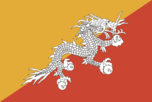
Description: divided diagonally from the lower-left corner to the upper-right corner; the upper triangle is yellow, and the lower triangle is dark orange; centered along the dividing line is a large, stylized black-and-white dragon facing to the right; the dragon is called the Druk (Thunder Dragon) and is the national emblem meaning: white stands for purity, and the jewels in the dragon's claws symbolize wealth; the background colors represent the spiritual and secular powers in Bhutan, with orange standing for Buddhism and yellow for the ruling dynasty
Mythical thunder dragon (druk)
Orange, yellow
"Druk tsendhen" (The Thunder Dragon Kingdom)
Gyaldun Dasho Thinley DORJI/Aku TONGMI
Adopted 1953
💹 Economy⬆️ Top
Hydropower investments spurring economic development; Gross National Happiness economy; sharp poverty declines; low inflation; strong monetary and fiscal policies; stable currency; fairly resilient response to COVID-19; key economic and strategic relations with India; climate vulnerabilities
$11.517 billion (2023 est.)
$10.981 billion (2022 est.)
$10.437 billion (2021 est.)
4.9% (2023 est.)
5.2% (2022 est.)
4.4% (2021 est.)
$14,600 (2023 est.)
$14,100 (2022 est.)
$13,500 (2021 est.)
$3.019 billion (2023 est.)
2.8% (2024 est.)
4.2% (2023 est.)
5.6% (2022 est.)
15% (2023 est.)
29.6% (2023 est.)
52.7% (2023 est.)
59.4% (2023 est.)
20.3% (2023 est.)
44.5% (2023 est.)
0.7% (2023 est.)
28.3% (2023 est.)
-53.2% (2023 est.)
Rice, milk, potatoes, root vegetables, maize, oranges, areca nuts, chillies/peppers, pumpkins/squash, carrots/turnips (2023)
Cement, wood products, processed fruits, alcoholic beverages, calcium carbide, tourism
0% (2023 est.)
406,500 (2024 est.)
2.9% (2024 est.)
3.2% (2023 est.)
6% (2022 est.)
13.8% (2024 est.)
11.2% (2024 est.)
16.5% (2024 est.)
12.4% (2022 est.)
28.5 (2022 est.)
3.6% (2022 est.)
22.7% (2022 est.)
3.6% of GDP (2023 est.)
3.3% of GDP (2022 est.)
2.6% of GDP (2021 est.)
$740.328 million (2020 est.)
$802.177 million (2020 est.)
111% of GDP (2020 est.)
12.3% (of GDP) (2020 est.)
-$669.766 million (2024 est.)
-$963.122 million (2023 est.)
-$805.723 million (2022 est.)
$944.391 million (2024 est.)
$867.871 million (2023 est.)
$791.342 million (2022 est.)
India 92%, Italy 4%, Indonesia 1%, China 1%, Singapore 0% (2023)
Iron alloys, aircraft, dolomite, semi-finished iron, cement (2023)
$1.513 billion (2024 est.)
$1.77 billion (2023 est.)
$1.581 billion (2022 est.)
India 82%, Singapore 8%, China 5%, Thailand 2%, Indonesia 1% (2023)
Refined petroleum, gold, plastics, broadcasting equipment, iron reductions (2023)
$941.018 million (2024 est.)
$654.481 million (2023 est.)
$825.755 million (2022 est.)
$2.827 billion (2023 est.)
Ngultrum (BTN) per US dollar -
83.669 (2024 est.)
82.599 (2023 est.)
78.604 (2022 est.)
73.918 (2021 est.)
74.1 (2020 est.)
⚡ Energy⬆️ Top
100% (2022 est.)
2.344 million kW (2023 est.)
11.914 billion kWh (2023 est.)
6 billion kWh (2020 est.)
834.7 million kWh (2023 est.)
86.681 million kWh (2023 est.)
100% of total installed capacity (2023 est.)
4,000 metric tons (2023 est.)
105,000 metric tons (2023 est.)
54 metric tons (2023 est.)
122,000 metric tons (2023 est.)
4,000 bbl/day (2023 est.)
64.082 million Btu/person (2023 est.)
📡 Communications⬆️ Top
0 (2024 est.) no service
0 (2024 est.) no service
790,000 (2024 est.)
100 (2024 est.)
State-owned TV station established in 1999; cable TV service offers dozens of Indian and other international channels; first radio station, privately launched in 1973, is now state-owned; 5 private radio stations are currently broadcasting (2012)
.bt
88% (2023 est.)
10,000 (2023 est.)
1 (2023 est.)
🚚 Transportation⬆️ Top
A5
4 (2025)
8 (2025)
🛡️ Military and Security⬆️ Top
Royal Bhutan Army (RBA; includes Royal Bodyguard of Bhutan, or RBG, and an air wing); National Militia Ministry of Home and Cultural Affairs: Royal Bhutan Police (2025)
Estimated 7-8,000 active Royal Bhutan Army (2025)
The Royal Bhutan Army is lightly armed; it has a small amount of heavy equipment, such as armored cars and helicopters, originating from the former Soviet Union, India, and Thailand (2025)
18 years of age for voluntary military service for men and women; militia training is compulsory for men aged 20-25 over a 3-year period (2025)
180 Central African Republic (MINUSCA) (2025)
The Army is responsible for external threats but also has some internal security functions such as conducting counterinsurgency operations, guarding forests, and providing security for prominent persons; Bhutan's closest security partner is India; under the 2007 India-Bhutan Friendship Treaty, both countries agreed to cooperate closely on issues relating to their national interests (2025)
🌐 Transnational Issues⬆️ Top
138 (2024 est.)
Source: Factbook JSON archive.